Return to entryChecking Siberian Ginseng printable layout…
Herbs & Salts Grimoire

Siberian Ginseng

Eleutherococcus senticosus

Traditional Uses

Eleuthero root has histories in Russian and East Asian practice for weakness and fatigue. It is not true Panax ginseng, and modern evidence is not robust enough to establish effectiveness.

Folklore

Known as eleuthero or taiga root, the plant developed a reputation in Russian and East Asian herbal traditions for stamina and resilience. Its Siberian ginseng name reflects comparison, not botanical identity.

Magical Associations

  • Stamina
  • Endurance
  • Adaptation
  • Resilience

Core Correspondences

Element:
Earth
Planet:
Saturn
Energy:
Grounding · Steady

Witchcraft Uses

  • Strength and endurance charm bags
  • Protection sachets
  • Perseverance rituals
  • Steady-progress altar work
  • Grounding symbolism

Caution

Eleuthero may interact with medicines and may be unsuitable with high blood pressure, heart rhythm concerns, or some other conditions.

Educational purposes only. Not medical advice.

How to Work With

Keep a small correctly identified root piece sealed in a strength or protection charm, or use its botanical image in grounding and perseverance rituals.

Best Time to Harvest

Root harvest can kill or seriously damage a slow-growing shrub.

Correspondences

Color: Green · Black • Season: Autumn · Winter

Herbs & Salts Grimoire

Siberian Ginseng

Eleutherococcus senticosus

Botanical Profile

Plant FamilyAraliaceae
Common NamesSiberian ginseng · Eleuthero
Alternate NamesTaiga root · Devil's shrub
Growth HabitThorny deciduous shrub
Native RangeNortheastern Asia, including parts of Russia, China, Korea, and Japan
HabitatMixed and coniferous forests, thickets, forest margins, and rocky slopes
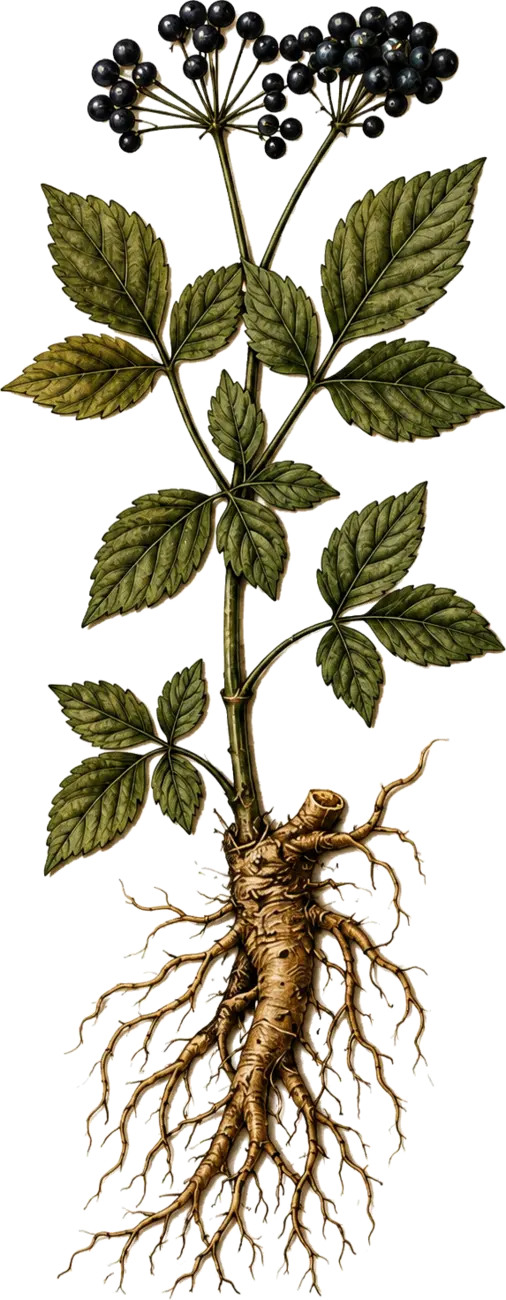
Identifying CharacteristicsA thorny shrub with palmately compound leaves, small flowers in rounded umbels, clusters of dark blue-black berries
Parts Traditionally UsedRoots · Rhizomes

Traditional Uses & Modern Evidence

Eleutherococcus senticosus has been used in Russian and East Asian traditions, particularly as a root preparation associated with stamina, convalescence, and resistance to stress. It later became widely marketed as an adaptogen. The common name Siberian ginseng is potentially confusing: this species belongs to the same family but is not Panax ginseng.

Magical & Spiritual Practice

Eleuthero's woody root, thorny stems, and ability to persist in cold forest regions offer a strong symbolic language of endurance, boundaries, resilience, and slow-earned strength. The approved source emphasizes adaptation and perseverance through challenging times. A small correctly identified root piece may be kept sealed in a protection or endurance charm, or the botanical image used in grounding work. These are symbolic spiritual practices, not evidence of improved physical performance or medical benefit.

Notes & Personal Connection

Add your own experiences, observations, and notes about working with this plant. How does it speak to you? What is your personal connection?

Safety & Caution

Eleuthero may interact with medicines and may be unsuitable with high blood pressure, heart rhythm concerns, or some.

Sources & Research Notes

Approved Black Cat Curiosity Co • Kew Science • PubMed