The Complete Guide to Samhain
Folklore & Traditional Customs
Page 3 of 10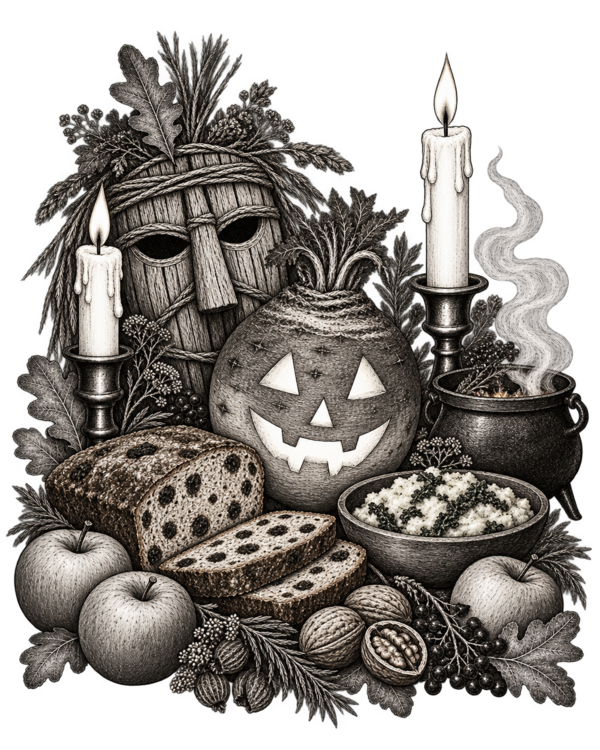
INTRO:
The richest surviving picture of Samhain-season custom comes not from a single ancient ritual manual, but from folklore, museum collections, literature, local tradition, and remembered household practice.
DOCUMENTED / WELL-ATTESTED CUSTOMS:
1. FEASTING
Fruit, nuts, potatoes, breads, and seasonal foods played an important role in Irish Halloween gatherings.
2. APPLES & NUTS
Apples and nuts were both food and game materials. Apple-bobbing and suspended-apple games are documented, while nuts could also appear in fortune-telling customs.
3. BÁIRÍN BREAC / BARMBRACK
Barmbrack is strongly associated with Irish Halloween. Objects baked or placed within it could be interpreted as signs about a person’s future. The familiar ring foretold marriage; other objects varied and could carry less cheerful meanings.
Modern safety note:
Do not hide hard objects in food without clearly warning everyone who may eat it. A symbolic charm can instead be placed beside a serving or represented with paper tokens.
4. COLCANNON & POTATO FOODS
Colcannon and other potato dishes are documented as traditional Halloween fare in Ireland.
5. DIVINATION & FORTUNE-TELLING
Marriage and future-spouse divination was especially common in recorded folk custom. Games using food, household items, bowls, dreams, or blind selection were used to “tell” future marriage, prosperity, death, travel, or other outcomes.
Use modern framing:
These practices are folklore and divination traditions, not reliable prediction methods.
6. THE DEAD RETURNING HOME
Irish folk belief recorded the expectation that souls of the dead might return to the family home on Halloween. This helps explain why remembrance and the dead remain central to modern Samhain observance.
7. SPIRITS, FAIRIES & DANGEROUS NIGHT TRAVEL
Halloween was also associated with active spirits and supernatural danger. People could avoid travelling alone and might avoid places connected with fairies or supernatural beings.
Terminology note:
Do not flatten Irish supernatural traditions into the generic modern word “fairy” without context when more specific traditional terms are available.
8. PROTECTING THE HOME
Protective customs included holy water in Christian folk practice and, in some areas, special Halloween crosses hung to protect the household and encourage good fortune for the coming year.
9. GUISES, MASKS & VISITING
People in disguise visited homes, entertained neighbors, played pranks, and received food or treats. Scottish and Irish traditions both preserve forms of seasonal disguise.
10. TURNIP LANTERNS
Carved turnip lanterns are documented in Ireland and Scotland. Candles were placed inside carved roots to create frightening faces. Pumpkins became the easier and now-famous North American version.
11. BONFIRES
Bonfires are associated with Halloween in parts of Ireland and have served as communal markers of the move into the darker season, identity, celebration, and protection.
Fire safety:
Never recommend uncontrolled bonfires, open flame indoors, unsafe accelerants, or unattended candles.
12. THE PÚCA
Irish Halloween folklore includes the púca, a shape-changing supernatural being with many local forms and stories. One recorded custom warned that the púca spoiled or spat on wild fruit after Halloween, discouraging people from eating late-season berries.
Do not define the púca simply as “a Celtic ghost.” It is a more complex being in Irish folklore.