Crystal & Gemstone Grimoire
Snowflake Obsidian
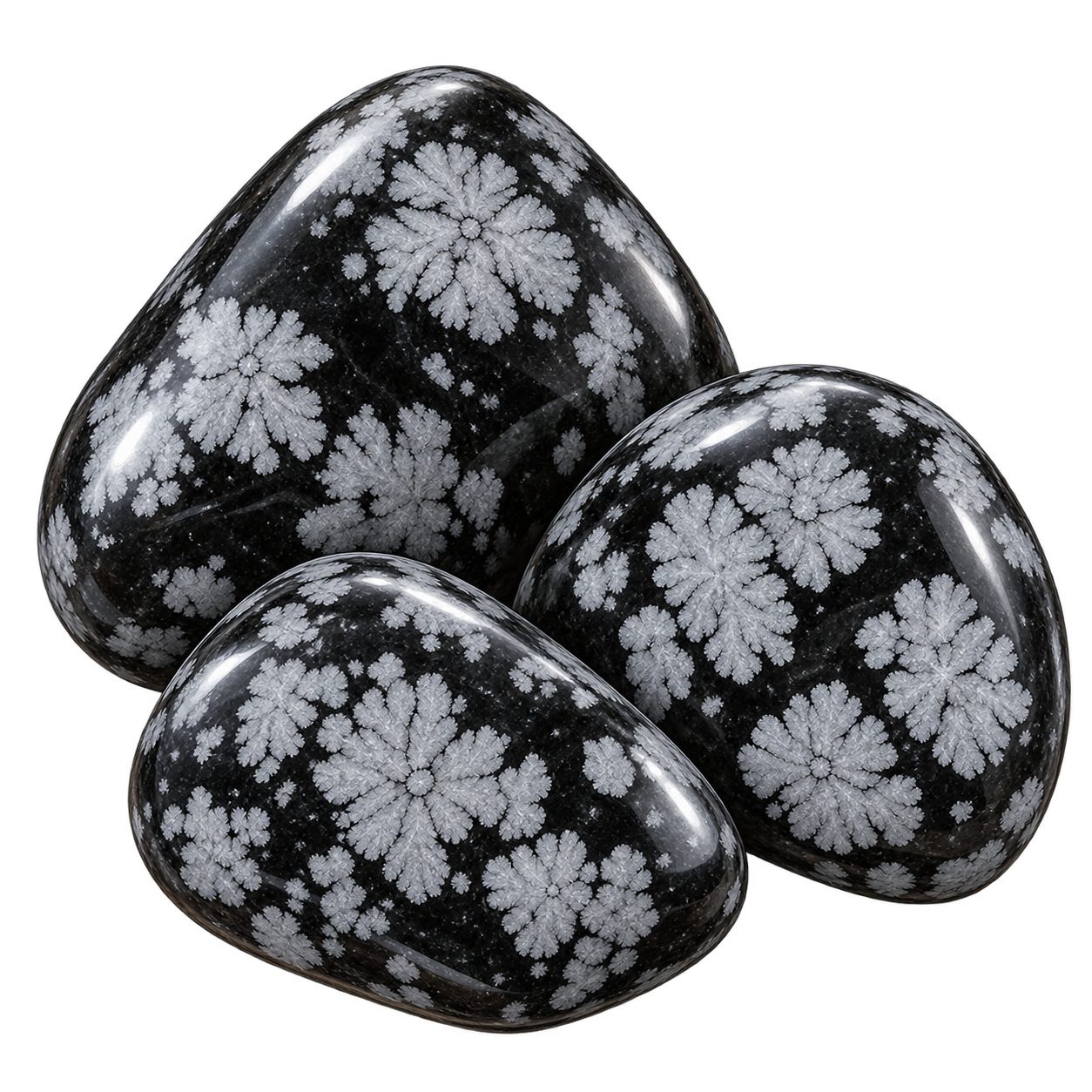
Snowflake Obsidian (patterned natural volcanic glass)Historical & Cultural Uses
Obsidian broadly has a long archaeological history as a material for sharp tools, projectile points, ornaments, mirrors, and ritual objects. Specific ancient traditions for the modern variety name “Snowflake Obsidian” are not assumed.
Magical Associations
- Grounding
- Balance
- Pattern recognition
- Protection
- Boundaries
- Integration
- Calm strength
Folklore & Legends
Within modern crystal practice, Snowflake Obsidian is associated with grounding, balance, pattern recognition, steadiness, and shadow work. These are contemporary symbolic associations.
Core Correspondences
- Mohs
- Approximately 5–5.5
Spiritual & Magical Uses
- Grounding
- Protection bowls
- Boundary work
- Shadow-work symbolism
- Balance
- Home protection
- Meditation
- Pattern-recognition journaling
⚠ Care & Safety
Clean with water and a soft cloth. Protect from hard impacts, and handle chipped or broken material carefully because conchoidal fracture can create razor-sharp edges.
Educational purposes only. Not medical advice.How to Work With This Crystal
The stone's modern grounding and balance symbolism complements the Peaceful Home bowl by giving the arrangement a boundary/anchoring component beside Rose Quartz and Amethyst.
Cleansing & Care
Obsidian can chip and fracture into extremely sharp edges. Avoid impacts and handle damaged pieces cautiously.
Additional Correspondences
Page 2 of 2
Deeper Reading
Mineral Profile
- Mineral Class
- Natural volcanic glass; not a mineral species
- Chemical Composition
- Silica-rich volcanic glass containing pale spherulitic devitrification structures
- Crystal System
- Not applicable — amorphous glass host
- Hardness (Mohs)
- Approximately 5–5.5
- Luster
- Vitreous
- Color(s)
- Black to dark brown ground · Gray-white to pale snowflake patterns
- Transparency
- Usually opaque
- Streak
- White
- Common Formations
- Massive volcanic glass · Flow-banded masses · Rounded rough and nodules · Pale spherulites created by localized devitrification · Tumbles, cabochons, beads, and carvings
- Cleavage
- None
- Fracture
- Conchoidal; broken edges can be razor-sharp
- Geological Origin
- Snowflake Obsidian is silica-rich volcanic glass formed by rapid cooling. Its pale snowflake patterns are spherulitic areas where the glass has begun to devitrify into microscopic crystalline aggregates.
- Common Locations
- United States · Mexico · Iceland · Italy · Armenia
- Notable Varieties
- Black snowflake obsidian · Brown snowflake obsidian · Spherulitic obsidian
- Rarity
- Generally available; unusually balanced, high-contrast patterns are more selective.
Historical & Cultural Uses
The parent material, obsidian, was widely worked and traded because conchoidal fracture produces extremely sharp edges. Snowflake Obsidian's modern variety name describes its pale spherulitic pattern; unsupported claims of a distinct ancient tradition under that name are avoided.
Magical & Spiritual Uses
Snowflake Obsidian is patterned volcanic glass. In modern crystal practice, its black-and-white pattern is often interpreted symbolically as balance, integration, grounding, and the ability to recognize repeating patterns. - Grounding - Protection bowls - Boundary work - Shadow-work symbolism - Balance - Home protection - Meditation - Pattern-recognition journaling The stone's modern grounding and balance symbolism complements the Peaceful Home bowl by giving the arrangement a boundary/anchoring component beside Rose Quartz and Amethyst.
Notes & Personal Connection
Add your own experiences, observations, dreams, and notes about working with this crystal. How does this crystal speak to you? What is your personal connection?
Keep This Grimoire Entry
Print Page 1 and Page 2 together, single-sided or front and back.
Download to Print