Deity Grimoire
Bastet
Ancient Egyptian feline goddess of protection, prosperity, music, and joy
Domains
- Protection
- Lower Egypt
- Household well-being
- Fertility and motherhood
- Music and festivity
Symbols
- Cat
- Lioness
- Kittens
- Sistrum
- Aegis
- Bubastis
Offerings
- Historically contextual food, drink, music, and
- Modern: music or dance
- Modern: clean water or food
- Modern: responsible care for cats
Aspects
- Earlier lioness form
- Later domestic-cat form
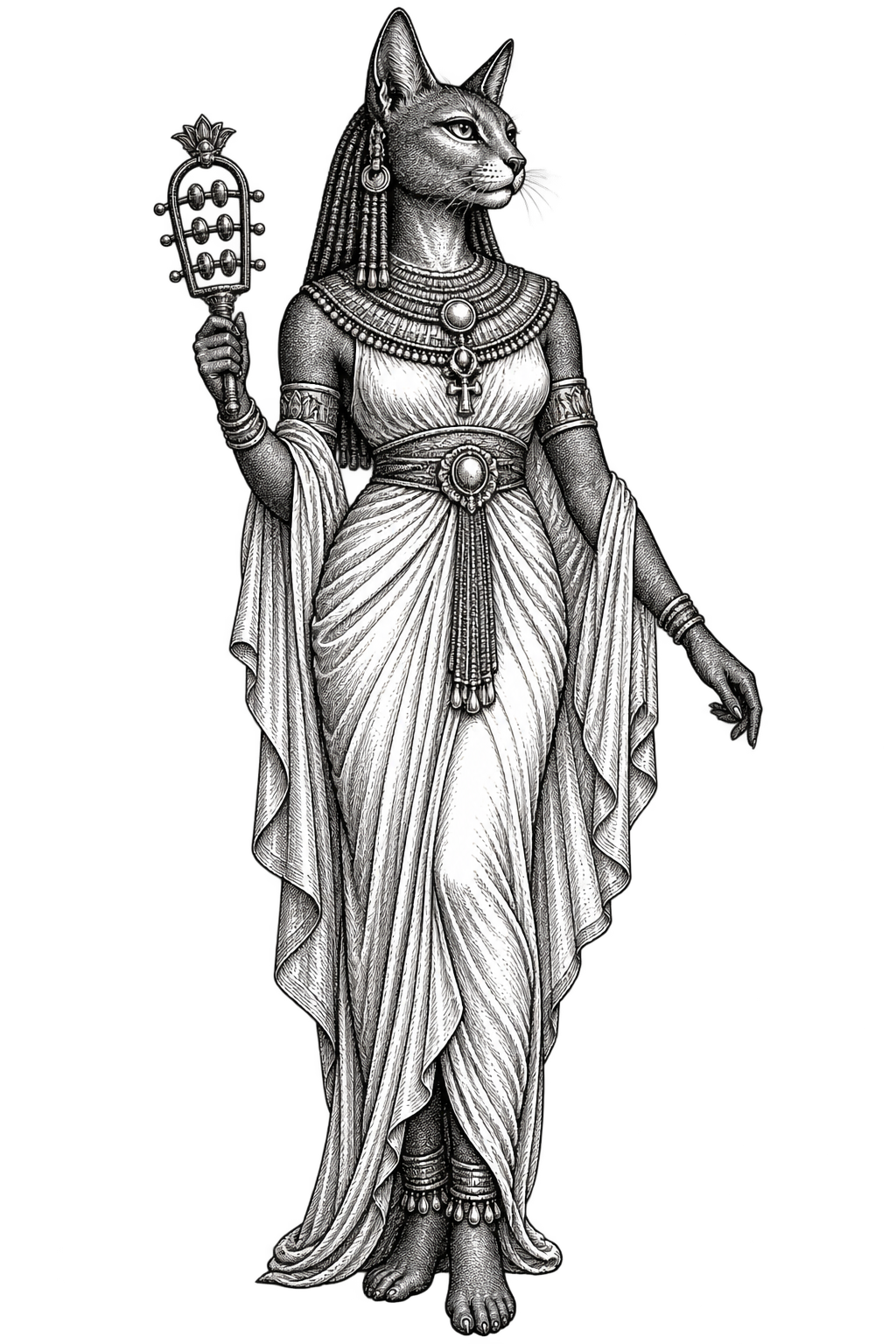
- Cat-headed woman
- Guardian and maternal protector
- Lady of Bubastis
Magical / Spiritual Work
- Home protection
- Protective boundaries
- Joy and celebration
- Maternal care
- Prosperity
Important Context
Bastet was not only a domestic-cat goddess.
Sacred Days / Festivals / Times
Festival of Bastet at Bubastis — historically reported with source caution · No historically required Moon phase
Devotional Approach
Core Correspondences
Deity Grimoire
Bastet
Ancient Egyptian feline goddess of protection, prosperity, music, and joy
Mythology, History & Important Context
Historical & Cultural Context
Bastet belongs to the ancient Egyptian family of powerful feline goddesses. Her earliest character should not be understood through the later domestic-cat image alone. In older Egyptian religion, Bastet could appear as a lioness or lioness-headed woman and carried the dangerous protective force associated with leonine deities. As Egyptian religious imagery developed, her representation increasingly shifted toward the domestic cat, particularly from the first millennium BCE onward. That change did not erase her older protective force. Instead, later Bastet imagery often emphasizes a more peaceful feline form while retaining her role as a guardian. Museums describe her as a powerful protector of Lower Egypt who could also bring prosperity, and later statuettes frequently emphasize fertility, motherhood, music, festivity, and abundance.
Major Myths & Stories
Earlier imagery Bastet could be represented as a lioness or lioness-headed woman. This connects her with the fierce, protective solar and royal power seen among Egyptian leonine goddesses. Later imagery In later Egyptian art, Bastet is very commonly represented: • as a domestic cat; • as a woman with a cat’s head; • with kittens at her feet; • holding a sistrum; • carrying a protective aegis; • wearing elaborate jewelry and patterned clothing. The domestic-cat form emphasizes alertness, protection, fertility, and maternal care rather than weakness or passivity. Cat imagery Cats were sacred to Bastet, especially in later periods.
Bastet and Sekhmet
Bastet and Sekhmet are both feline goddesses, and ancient Egyptian theology could connect or contrast them. Modern summaries sometimes call Bastet the “gentle form” of Sekhmet. That shorthand is useful only if handled carefully. Sekhmet is strongly associated with leonine ferocity, destructive heat, royal power, plague, warfare, and healing. Bastet also had an older lioness character, but later imagery increasingly emphasized the domestic cat, maternal protection, prosperity, music, festivity, and joy. They should not be treated as merely two names for one goddess. A better reader-facing explanation is: Egyptian religion often grouped, contrasted, merged, or related deities through shared attributes.
Bubastis — Bastet’s Cult Center
Bastet’s principal cult center was the city known in Egyptian as Per-Bastet and in Greek as Bubastis, located in the Nile Delta. Bubastis became one of the places most strongly associated with sacred cats, votive feline images, and Bastet’s temple cult. Archaeological evidence from Bastet-related sacred sites includes large numbers of cat statuettes and mummified cats deposited as offerings. This later votive practice is important because it shows that the cat was not simply decorative symbolism. The animal itself became deeply bound to Bastet’s sacred identity.
Deity Grimoire
Bastet
Ancient Egyptian feline goddess of protection, prosperity, music, and joy
Mythology, History & Important Context
Later Interpretation / Important Context
A famous description of Bastet’s festival at Bubastis survives in the writings of the Greek historian Herodotus. He describes crowds traveling by boat, making music, clapping, singing, celebrating, and drinking during the journey to Bubastis. His account has strongly shaped modern impressions of Bastet as a goddess of celebration, music, pleasure, and festivity. Evidence caution Herodotus was a Greek visitor writing about Egypt from an outsider’s perspective. His account is valuable but should not be treated as a transparent transcript of all Egyptian practice.
Personal Notes
Worship & Historical Practice
Historically grounded offering context Egyptian temples and household or funerary practice could.
Working With Bastet Today
Simple devotional practice 1. Clean and settle the space. 2.