Deity Grimoire
Bastet
Ancient Egyptian feline goddess · Protector of Lower Egypt · Goddess of household protection, music, festivity, and prosperityDomains
- Protection
- Lower Egypt
- Household well-being
- Fertility and motherhood
- Music and festivity
- Joy and prosperity
Symbols
- Cat
- Lioness
- Kittens
- Sistrum
- Aegis
- Bubastis
Offerings
- Historically contextual food, drink, music, and votive gifts
- Modern: music or dance
- Modern: clean water or food
- Modern: responsible care for cats
- Modern: devotional art
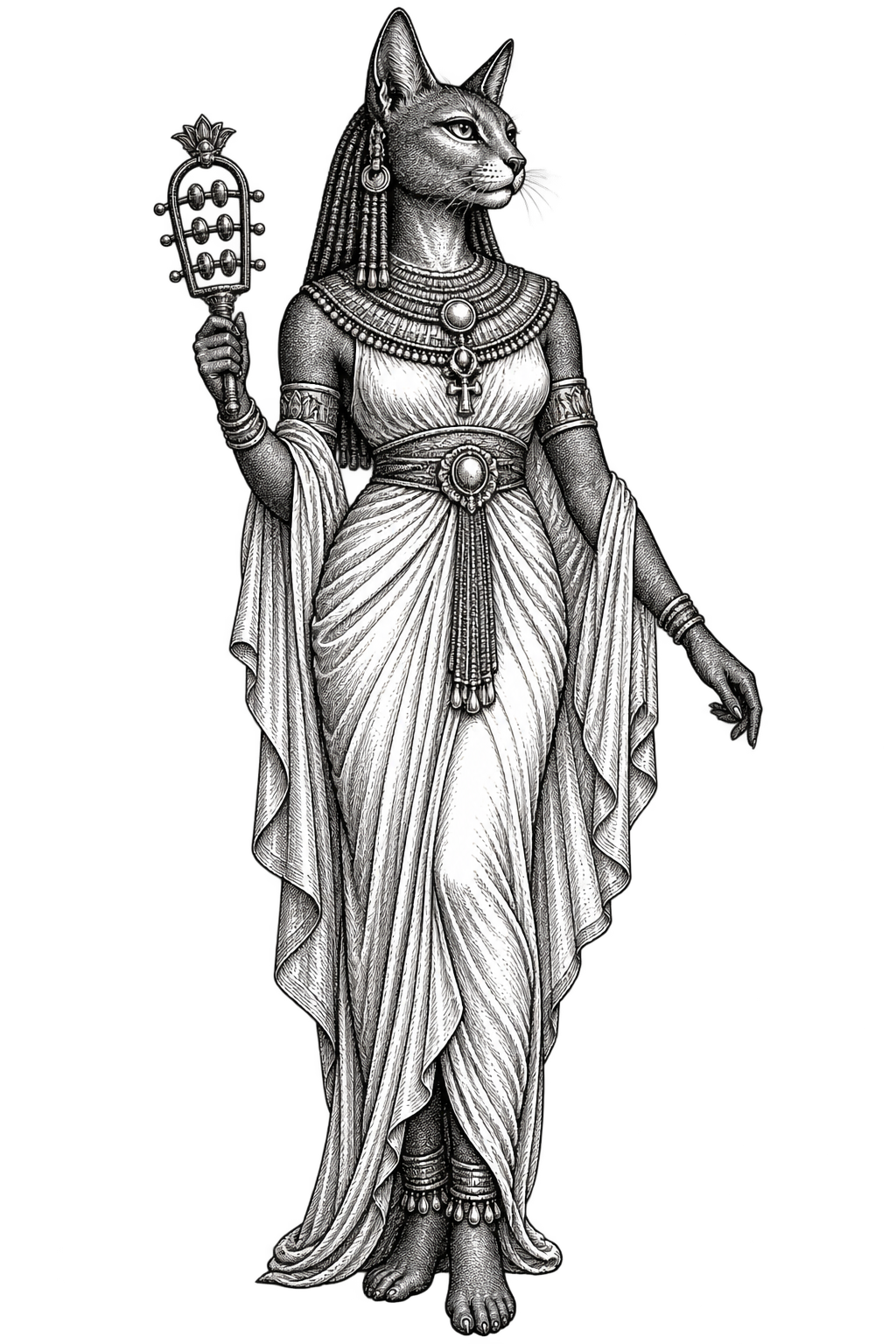
Aspects
- Earlier lioness form
- Later domestic-cat form
- Cat-headed woman
- Guardian and maternal protector
- Lady of Bubastis
Magical / Spiritual Work
- Home protection
- Protective boundaries
- Joy and celebration
- Maternal care
- Prosperity
- Animal welfare
⚠ Important Context
Bastet was not only a domestic-cat goddess. Her history includes earlier leonine power and later cat imagery, and she is related to—but not simply interchangeable with—Sekhmet.
Sacred Days / Festivals / Times
Festival of Bastet at Bubastis — historically reported with source caution · No historically required Moon phase
Devotional Approach
Honor Bastet through source-aware study, music, responsible cat care, household protection, joy, and clearly labeled contemporary offerings.
Core Correspondences
Page 2 of 2
Deeper Reading
Name & Identity
Primary name: Bastet Other common renderings: Bast, Ubasti, Bubastis-derived Greek associations Tradition: Ancient Egyptian religion Primary roles: protective goddess; feline deity of Lower Egypt; household and maternal protection; fertility and fecundity; music, festivity, pleasure, and joy in later periods Primary cult center: Bubastis in the Nile Delta Common iconography: lioness or lioness-headed woman in earlier forms; later commonly a domestic cat or cat-headed woman Common attributes: cat, kittens, sistrum, aegis, basket or ritual objects in later statuettes Reader-facing overview Bastet is one of ancient Egypt’s best-known feline deities. Modern culture often reduces her to “the Egyptian cat goddess,” but her historical identity is richer. She was a powerful protective goddess of Lower Egypt whose imagery and emphasis changed significantly across Egyptian history. Earlier representations could be leonine, connecting her with the fierce protective power shared by several Egyptian lioness goddesses. Over time, especially in the first millennium BCE, her imagery increasingly emphasized the domestic cat. This later form retained protection while also highlighting maternal care, fertility, household well-being, music, celebration, pleasure, and prosperity. Her major cult center was at Bubastis in the Nile Delta. Cat statuettes and cat mummies became strongly associated with her worship in later periods, and large numbers were deposited as votive offerings. Bastet therefore holds both sides of feline symbolism: alert protection and warmth, ferocity and affection, guardianship and joy.
Historical & Cultural Context
Bastet belongs to the ancient Egyptian family of powerful feline goddesses. Her earliest character should not be understood through the later domestic-cat image alone. In older Egyptian religion, Bastet could appear as a lioness or lioness-headed woman and carried the dangerous protective force associated with leonine deities. As Egyptian religious imagery developed, her representation increasingly shifted toward the domestic cat, particularly from the first millennium BCE onward. That change did not erase her older protective force. Instead, later Bastet imagery often emphasizes a more peaceful feline form while retaining her role as a guardian. Museums describe her as a powerful protector of Lower Egypt who could also bring prosperity, and later statuettes frequently emphasize fertility, motherhood, music, festivity, and abundance. Her principal cult center was Per-Bastet, known to the Greeks as Bubastis, in the eastern Nile Delta. Evidence note Ancient Egyptian religion changed over thousands of years. Bastet’s appearance, divine relationships, and theological interpretations are not identical in every period or location. Modern descriptions should therefore avoid presenting one late-period form as though it represents every era of Bastet’s worship.
Appearance & Sacred Imagery
Earlier imagery Bastet could be represented as a lioness or lioness-headed woman. This connects her with the fierce, protective solar and royal power seen among Egyptian leonine goddesses. Later imagery In later Egyptian art, Bastet is very commonly represented: • as a domestic cat; • as a woman with a cat’s head; • with kittens at her feet; • holding a sistrum; • carrying a protective aegis; • wearing elaborate jewelry and patterned clothing. The domestic-cat form emphasizes alertness, protection, fertility, and maternal care rather than weakness or passivity. Cat imagery Cats were sacred to Bastet, especially in later periods. Cat statuettes became extremely common votive dedications. Archaeological finds at Bubastis and Saqqara include cat burials, cat mummies, and feline votive objects associated with Bastet’s cult.
Major Historical Roles
Historically grounded roles include: • protector of Lower Egypt; • protective feline goddess; • household and maternal protection; • fertility and fecundity; • motherhood and nurturing; • prosperity; • music and festivity; • joy and celebration; • sacred feline guardianship. Modern readers often encounter Bastet through themes of sensuality, love, beauty, independence, and domestic comfort. Some of those can be meaningful modern devotional interpretations, but they should not automatically be presented as the primary ancient theological categories.
Bastet and Sekhmet
Bastet and Sekhmet are both feline goddesses, and ancient Egyptian theology could connect or contrast them. Modern summaries sometimes call Bastet the “gentle form” of Sekhmet. That shorthand is useful only if handled carefully. Sekhmet is strongly associated with leonine ferocity, destructive heat, royal power, plague, warfare, and healing. Bastet also had an older lioness character, but later imagery increasingly emphasized the domestic cat, maternal protection, prosperity, music, festivity, and joy. They should not be treated as merely two names for one goddess. A better reader-facing explanation is: Egyptian religion often grouped, contrasted, merged, or related deities through shared attributes. Bastet and Sekhmet share feline protective power, but each developed her own cult, imagery, and religious identity.
Bubastis — Bastet’s Cult Center
Bastet’s principal cult center was the city known in Egyptian as Per-Bastet and in Greek as Bubastis, located in the Nile Delta. Bubastis became one of the places most strongly associated with sacred cats, votive feline images, and Bastet’s temple cult. Archaeological evidence from Bastet-related sacred sites includes large numbers of cat statuettes and mummified cats deposited as offerings. This later votive practice is important because it shows that the cat was not simply decorative symbolism. The animal itself became deeply bound to Bastet’s sacred identity.
The Festival of Bastet
A famous description of Bastet’s festival at Bubastis survives in the writings of the Greek historian Herodotus. He describes crowds traveling by boat, making music, clapping, singing, celebrating, and drinking during the journey to Bubastis. His account has strongly shaped modern impressions of Bastet as a goddess of celebration, music, pleasure, and festivity. Evidence caution Herodotus was a Greek visitor writing about Egypt from an outsider’s perspective. His account is valuable but should not be treated as a transparent transcript of all Egyptian practice. Use it as a historical source describing the festival, not as proof for every modern “Bastet party goddess” claim.
Music, Sistrum & Celebration
Later Bastet statuettes frequently show her holding a sistrum, an Egyptian ritual rattle strongly associated with sacred music and celebration. The sistrum links Bastet with: • ritual music; • joyful movement; • festivity; • celebration; • divine presence expressed through sound. Some surviving statuettes combine the sistrum with kittens or elaborate dress, emphasizing multiple aspects of Bastet at once: fertility, femininity, prosperity, protection, and joy.
Fertility, Motherhood & Kittens
Later Bastet imagery often emphasizes fecundity and maternal protection. Statuettes may show: • kittens at Bastet’s feet; • a nursing cat with kittens; • groups of kittens incorporated into votive imagery. These images support her later association with fertility, motherhood, and protective care. It is more accurate to describe Bastet as having strong maternal and fertility dimensions than to reduce her to a generalized modern “fertility goddess” without context.
Protection
Protection is one of Bastet’s deepest historical themes. Her feline nature expresses watchfulness and readiness. Museum descriptions of later cat forms emphasize the animal as alert and on guard against outside forces. Bastet’s protective character also belongs to the wider Egyptian tradition of fierce feline divinities defending kings, homes, sacred places, and cosmic order. Modern household-protection practice can therefore draw meaningfully from a real historical aspect of Bastet, provided the specific modern ritual itself is labeled as modern.
Divine Relationships & Theological Variation
Bastet’s relationships vary across time and religious setting. She may be connected with: • Ra, through solar and protective theology; • Sekhmet, through feline power and theological comparison; • Wadjet, another powerful protector associated with Lower Egypt; • Hathor, particularly through music, femininity, joy, and the sistrum; • other deities through local or later syncretic traditions. No single simplified family tree should be presented as the one universally correct ancient version.
Symbols & Historically Grounded Associations
Historically grounded symbols include: • domestic cats; • lioness imagery; • kittens; • sistrum; • aegis; • Bubastis; • feline votive statuettes; • cat mummies and votive burials; • protective jewelry and amulets; • music and festival imagery; • motherhood and fecundity; • alert guardianship. Colors Ancient Egyptian divine imagery used many materials and colors, but there is no need to invent a single “sacred Bastet color.” Black, bronze, gold, green, and red may all appear in modern Bastet aesthetics, but only historically attested object coloration should be described as historical evidence.
Historical Offerings vs. Modern Offerings
Historically grounded offering context Egyptian temples and household or funerary practice could include: • food offerings; • bread; • beer; • wine; • water and libations; • incense; • flowers; • music; • ritual objects; • votive figures; • animal votives in later temple contexts. Cat statuettes and cat mummies became particularly prominent Bastet-related votives in later periods. Modern devotional offerings Modern practitioners may choose: • clean water; • bread or simple food; • flowers; • incense; • music; • a sistrum or rattle; • devotional art; • cat imagery; • donations to cat rescues or animal-welfare organizations; • caring for cats responsibly; • acts that protect home and family; • joyful movement, dance, or music. These are modern devotional choices unless a specific historical source documents the practice. Never harm, neglect, breed, purchase, or acquire an animal merely as an “offering.”
Modern Devotional Context
Modern Kemetic, Pagan, occult, and eclectic practitioners approach Bastet in different ways. A historically respectful modern practice can begin with documented themes: • protection; • feline guardianship; • motherhood; • fertility; • prosperity; • joy; • music; • festivity; • sacred domestic life. From there, a practitioner may develop a personal relationship without claiming that every modern ritual tool, crystal, candle color, or correspondence comes from ancient Egypt. Bastet may be meaningful in modern practice involving: • protection of the home; • care of family; • healthy pleasure and joy; • reclaiming play; • confidence without aggression; • maternal or nurturing work; • fertility symbolism; • animal welfare; • balancing softness with boundaries; • celebration after hardship.
Modern Magical Associations
This section is MODERN INTERPRETATION, not reconstruction of ancient Egyptian ritual. Modern practitioners may associate Bastet with: • home protection; • family protection; • boundaries; • confidence; • self-possession; • sensuality; • joy; • pleasure; • music; • dance; • abundance; • fertility; • motherhood; • independence; • grace; • animal guardianship; • feminine power; • comfort and domestic peace. These are strongest when tied back to her documented protective, maternal, prosperous, musical, and celebratory aspects.
Modern Correspondences — Clearly Labeled
Modern devotional / witchcraft correspondences only. These are not presented as ancient Egyptian standards. Suggested colors • black — modern feline symbolism and common Bastet imagery; • gold — modern devotional styling inspired by Egyptian metalwork and sacred visual culture; • green — modern prosperity/life symbolism; • red — modern protective/fierce-feline symbolism. Suggested altar symbols • Bastet image or statue; • cat imagery; • sistrum or small rattle; • bowl of clean water; • flowers; • incense; • protective amulet imagery; • music; • a safe candle; • photographs of beloved companion animals, if personally meaningful. Crystals No crystal should be labeled “sacred to Bastet in ancient Egypt” without direct evidence. Any crystals used in a Bastet altar or ritual must be labeled as modern symbolic choices based on the Black Cat Grimoire’s own crystal correspondences.
Working With Bastet — Modern Devotional Practice
Simple devotional practice 1. Clean and settle the space. 2. Place an image or symbol of Bastet where it can be treated respectfully. 3. Offer clean water, incense, flowers, or music. 4. State your intention plainly. 5. Spend a few minutes in gratitude, prayer, music, or quiet reflection. 6. If the work involves protection, name specifically what you are protecting. 7. If the work involves joy, name something you are allowing yourself to enjoy without guilt. 8. Close by giving thanks and dispose of physical offerings appropriately. Reflection prompts • What in my home deserves better protection? • Where do I need stronger boundaries without becoming closed off? • What brings me uncomplicated joy? • Have I confused constant seriousness with spiritual depth? • What does healthy pleasure look like for me? • Where can I protect others without controlling them? • What part of myself needs both gentleness and claws?
Practical Ritual — Guard the Threshold, Welcome the Joy
Modern devotional ritual inspired by Bastet’s documented protective and celebratory aspects. It is not an ancient Egyptian rite. Purpose For home protection while intentionally making the home feel warm, safe, and alive rather than merely defended. You will need • a small bowl of clean water; • a candle or electric candle; • music, a bell, or a small rattle; • paper and pen. Practice 1. Place the water near the entrance or on your altar. 2. Light the candle safely. 3. Write two short lists: - What I protect here - What I welcome here 4. The first list might include safety, privacy, rest, children, pets, peace, or personal boundaries. 5. The second might include laughter, friendship, music, creativity, affection, abundance, or rest. 6. Stand near the main entrance. 7. Make a small sound with a bell, rattle, clap, or music. 8. Say: May what harms be kept outside. May what nourishes be welcomed within. 9. Walk through the home once, thinking about both protection and welcome. 10. Return to the altar and read both lists. 11. If working devotionally with Bastet, offer thanks. 12. Carry out one practical action afterward: lock a weak window, clean a neglected area, add a light, repair something, call someone you love, play music, or do something else that materially supports the home you described.
Suggested Modern Prayer
Modern devotional writing — not an ancient Egyptian translation. Bastet, watchful one, guardian of the home and keeper of joy, teach me the wisdom of the cat: to rest without shame, to protect without cruelty, to move with confidence, and to know when softness needs claws. May this home hold warmth without becoming careless, boundaries without becoming cold, and joy without apology. Walk with me in protection, in music, in abundance, and in the small sacred pleasures of daily life.
Short Invocation
Modern devotional writing — not an ancient text. Bastet, watchful protector and bringer of joy, guard this space, strengthen its boundaries, and let warmth, music, and good things flourish within.
Respect, Cultural Context & Boundaries
Ancient Egyptian religion belongs to a real historical civilization, not a generic “Egyptian aesthetic.” Respectful modern practice distinguishes: • documented ancient Egyptian religion; • later Egyptian developments; • Greek and Roman interpretations; • modern Kemetic revival or reconstruction; • eclectic witchcraft and personal devotion. Avoid: • fake hieroglyphic spells; • claims that random modern crystals were sacred to Bastet; • treating cats as magical props; • buying or breeding animals for ritual purposes; • taking artifacts, soil, fragments, or remains from archaeological places; • presenting modern internet correspondences as ancient Egyptian facts.
Common Misconceptions
“Bastet was always a domestic cat goddess.” No. Earlier Bastet could be leonine. Her domestic-cat imagery became especially prominent in later periods. “Bastet is just the nice version of Sekhmet.” That is an oversimplification. The two goddesses share feline and protective qualities but developed distinct identities, cults, and iconography. “Bastet is mainly a love goddess.” Love and sensuality are common modern associations, but historically her strongest documented themes include protection, feline power, fertility, motherhood, prosperity, music, and festivity. “Cats were worshipped as gods.” Ancient Egyptians revered divine powers that could manifest through sacred animals and kept animal cults and votive traditions. Saying ordinary cats were simply “worshipped as gods” loses important religious nuance. “Every crystal associated with Bastet online comes from ancient Egypt.” No. Most modern crystal lists are modern correspondences unless supported by specific archaeological or textual evidence. “Bastet is only gentle.” No. Her history retains older leonine protective power beneath the later domestic-cat imagery.
Related Deities & Figures
Sekhmet — feline goddess strongly associated with leonine ferocity, royal power, destruction, disease, and healing. Bastet and Sekhmet share feline protective symbolism but should not be collapsed into one deity. Wadjet — cobra goddess and major protector associated with Lower Egypt; linked with Bastet through regional and protective theology. Hathor — goddess associated with music, joy, femininity, celebration, and the sistrum; overlaps with some later Bastet themes without being identical to her. Ra — solar deity with whom Bastet can be linked through protective and solar theology. Bes — household-associated protective deity connected with family, childbirth, music, and domestic protection in different ways from Bastet. Only create internal links where canonical Black Cat Grimoire entries already exist.
Safety & Ethics
• Keep flame away from fabrics, cat fur, herbs, oils, and unattended spaces. • Never burn incense or diffuse essential oils around cats without species-specific veterinary safety guidance; many aromatic substances can be harmful to animals. • Never place ritual oils on a cat. • Do not feed cats ritual foods without checking veterinary safety. • Do not treat companion animals as ritual tools or signs that must obey spiritual expectations. • Do not disturb archaeological sites or remove artifacts. • Do not use fake historical claims to market products as “ancient Bastet recipes” or “authentic temple formulas.” • Historical information in this entry is educational and is not a substitute for specialized Egyptological study.
Notes & Personal Connection
Explore This Entry
Keep This Grimoire Entry
Print every generated page in order, single-sided or front and back.
Download to Print