Deity Grimoire
Freyja
Vanir goddess of love, desire, fertility, and seiðr · Lady of Fólkvangr · Bearer of BrísingamenDomains
- Love and desire
- Fertility
- Seiðr and magic
- Wealth and precious things
- Grief
- The battle-slain
Symbols
- Brísingamen
- Cats and cat-drawn vehicle
- Falcon-feather garment
- Hildisvíni
- Golden tears
- Fólkvangr
Offerings
- No universal historical offering list survives
- Modern: jewelry or beautiful craft
- Modern: flowers, food, or drink
- Modern: poetry or song
- Modern: charitable support for people or animals
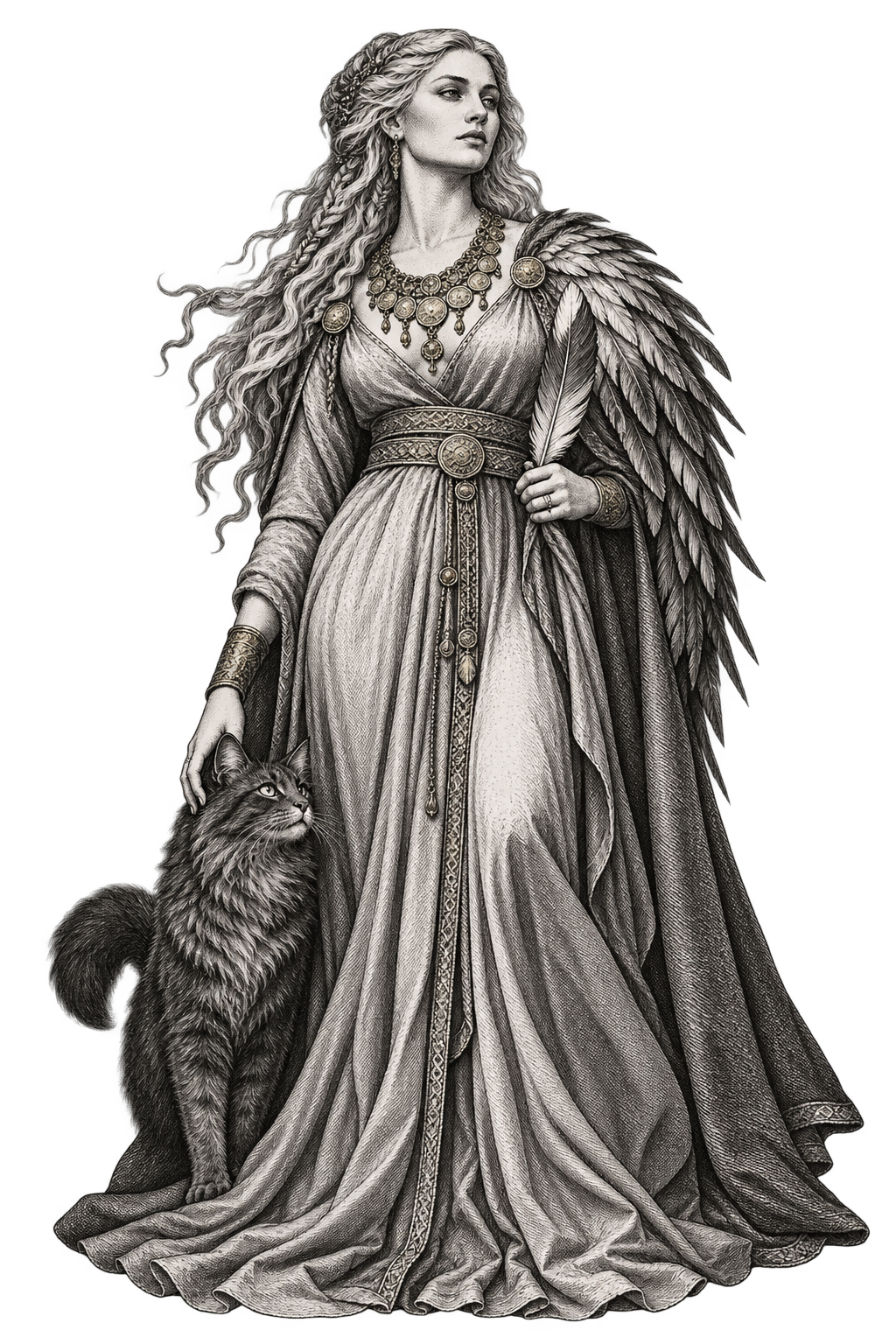
Aspects
- Vanir goddess
- Lady of Fólkvangr
- Bearer of Brísingamen
- Practitioner and teacher of seiðr
- Seeker of Óðr
- Receiver of half the battle-slain
Magical / Spiritual Work
- Love and desire
- Seiðr study
- Self-worth
- Grief and longing
- Prosperity
- Courage and sovereignty
⚠ Important Context
Freyja is not merely a love goddess. Surviving sources also connect her with seiðr, wealth, grief, Fólkvangr, and a share of the battle-slain; Freyja and Frigg should not be collapsed without qualification.
Sacred Days / Festivals / Times
Friday through linguistic and later associations, with caution · No historically required Moon phase
Devotional Approach
Approach Freyja through careful source study, beauty and craft, honest desire, grief reflection, self-worth, and modern offerings clearly identified as contemporary.
Core Correspondences
Page 2 of 2
Deeper Reading
Name & Identity
Primary name: Freyja Old Norse: Freyja Tradition: Old Norse / pre-Christian Scandinavian religion Divine group: Vanir Primary roles in surviving sources: love, desire, fertility, seiðr, wealth and precious objects, female divine power, and a share of the battle-slain Father: Njörðr Brother: Freyr Husband in surviving mythic tradition: Óðr Daughters named in later sources: Hnoss and Gersemi Hall / field: Fólkvangr; her hall is called Sessrúmnir Famous possession: Brísingamen Other attributes: falcon-feather cloak or feather garment; cat-drawn vehicle; boar Hildisvíni in some stories Reader-facing overview Freyja is one of the most prominent goddesses in surviving Old Norse mythology. She belongs to the Vanir and is associated with love, desire, fertility, wealth, magic, and death in battle. Calling her only a “goddess of love” leaves out much of her character. She is also a master of seiðr, the form of magic and divination most famously associated with völur and other ritual specialists. In the surviving mythic tradition, Freyja receives half of those slain in battle in her field, Fólkvangr, while Odin receives the other half. Her stories combine beauty, sexuality, grief, magic, wealth, sovereignty, and fierce independence. She possesses the celebrated necklace Brísingamen, travels with a feather garment that enables extraordinary movement in myth, and is famously linked with cats. Freyja therefore belongs simultaneously to love, fertility, magic, prosperity, grief, and death.
Historical & Cultural Context
Our knowledge of Freyja comes from several kinds of evidence: • medieval Icelandic texts such as the Poetic Edda and Prose Edda; • skaldic poetry; • saga material; • place names; • archaeological objects and iconographic interpretations; • comparative evidence from pre-Christian Scandinavian religion. The written sources are indispensable but must be read carefully. Much of the mythology was written down after the conversion of Scandinavia to Christianity. That does not make the material worthless, but it means modern readers should avoid treating every medieval literary detail as a direct transcript of Viking-Age ritual. Archaeology and place-name evidence help confirm that the divine figures known from the texts were not merely literary inventions. Freyja and the Vanir belong to a wider religious world that existed before the surviving manuscripts were written. Evidence note This entry distinguishes: • material clearly present in Old Norse mythic texts; • archaeological or place-name evidence; • later folklore; • modern Heathen or witchcraft practice. Those categories must not be blended together without labeling.
The Vanir
Freyja belongs to the Vanir, a divine group associated especially with fertility, prosperity, wealth, and the fruitful powers of the world. Her father is Njörðr and her brother is Freyr. In the mythic account of conflict and reconciliation between the Æsir and Vanir, members of the Vanir become part of the wider divine community. Freyja’s Vanir identity helps explain the recurring combination of: • fertility; • prosperity; • sensuality; • magical skill; • abundance; • land and life-giving power. But she is not simply a passive fertility figure. Her myths repeatedly give her agency, authority, desire, and magical expertise.
Love, Desire & Sexuality
Freyja is strongly associated with love and sexual desire in the surviving sources. She is repeatedly described as beautiful and desirable. Giants seek her as a bride or prize in several myths, while the gods themselves recognize her extraordinary desirability. Her sexuality is sometimes described critically or mockingly in medieval literature. Those portrayals should be read in context rather than used as a license for modern moral judgment. In modern devotional work, Freyja may be approached around: • love; • desire; • self-possession; • healthy sexuality; • confidence; • intimacy; • fertility. These modern applications are strongest when they preserve her agency rather than reducing her to attractiveness for others.
Seiðr & Magic
Freyja is deeply associated with seiðr, a form of Old Norse magic involving prophecy, altered states, fate, influence, and ritual performance. Later literary sources portray Freyja as exceptionally skilled in seiðr and connect her with the transmission of that knowledge among the gods. The völva or seeress is one of the best-known ritual specialists associated with seiðr in the surviving record. Archaeological burials containing staffs and other unusual objects are sometimes interpreted in connection with such practitioners. Freyja’s connection with seiðr makes her especially important to modern practitioners interested in divination and magical practice, but the historical evidence does not justify pretending modern tarot, pendulums, crystal grids, or contemporary spell systems are ancient Norse seiðr. Evidence caution Seiðr is historically real, but its exact techniques are incompletely preserved. Modern reconstruction necessarily includes interpretation.
Fólkvangr & the Battle-Slain
Freyja is not only a goddess of love and fertility. In the surviving mythic tradition, she receives half of those slain in battle in her field called Fólkvangr, while Odin receives the other half. Her hall there is called Sessrúmnir. This makes Freyja part of the Norse religious imagination surrounding battle, death, honor, and the afterlife. Her association with the dead complicates the modern tendency to frame her as purely soft, romantic, or domestic. Freyja can therefore hold both: • desire and death; • fertility and grief; • beauty and battle; • pleasure and loss.
Brísingamen
One of Freyja’s most famous possessions is the necklace Brísingamen. The necklace appears in several literary traditions and becomes one of her defining symbols. Its exact mythic history varies depending on the source. Modern retellings often present one single dramatic acquisition story as though it is universally ancient and uncontested. The safest reader-facing approach is: • Brísingamen is strongly and repeatedly associated with Freyja; • it symbolizes her connection with beauty, wealth, precious objects, and status; • specific stories about how she obtained it vary in tone, date, and source context. Do not present later or hostile literary versions as the only authentic account.
Cats & Freyja's Vehicle
Freyja is famously associated with cats. Later Old Norse literary tradition describes her traveling in a vehicle drawn by cats. Archaeological material has sometimes been interpreted in light of this association. Cats therefore became one of Freyja’s most recognizable modern symbols. Evidence caution The surviving sources do not provide a standardized ancient “cat offering” ritual or a fixed breed, color, or magical cat correspondence for Freyja. Modern cat symbolism should not be inflated beyond what the evidence supports.
Falcon-Feather Garment
Freyja possesses a feather garment or falcon-associated cloak in mythic tradition. This magical garment allows extraordinary travel and appears in myths where it may be borrowed. The motif connects Freyja with: • transformation; • movement between places; • magical travel; • bird symbolism; • liminality. Modern practitioners sometimes extend this into spirit-flight symbolism, but such uses should be clearly identified as modern interpretation.
Hildisvíni
Freyja is also associated in surviving literature with a boar called Hildisvíni, often translated as “battle swine.” The boar appears in stories involving Freyja’s movement and companionship. Because boars are also important in Vanir symbolism, Hildisvíni reinforces her connection with fertility, wealth, strength, and the Vanir religious sphere. Modern readers should avoid confusing Hildisvíni with Freyr’s boar Gullinbursti.
Óðr, Grief & the Golden Tears
Freyja’s husband is called Óðr in the surviving mythological tradition. He is often absent, wandering, or difficult to identify clearly. Freyja is described as searching for him and weeping tears associated with gold. These stories add grief, longing, and separation to her character. The golden-tears motif has made Freyja meaningful to modern practitioners working with: • grief; • longing; • love across distance; • abandonment wounds; • continuing love after separation. Those modern uses should be labeled as interpretation built from mythic themes, not reconstructed ancient therapy practice.
Freyja & Frigg
Freyja and Frigg are sometimes treated online as though scholarship has proven they were originally one goddess. The reality is more complicated. They share some overlapping themes: • love and marriage; • high divine status; • magical or prophetic associations; • names that may invite linguistic comparison. But the surviving mythology treats them as distinct figures. Some scholars have explored whether they may share earlier roots, while others emphasize their separate identities in the surviving sources. For the Grimoire: • present them as distinct deities; • acknowledge the scholarly discussion; • do not state that “Freyja and Frigg are the same goddess” as fact.
Historical Worship & Place Names
Freyja’s worship is harder to reconstruct in detail than modern devotional guides often suggest. Place names in Scandinavia have been interpreted as evidence of cultic or religious associations connected with Freyja and other Vanir deities. The Danish National Museum notes that place names associated with Freyr and Freyja are especially found in Norway and Sweden. This supports the idea that these deities had real pre-Christian religious importance beyond the later manuscript tradition. What the evidence does NOT support We do not possess a complete historical “Freyja ritual manual.” Modern lists assigning: • exact candle colors; • crystals; • tarot cards; • weekday rules; • standardized incense blends; • modern spell jars; • roses as universally ancient offerings should be labeled as modern correspondence unless backed by a specific historical source.
Offerings: Historical Evidence vs. Modern Devotion
Historically grounded context Pre-Christian Norse religion included feasting, sacrifice, drinking rituals, offerings, and cult practice connected with divine favor and reciprocity. Specific Freyja-only offering lists are not preserved in the detailed way modern practitioners sometimes expect. Historically responsible language may mention: • food; • drink; • feasting; • precious objects; • sacrifice within the broader religious culture; • spoken praise and ritual observance. Do not create a false “Viking shopping list” for Freyja. Modern devotional offerings Modern Heathen or eclectic practitioners may choose: • mead, ale, wine, or non-alcoholic drink; • bread, fruit, honey, or good food; • flowers; • beautiful jewelry; • amber; • devotional poetry; • music; • perfume; • cat-related charity; • acts of generosity; • acts that support bodily autonomy, love, fertility, or women’s safety. These are modern devotional choices unless directly evidenced historically.
Modern Devotional Context
Modern Heathen, Norse Pagan, occult, and witchcraft practitioners approach Freyja in different ways. A respectful modern relationship can begin with historically grounded themes: • love; • fertility; • desire; • seiðr; • wealth; • beauty; • battle-death; • grief; • magic; • independence. From there, practitioners may build personal devotional practice without pretending every modern tool is Viking Age. Freyja may be meaningful in modern work involving: • confidence; • self-worth; • desire; • fertility; • grief; • independence; • relationship healing; • divination; • magical practice; • prosperity; • reclaiming pleasure; • personal sovereignty.
Modern Magical Associations
This section is MODERN INTERPRETATION, not reconstruction of pre-Christian Norse ritual. Modern practitioners commonly associate Freyja with: • love; • attraction; • sexuality; • fertility; • beauty; • self-worth; • confidence; • prosperity; • seiðr-inspired magical work; • divination; • grief; • independence; • feminine power; • protection; • battle courage; • spirit work; • transformation. These correspondences are most defensible when tied to documented mythic roles rather than presented as arbitrary lists.
Modern Correspondences — Clearly Labeled
Modern devotional / witchcraft correspondences only. These are not claimed as Viking-Age standards. Suggested colors • gold — Brísingamen, wealth, preciousness; • amber — modern Nordic devotional symbolism; • red — desire, vitality, courage; • green — fertility and Vanir abundance; • deep rose — modern love and devotion symbolism. Suggested altar symbols • necklace or beautiful jewelry; • cat imagery; • falcon or feather imagery; • boar imagery; • amber; • flowers; • bowl or cup for offering drink; • devotional poetry; • symbols of Fólkvangr or the slain handled respectfully. Crystals No crystal should be described as “historically sacred to Freyja” without specific evidence. Any crystals used should be labeled as modern symbolic correspondences based on the Black Cat Grimoire’s established crystal system.
Working With Freyja — Modern Devotional Practice
Simple devotional practice 1. Clean and prepare the space. 2. Place a symbol of Freyja: jewelry, cat imagery, a feather, or devotional art. 3. Offer food, drink, flowers, poetry, or another respectful modern offering. 4. State clearly why you are present. 5. Speak praise before making a request. 6. Sit quietly and reflect on the quality you are cultivating. 7. Close with thanks. 8. Follow devotional work with a practical action. Reflection prompts • Where have I confused being desired with being valued? • What do I want when no one else is watching? • What pleasure have I treated as something I must earn? • Where do I need more independence? • What grief am I carrying alongside love? • What would it mean to value myself as something precious? • Where do I need both tenderness and courage?
Practical Ritual — What Is Precious
Modern devotional ritual inspired by Brísingamen, Freyja’s themes of value, beauty, desire, and sovereignty. It is not an ancient Norse rite. Purpose For self-worth, clarifying desire, and choosing what deserves your energy. You will need • one piece of jewelry or another small beautiful object; • paper and pen; • a candle or electric candle; • optional offering. Practice 1. Place the jewelry before you. 2. Light the candle safely. 3. Write the heading: What is precious to me? 4. List five things that genuinely matter to you. 5. Circle one that your current actions do not adequately protect. 6. Ask: What would I do differently if I treated this as precious? 7. Write one real action. 8. Hold or wear the jewelry while speaking: I choose what I value. I protect what is precious. I do not measure my worth by another person’s desire. 9. If working devotionally, offer thanks to Freyja. 10. Carry out the practical action within a reasonable time.
Suggested Modern Prayer
Modern devotional writing — not an Old Norse translation. Freyja, bright one of the Vanir, keeper of desire, magic, and precious things, teach me to know what I value and to know my own value without asking permission. Stand with me in love without self-erasure, in pleasure without shame, in grief without surrender, and in courage without hardness. Teach me the wisdom to choose, the strength to leave, the heart to love, and the magic to become more fully my own.
Short Invocation
Modern devotional writing — not an ancient text. Freyja, lady of love, magic, wealth, and fierce self-possession, be present in this work. Help me recognize what is precious and act accordingly.
Respect, Cultural Context & Boundaries
Old Norse religion belongs to real historical cultures and modern living religious communities. Respectful practice should distinguish: • Viking-Age and earlier pre-Christian Scandinavian religion; • medieval Icelandic literary preservation; • later Scandinavian folklore; • modern Heathenry / Ásatrú; • eclectic witchcraft and personal devotion. Avoid: • presenting television or fantasy portrayals as history; • claiming modern crystals or tarot cards were used by Viking-Age Freyja worshippers; • describing seiðr as though its full ancient method survives intact; • using modern nationalist or racialized interpretations as though they were inherent to Norse religion; • treating Norse religion as ethnically exclusive. Historical Norse religion developed among specific cultures, but modern devotional participation is not established by ancestry alone.
Common Misconceptions
“Freyja is just a love goddess.” No. Love is important, but she is also associated with fertility, magic, wealth, the slain, grief, and powerful independence. “Freyja and Frigg are definitely the same goddess.” No. Their possible relationship is debated. Surviving sources present them as distinct. “Freyja invented modern witchcraft.” No. She is associated with seiðr, a historically attested Norse magical practice. Modern witchcraft systems are not identical to seiðr. “All cats are sacred to Freyja in exactly the same way.” Cats are famously linked with her vehicle, but the sources do not provide a standardized universal cat cult. “She only represents femininity in a soft or romantic sense.” No. Her mythology includes death, magic, grief, battle-slain warriors, autonomy, and power. “The medieval Eddas are direct Viking-Age transcripts.” No. They preserve crucial mythic material but were written down later and must be interpreted critically.
Related Deities & Figures
Freyr — Freyja’s brother; Vanir deity associated with fertility, prosperity, peace, and abundance. Njörðr — Freyja’s father; Vanir deity associated with wealth, seafaring, and prosperity. Odin — associated with the slain and with seiðr; Freyja receives part of the battle-dead while Odin receives another part. Frigg — major goddess associated with marriage, foresight, and high divine status; overlaps exist, but she and Freyja remain distinct in surviving mythology. Loki — appears in stories involving Freyja, Brísingamen, and the feather garment. Óðr — Freyja’s often-absent husband in surviving mythic tradition. Only create internal links where canonical Black Cat Grimoire entries already exist.
Safety & Ethics
• Keep flames away from fabric, feathers, herbs, alcohol, and unattended areas. • If offering alcohol, do not consume it if unsafe, medically inappropriate, or contrary to recovery needs. • Never give alcohol or ritual food to animals. • Do not use feathers obtained illegally or from protected species. • Do not use psychoactive plants in an attempt to “recreate seiðr.” • Do not claim archaeological uncertainty is proof of any preferred modern practice. • Historical information here is educational and is not a substitute for specialist Old Norse or archaeological scholarship.
Notes & Personal Connection
Explore This Entry
Keep This Grimoire Entry
Print every generated page in order, single-sided or front and back.
Download to Print