Deity Grimoire
Hel
Ruler or keeper of the realm Hel · Daughter of Loki and Angrboða · Medieval Norse figure associated with the deadDomains
- The dead and the underworld
- Boundaries
- Endings
- Mortality
- Grief and acceptance
Symbols
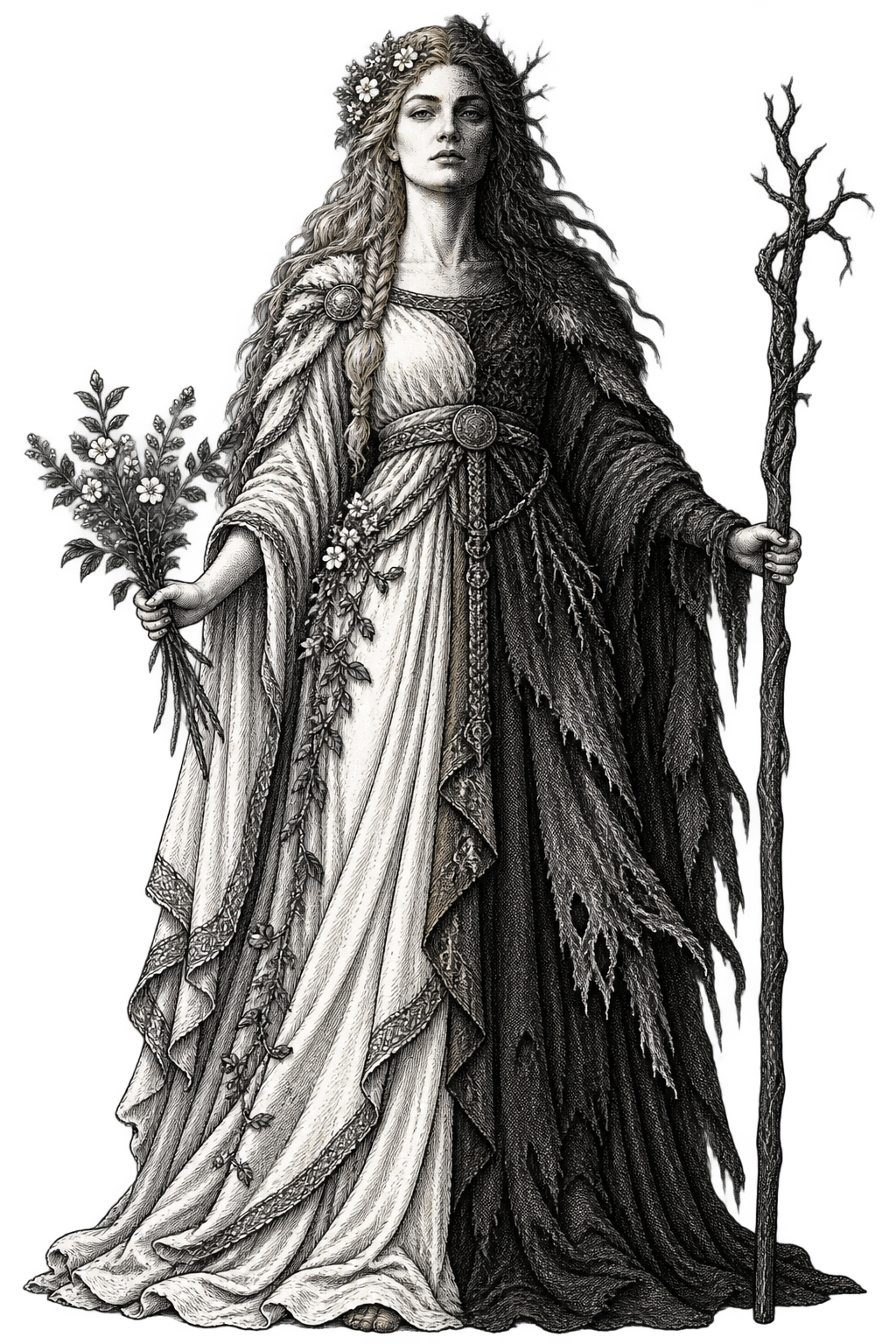
- Divided light and dark appearance
- The realm Hel
- Baldr and Hermóðr story
- Éljúðnir
- Threshold imagery
- Winter stillness
Offerings
- No securely documented universal historical offering system
- Modern: remembrance of the dead
- Modern: clean water or simple food
- Modern: flowers or a safe candle
- Modern: grief-supporting acts of care
Aspects
- Daughter of Loki and Angrboða
- Sister of Fenrir and Jörmungandr
- Ruler of Hel in Snorri's account
- Keeper of the dead
- Being and realm sharing one name
Magical / Spiritual Work
- Grief and acceptance
- Mortality reflection
- Ancestor remembrance
- Endings and transition
- Boundaries
- Letting go
⚠ Important Context
Hel is not Satan, the realm Hel is not simply Christian Hell, and those who go there are not automatically being punished. Evidence for a standardized historical cult is limited.
Sacred Days / Festivals / Times
Winter in modern symbolic practice · No historically required Moon phase
Devotional Approach
Use source study, remembrance, grief reflection, and safe modern devotional practice while respecting the ambiguity between Hel as realm and Hel as personified ruler.
Core Correspondences
Page 2 of 2
Deeper Reading
Name & Identity
Primary name: Hel Old Norse: Hel Tradition: Old Norse / pre-Christian Scandinavian religion and mythology Primary role: ruler or keeper of the realm called Hel in surviving mythic tradition Father: Loki Mother: Angrboða Siblings: Fenrir and Jörmungandr Realm: Hel, often described as a place associated especially with those who do not die in battle Important source context: much of the detailed personified description comes from medieval Icelandic sources, especially Snorri Sturluson Reader-facing overview Hel is one of the most misunderstood figures in Norse mythology. She is the daughter of Loki and the giantess Angrboða and the sister of Fenrir and Jörmungandr. In the surviving mythic tradition, Odin casts Hel into the realm that bears her name and gives her authority over those who come there. Modern popular culture often treats Hel as a Norse equivalent of the Christian Devil, or her realm as simply “Hell.” That is historically misleading. The Old Norse word Hel can refer both to the mythic figure and to the realm of the dead. The surviving sources describe a destination associated especially with people who die from illness, age, or causes other than battle. It is not simply a place of punishment for evil people. Hel is therefore better understood through themes of death, inevitability, boundaries, the dead, and the acceptance of what cannot be reversed.
Historical & Cultural Context
Hel survives in Old Norse literature as both: • a personified female figure; and • the name of an underworld or realm of the dead. That overlap is important. The personified Hel is especially developed in the Prose Edda, written by Snorri Sturluson in Christian-era Iceland. Earlier poetic material preserves Hel as a place, power, or destination of the dead, but the detailed image of Hel as Loki’s daughter ruling a richly described hall belongs strongly to the medieval literary tradition. This means the historical picture is not simple. We have strong evidence that hel was an important term connected with death and the underworld in the Germanic/Norse religious world. We have less evidence for a standardized Viking-Age cult centered on a goddess Hel with the full personality and household details found in later literary sources. Evidence note The correct approach is not to dismiss Snorri, but to distinguish: • pre-Christian death concepts; • medieval mythic preservation; • later Christian influence; • modern devotional interpretation.
Hel as Both Being & Realm
One of the most important things to understand is that Hel is both a name and a place-name in the surviving tradition. The realm Hel is a destination of the dead. In medieval mythological description, the figure Hel rules there. Because the same word is used for both, modern readers can easily assume that every reference to “Hel” in a poem is necessarily describing the goddess as a person. That is not always safe. Some passages may refer to: • the realm; • the condition of death; • the power of death; • the personified ruler; • or a poetic overlap between them. This ambiguity should be preserved rather than pretending every source uses Hel in exactly the same way.
Parentage & Siblings
In Snorri’s mythological account, Hel is one of three children born to Loki and Angrboða. Her siblings are: • Fenrir, the great wolf; • Jörmungandr, the Midgard Serpent. The gods fear what these children may become. Odin therefore acts against all three: • Jörmungandr is thrown into the sea around Midgard; • Fenrir is eventually bound; • Hel is cast into the underworld realm and given authority there. This story links Hel with the wider mythic theme of dangerous or unavoidable forces that the gods try to contain but cannot completely eliminate.
Hel’s Appearance
Snorri gives Hel one of the most memorable descriptions in Norse mythology. She is described as having a divided appearance, with one half of her body different in color from the other. Translations vary because the Old Norse color vocabulary does not map perfectly onto modern English. A common translation describes her as: • half flesh-colored; • half blue-black or dark. The important point is not modern horror imagery. Her divided appearance visually expresses the boundary between life and death. Modern caution Do not turn this literary description into exaggerated corpse-horror imagery. The source presents her as striking and grim, but the Grimoire art should remain dignified, mythic, and historically inspired.
Odin Sends Hel to the Underworld
In Snorri’s account, Odin sends Hel to the realm of the dead and grants her authority there. She is given responsibility for those who come to her. This is not framed simply as imprisonment. Hel becomes a ruler. That distinction matters. Her identity is therefore not only about exclusion or punishment. She has authority, territory, and a function within the structure of the cosmos. Modern devotional interpretations often find meaning in this as: • sovereignty within unwanted circumstances; • making a place in what cannot be avoided; • holding boundaries; • governing endings rather than denying them. Those modern applications should be labeled as interpretation.
Who Goes to Hel?
The surviving Norse afterlife tradition is more complicated than the popular “warriors go to Valhalla, everyone else goes to Hel” summary. Different sources preserve multiple destinations for the dead. Hel is strongly associated with people who die through: • illness; • age; • ordinary death rather than battle. This does not make them morally condemned. The realm is not simply a punishment zone for bad people. Some later descriptions contain grim imagery, but Old Norse afterlife ideas do not map cleanly onto the Christian Heaven/Hell moral binary.
Hel & Baldr
The most important story involving Hel as an active ruler comes after the death of Baldr. After Baldr is killed, the gods seek a way to bring him back. Hermóðr rides to Hel to negotiate for Baldr’s release. Hel agrees to a condition: if all beings and things weep for Baldr, he may return. Nearly everything weeps. One figure refuses. As a result, Baldr remains among the dead until after Ragnarök. Why this matters Hel is not portrayed as randomly cruel. She sets a condition. She does not simply release Baldr because the gods want him back. The story reinforces: • the finality of death; • the limits of divine power; • the boundary between living and dead; • the idea that some losses cannot simply be undone. For modern devotional reflection, this can support themes of grief and acceptance—but that is a modern application, not an ancient therapeutic ritual.
Hel’s Hall & Household
Snorri gives elaborate names to Hel’s hall, belongings, and attendants. Her hall is called Éljúðnir. Other grimly named details are attached to: • her dish; • knife; • threshold; • bed; • curtains; • servants. These names create a literary atmosphere of hunger, decay, sickness, and inevitability. Evidence caution These details come from a medieval literary source and should not automatically be treated as evidence for a historical temple cult or devotional household system. They are valuable mythic material. They are not proof of a standardized Viking-Age ritual environment.
Hel, Niflhel & Underworld Language
Old Norse texts use several terms connected with the dead and underworld. These include: • Hel; • Niflhel; • Niflheimr in later systematization; • grave and mound language; • other poetic death-realms or destinations. These terms are not always used consistently across sources. Modern charts that turn Norse cosmology into one fixed map can therefore be misleading. For the Grimoire: • acknowledge variation; • do not force every underworld term into one perfectly organized system; • do not claim Hel has one universally fixed geographic location in all Norse tradition.
Hel Is Not the Christian Hell
The similarity between the English word hell and Old Norse Hel is historically related through Germanic language, but the concepts are not identical. Christian Hell becomes a place of punishment for the damned within Christian theology. Old Norse Hel is a realm of the dead and is not defined primarily by moral damnation. Later Christian-era writers inevitably wrote within a world already influenced by Christian ideas. That makes careful distinction especially important. Common error Do not write: “Hel is the Norse goddess of Hell.” Better: “Hel is a figure in Old Norse mythology associated with the realm of the dead that shares her name.”
Hel & Ragnarök
Hel’s realm remains important in the larger mythic structure leading toward Ragnarök. The dead and underworld powers are part of the destabilization of the cosmos. Some literary material describes forces coming from Hel or the realm of the dead. However, Hel herself is not as clearly given an individual final battle role as figures such as Loki, Fenrir, Jörmungandr, Thor, or Odin. Do not invent a specific combat role for her at Ragnarök.
Historical Worship & Evidence Limits
Evidence for a distinct historical cult of Hel is limited. We do not have strong evidence for: • a widely standardized Hel temple network; • a universal priesthood dedicated to Hel; • a fixed festival calendar; • a consistent offering list; • a well-documented public cult comparable to deities such as Thor or Odin. This absence should be stated honestly. It does not mean Hel was meaningless. Death, burial, ancestors, graves, and the underworld were obviously important in pre-Christian Scandinavian religion. But the literary Hel should not be automatically converted into a fully documented historical cult where the evidence does not support that.
Burial, Ancestors & the Dead
Pre-Christian Scandinavian burial traditions were diverse. The dead could be connected with: • graves; • burial mounds; • ships; • cremation; • grave goods; • ancestral presence; • different afterlife destinations. These practices provide broader historical context for Norse relationships with death. They should not all be labeled “Hel worship.” A modern devotional practice centered on Hel may draw meaning from death, ancestors, grief, or boundaries, but it must not claim every Norse burial custom historically belonged to her cult.
Symbols & Historically Grounded Associations
Historically or textually grounded associations include: • the realm of the dead; • death by illness or age; • boundaries between living and dead; • Loki; • Angrboða; • Fenrir; • Jörmungandr; • Baldr; • Hermóðr; • Éljúðnir; • underworld imagery; • divided light/dark bodily appearance in Snorri’s description. What is NOT securely ancient There is no secure universal historical system assigning Hel: • black candles; • white candles; • obsidian; • bones as altar requirements; • skull imagery as a cult standard; • specific planets; • tarot cards; • moon phases. Those are modern systems if used at all.
Offerings — Historical Evidence vs. Modern Devotion
Historically grounded context Pre-Christian Norse religion included offerings, feasting, sacrifice, burial rites, and reciprocal relationships with divine powers. However, a standardized ancient offering list specifically for Hel is not securely preserved. Avoid presenting modern internet lists as historical fact. Modern devotional offerings Modern practitioners may choose: • clean water; • bread or simple food; • dark or plain flowers; • devotional poetry; • quiet remembrance; • acts of care for graves or cemeteries where lawful; • grief-support charity; • hospice support; • ancestor remembrance; • acts that honor the dignity of the dead. These are modern devotional choices unless a specific historical source demonstrates otherwise. Never remove objects from graves or archaeological sites.
Modern Devotional Context
Modern Heathen, Pagan, occult, and eclectic practitioners may work devotionally with Hel in different ways. Historically responsible modern themes may include: • death; • grief; • acceptance; • endings; • boundaries; • ancestor remembrance; • mortality; • care for the dead; • living with what cannot be reversed; • dignity in loss. Hel may be especially meaningful to people doing: • grief work; • end-of-life reflection; • ancestor remembrance; • boundary work; • acceptance after irreversible change. These are modern devotional applications. They should not be presented as reconstructed Viking-Age ritual.
Modern Magical Associations
MODERN INTERPRETATION ONLY. Modern practitioners may associate Hel with: • grief; • death work; • ancestor work; • endings; • acceptance; • shadow work involving mortality; • firm boundaries; • release; • transition; • stillness; • winter symbolism; • remembrance. These correspondences are strongest when they arise from her documented underworld role rather than arbitrary occult lists.
Modern Correspondences — Clearly Labeled
Modern devotional / witchcraft correspondences only. Suggested colors • black — modern death/underworld symbolism; • white — modern liminality and death symbolism; • gray — modern threshold symbolism; • deep blue-black — inspired by translation traditions concerning Hel’s appearance. Suggested altar symbols • simple bowl of water; • plain candle; • respectful ancestor object; • written names of the dead; • winter branches; • a covered or divided-color cloth; • devotional art of Hel. Crystals No crystal should be labeled “historically sacred to Hel” without direct evidence. If crystals are used, they are modern symbolic choices only.
Working With Hel — Modern Devotional Practice
Simple devotional practice 1. Prepare a quiet space. 2. Place a simple symbol of Hel or a bowl of water. 3. State clearly why you are present. 4. If honoring the dead, name them respectfully. 5. Sit with the reality of the loss or ending without trying to force a sign. 6. Speak a prayer or reflection if desired. 7. Close with thanks. 8. Follow with a practical act of remembrance or care. Reflection prompts • What ending have I refused to acknowledge? • What cannot be restored exactly as it was? • What boundary protects the living and honors the dead? • Where am I mistaking acceptance for approval? • What does dignity look like in grief? • What remains meaningful even after something has ended? • What deserves remembrance without becoming a place I remain trapped?
Practical Ritual — What Cannot Be Carried Back
Modern devotional ritual inspired by Hel’s role as keeper of the boundary of the dead. It is not an ancient Norse rite. Purpose For grief, endings, and accepting that something has changed permanently. You will need • a bowl of clean water; • paper and pen; • a candle or safe electric candle. Practice 1. Place the water before you. 2. Light the candle safely. 3. Write the name of what has ended. 4. Beneath it, write: What can I still carry forward? 5. List what remains: - memory; - lesson; - love; - responsibility; - changed identity; - practical next steps. 6. Then write: What cannot come back exactly as it was? 7. Read that line once. 8. Sit quietly without arguing with it. 9. If working devotionally with Hel, offer thanks for holding the boundary between what is gone and what remains. 10. Extinguish the candle. 11. Keep the part you can carry forward. Dispose of the rest when ready.
Suggested Modern Prayer
Modern devotional writing — not an Old Norse translation. Hel, keeper of the boundary, ruler where the road of the living ends, teach me to look at what is gone without turning away. Help me honor what cannot return, remember without clinging, and accept without pretending loss does not hurt. May the dead be treated with dignity. May the living know when to continue. May I learn the difference between remembrance and refusing to release what has already changed.
Short Invocation
Modern devotional writing — not an ancient text. Hel, keeper of the dead and guardian of the final boundary, be present in this work. Help me face endings clearly, honor what is gone, and carry forward only what still belongs among the living.
Respect, Cultural Context & Boundaries
Respectful work with Hel should distinguish: • pre-Christian Norse death concepts; • medieval Icelandic literary preservation; • later Christian influence; • modern Heathenry; • eclectic witchcraft and occult practice. Avoid: • calling Hel “the Norse Satan”; • calling her realm a simple copy of Christian Hell; • treating every graveyard practice as historically Norse; • collecting grave dirt without permission; • removing objects from graves; • handling human remains; • claiming a complete ancient Hel cult where evidence is weak; • inventing “Viking death spells” and presenting them as historical.
Common Misconceptions
“Hel is the Norse goddess of evil.” No. The surviving sources connect her with the dead and the underworld, not with a universal principle of evil. “Hel is exactly the same as Christian Hell.” No. The words are historically related, but the religious concepts are not identical. “Everyone in Hel is being punished.” No. Hel is associated especially with ordinary death, illness, and age—not merely moral condemnation. “Hel has a fully documented historical cult.” The evidence is limited. Her literary importance is clearer than a standardized public cult. “Hel personally fights the gods at Ragnarök.” The surviving sources do not give her the same explicit individual combat role as Loki, Fenrir, Jörmungandr, Thor, or Odin. “Her half-dark appearance means she is half evil.” No. That is a modern moral interpretation imposed on a literary description.
Related Deities & Figures
Loki — Hel’s father in Snorri’s account. Angrboða — Hel’s mother. Fenrir — Hel’s wolf brother. Jörmungandr — Hel’s serpent brother. Odin — sends Hel to the underworld realm and gives her authority there in Snorri’s account. Baldr — remains among the dead after Hel’s condition for his release is not fulfilled. Hermóðr — rides to Hel to negotiate for Baldr. Only create internal links where canonical Black Cat Grimoire records already exist.
Safety & Ethics
• Do not trespass in cemeteries. • Do not remove grave dirt, offerings, stones, flowers, bones, or objects without explicit lawful permission. • Do not handle human remains. • Follow cemetery rules and respect grieving families. • Do not use unsafe fire, smoke, or intoxicants in death-related ritual. • Do not encourage people to interpret grief symptoms as supernatural commands. • Modern devotional practice should support, not replace, practical grief care and real-world responsibilities. • Historical information here is educational and not a substitute for specialist Old Norse scholarship.
Notes & Personal Connection
Explore This Entry
Keep This Grimoire Entry
Print every generated page in order, single-sided or front and back.
Download to Print