Deity Grimoire
Odin
Norse god of wisdom, poetry, runes, magic, war, rulership, and the deadDomains
- Wisdom
- Poetry
- Runes
- Magic
- War
- Rulership
- The dead
- Prophecy
- Knowledge-seeking
- Sovereignty
Symbols
- One eye
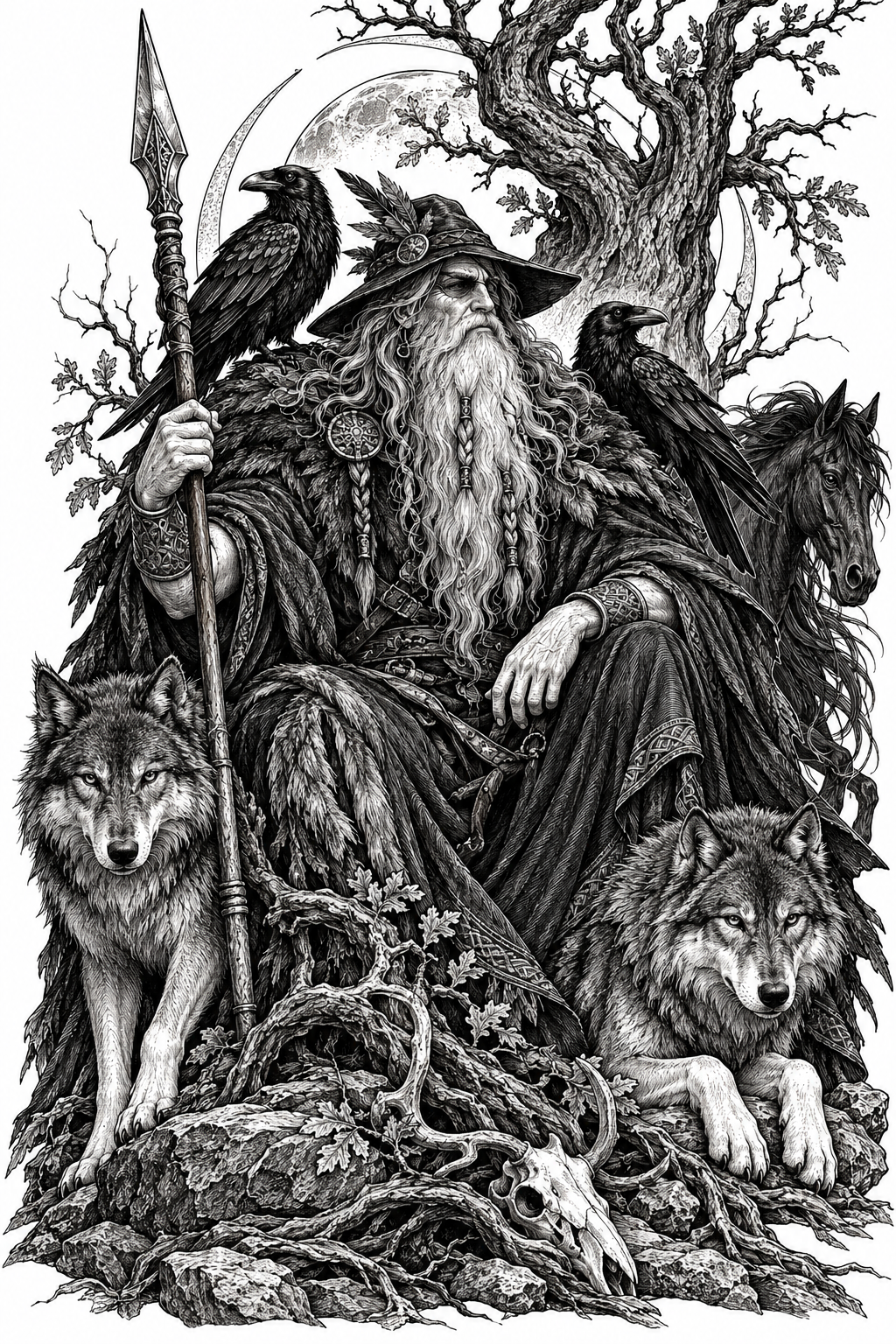
- Huginn and Muninn
- Geri and Freki
- Gungnir
- Sleipnir
- Runes
- Hanging and tree ordeal
- Poetry and mead
- Disguise and many names
Offerings
- Modern: poetry or spoken recitation
- Modern: time devoted to learning
- Modern: mead, wine, a nonalcoholic drink, bread, food, or water
- Modern: a candle or safely used incense
- Modern: responsible charitable support or a completed course of study
Aspects
- One-eyed seeker of wisdom
- Wanderer and disguised stranger
- Patron of poetry and runic knowledge
- Ruler of Valhalla
- Practitioner of seiðr in medieval sources
Magical / Spiritual Work
- Study and knowledge-seeking
- Poetry and deliberate language
- Historically informed rune study
- Leadership and difficult questions
- Safe sacrifice through time, service, or discipline
- Ethical raven observation
⚠ Important Context
The fullest narratives were written down in medieval Iceland after Christianization. Odin’s rune ordeal is myth, not a safety instruction; Valhalla is not the destination of every fallen warrior; modern correspondences are not ancient Norse facts.
Sacred Days / Festivals / Times
Wednesday — linguistically connected to Woden/Odin in English · No historically required Moon phase
Devotional Approach
Use study, poetry, historically informed rune learning, deliberate questions, and safe forms of disciplined giving while labeling modern practice as contemporary.
Core Correspondences
Page 2 of 2
Deeper Reading
OVERVIEW
Odin is difficult to reduce to a single title. He is a god of wisdom, poetry, magic, war, kingship, death, prophecy, runes, ecstatic inspiration, and relentless knowledge-seeking. His stories rarely present wisdom as something received passively. Again and again, Odin travels, bargains, sacrifices, disguises himself, questions the dead, seeks out seeresses, and gives up something valuable in exchange for knowledge. In Old Norse literature he belongs to the Æsir and is frequently presented as a leader among the gods. Later medieval sources call him Allfather, but that title should not be used to flatten the diversity of pre-Christian Germanic religion into a single universal hierarchy. Odin’s importance also extends beyond Scandinavia. Related forms of the god appear across Germanic-language traditions. The Old English Woden survives indirectly in the English weekday name Wednesday, historically “Woden’s day.” The surviving evidence for Odin comes from several kinds of sources: • Eddic poetry • skaldic poetry • Snorri Sturluson’s Prose Edda • sagas • place-name and linguistic evidence • archaeological objects and images • later historical descriptions These sources do not all come from the same period or religious setting, so they should not be treated as one perfectly uniform “Viking Bible.”
NAMES & IDENTITY
Odin is famous for having many names. Old Norse poetry uses numerous bynames and poetic names for him, reflecting his changing roles: wanderer, war god, disguised stranger, ruler, poet, sorcerer, seeker of knowledge, and god of the slain. This multiplicity is important. Odin is frequently a god in motion. He conceals his identity, takes other names, enters dangerous places, tests people, asks questions, and seeks information. Rather than signaling inconsistency, the many names fit a deity whose mythology repeatedly centers on hidden identity and knowledge gained through crossing boundaries.
ODIN IN THE SOURCES
Our most detailed surviving narratives were written down after Scandinavia had become Christian. The Prose Edda, compiled by Snorri Sturluson around the early thirteenth century, preserves a vast amount of mythic material but also reflects the literary and Christian environment in which Snorri wrote. The Poetic Edda survives in medieval manuscripts compiled later, though many individual poems preserve older poetic traditions. Skaldic poetry can preserve pre-Christian material but is often dense, allusive, and difficult to interpret without later explanatory texts. Because of this, statements about Odin should distinguish: • what a specific poem or medieval author says • what appears broadly in several sources • what modern practitioners later developed
ODIN'S ONE EYE & MÍMIR'S WELL
Odin’s missing eye is one of his clearest identifying features. In Snorri’s Gylfaginning, Mímir’s well lies beneath one of the roots of Yggdrasil and contains wisdom and understanding. Odin seeks a drink from the well and leaves one of his eyes as a pledge. The story captures one of Odin’s central mythic themes: knowledge has a cost. Odin does not receive wisdom because he is already all-knowing. He actively seeks it and gives something of himself to obtain it. The one-eyed Odin also has support in material culture. A Viking Age bronze figurine from Lindby, Sweden, has one eye visibly altered or deformed and is interpreted by the Swedish History Museum as probably representing Odin. The archaeological identification is cautious rather than absolute, but it fits the strong literary tradition of the one-eyed god.
HUGINN & MUNINN — THE RAVENS
Odin’s two ravens are: • Huginn — commonly interpreted as Thought / Mind • Muninn — commonly interpreted as Memory / Mind / Remembrance, depending on translation nuance In Grímnismál and Snorri’s Gylfaginning, the ravens travel over the world and return with knowledge. Snorri describes them sitting on Odin’s shoulders and telling him what they have seen and heard. The ravens are therefore more than decorative birds. They belong to Odin’s identity as a god who gathers information constantly. Modern practitioners often use raven imagery for thought, memory, observation, messages, intelligence, and the search for hidden knowledge. Those modern uses make sense symbolically but should still be distinguished from the exact wording of medieval sources.
GERI & FREKI — THE WOLVES
Odin’s wolves are Geri and Freki. In Grímnismál and the Prose Edda, Odin gives them the food from his table while he himself is described as living on wine. The wolves reinforce Odin’s connection with: • battle • the dead • predatory power • the wild • the feast after conflict But the mythology does not require every modern Odin altar to contain wolf imagery. They are specific mythic companions, not a commandment for practice.
SLEIPNIR
Sleipnir is Odin’s extraordinary eight-legged horse. Sleipnir is described as exceptionally swift and able to travel where ordinary horses cannot. He is also associated with movement between realms. The horse’s parentage is one of the stranger stories in Norse mythology: Loki, in mare form, gives birth to Sleipnir after luring away the stallion Svaðilfari. Sleipnir later becomes Odin’s mount. Eight-legged horse imagery appears in Viking Age Scandinavian picture stones, though individual identifications should remain cautious where inscriptions do not name the figure.
GUNGNIR — ODIN'S SPEAR
Odin’s spear is called Gungnir. It is one of his best-known weapons and symbols. Odin’s relationship with the spear reaches beyond combat. In mythic and ritual imagery, the spear can also connect with dedication to Odin, sacrifice, and the choosing of battle-dead. Hávamál describes Odin as wounded with a spear during his self-sacrifice on the tree. The spear should therefore be understood as both a weapon and part of a larger symbolic complex around war, offering, death, and knowledge.
THE RUNES & ODIN'S SELF-SACRIFICE
One of Odin’s most important myths appears in Hávamál. The speaker describes hanging on a windswept tree for nine nights, wounded by a spear, offered to Odin—himself to himself. He receives no food or drink. At the end of the ordeal, he perceives and takes up the runes, then falls from the tree. The poem does not present this as a casual lesson in rune reading. It is a myth of extreme knowledge-seeking through self-sacrifice. Modern rune practice is much broader and more systematized than the description in Hávamál. The poem establishes Odin’s relationship with runic knowledge, but it does not hand down a complete modern divination manual. Safety This myth should never be used as instruction to imitate hanging, starvation, blood loss, or dangerous ordeal practice. The spiritual theme can be approached symbolically: • What are you willing to give up to learn? • What assumptions must be surrendered? • What knowledge changes the person who receives it?
MÍMIR & THE PURSUIT OF WISDOM
Odin’s relationship with Mímir reinforces the same theme seen in the rune ordeal. Wisdom must be sought. Odin repeatedly pursues information from beings who possess knowledge he does not. This matters because modern summaries sometimes call him “the god of wisdom” in a way that makes him sound serenely omniscient. His mythology is more restless than that. Odin is powerful because he keeps seeking.
THE MEAD OF POETRY
Another major Odin story concerns the Mead of Poetry. In Snorri’s telling, the mead ultimately comes from the blood of Kvasir and gives poetic or scholarly ability to those who drink it. Odin obtains the mead through disguise, cunning, seduction, transformation, and escape. He eventually returns to the gods in eagle form carrying the mead. The story links Odin with: • poetry • eloquence • inspiration • cunning • theft and acquisition of knowledge • transformation • the dangerous pursuit of exceptional ability Odin’s relationship with poetry is therefore not merely peaceful artistic patronage. It is tied to power, competition, and possession of rare knowledge.
WAR, THE DEAD & VALHALLA
Odin is strongly associated with war and the dead. He rules Valhalla, the hall of the slain, where selected fallen warriors—the einherjar—prepare for Ragnarök. The Valkyries are involved in choosing and bringing battle-dead warriors. However, not every fallen warrior belongs to Odin in all sources. In Grímnismál, Freyja receives half of those slain in battle, while Odin receives the other half. That distinction matters because modern summaries often incorrectly say that every warrior killed in battle automatically goes to Valhalla. Odin’s warlike character is also not the same as simple protection. He can grant victory, but he can also withdraw it. His mythic relationship with battle is closely connected to fate, death, selection, kingship, and the gathering of warriors for the final conflict.
ODIN, MAGIC & SEIÐR
Medieval Icelandic sources strongly associate Odin with magic. In Ynglinga saga, Snorri describes Odin as practicing seiðr, a form of magic associated with prophecy and influencing events. The same passage also reflects medieval Icelandic ideas about gender and social reputation, saying that this form of magic carried stigma for men. This material should be handled carefully. It is useful evidence for the medieval Norse tradition connecting Odin with seiðr, but Ynglinga saga is a thirteenth-century literary source and also presents the gods through a euhemerizing framework. Modern practitioners should not pretend we possess a complete unchanged Viking Age seiðr manual from Odin. A historically responsible approach distinguishes: • medieval literary description • archaeological interpretation • reconstructed modern practice
ODIN & THE VÖLVA
In Völuspá, Odin seeks knowledge from a seeress, or völva. She speaks about the creation of the world, the gods, and the catastrophe of Ragnarök. The scene once again shows Odin not simply possessing all knowledge, but going to someone else because she knows what he wants to learn. The National Museum of Denmark highlights this episode in its discussion of Viking seeresses: Odin himself seeks the völva’s knowledge of the future.
RAGNARÖK
At Ragnarök, Odin fights the wolf Fenrir. Odin is killed and swallowed by Fenrir. His son Víðarr then avenges him by killing the wolf. The death of Odin is one of the clearest reminders that Norse gods are not presented as infinitely invulnerable or outside fate. Even the great seeker of knowledge cannot escape the final doom foretold for him.
HISTORICAL WORSHIP & SOCIAL CONTEXT
Odin appears to have been especially important in elite, warrior, poetic, and rulership contexts. The National Museum of Denmark describes him as particularly associated with kings, warrior chieftains, and their men. The Swedish History Museum similarly emphasizes Odin’s relationship with rulers, warriors, wisdom, the dead, and elite culture. This should not be turned into the claim that ordinary people never worshipped Odin. Pre-Christian Scandinavian religion varied across time, region, social class, household, and local community. Thor appears to have had extremely broad popular importance, while Odin’s surviving literary and archaeological profile often has a more aristocratic, martial, or specialist character.
ARCHAEOLOGICAL & VISUAL EVIDENCE
Lindby one-eyed figurine A Viking Age bronze figurine found at Lindby in Skåne has one eye altered/deformed and is interpreted by the Swedish History Museum as probably representing Odin. Gotland picture stones Eight-legged horse imagery on Gotland picture stones has often been interpreted in relation to Sleipnir and Odin. Because many prehistoric images are not labelled, specific identifications should remain careful rather than absolute. Raven imagery Bird imagery in Viking and Anglo-Scandinavian contexts can sometimes be associated with Odin, but individual birds are not automatically “Odin’s raven.” The British Museum notes this ambiguity when discussing Viking-age imagery: a bird may be interpreted as Odin’s raven in some contexts, but other meanings can also be possible.
SYMBOLS & ATTRIBUTES
Strongly historically grounded • one eye • ravens Huginn and Muninn • wolves Geri and Freki • spear Gungnir • eight-legged horse Sleipnir • Valhalla • Valkyries • runes • hanging/tree ordeal • poetry and poetic inspiration • disguise / many names • wisdom-seeking • magic • war • the dead • prophecy • mead / wine in mythic contexts Useful but context-dependent • staff or wanderer imagery • cloak • broad-brimmed hat • throne/high-seat imagery • eagle and serpent imagery through specific myths Do not convert every poetic motif into a fixed universal altar symbol.
MODERN DEVOTIONAL PRACTICE
Modern Heathens, Pagans, occultists, witches, reconstructionists, and independent practitioners approach Odin in different ways. Some emphasize: • historical Norse religion • poetry • runes • wisdom • scholarship • leadership • war and the dead • ecstatic practice • spirit work • sacrifice understood as disciplined giving • truth-seeking • confronting uncomfortable knowledge Modern practice should be clear about what is reconstructed and what is newly developed. A practitioner can build a meaningful relationship with Odin without claiming that every modern devotional act is archaeologically attested.
MODERN OFFERINGS
No single universal Odin offering list can be reconstructed for every time and place. Modern offerings may be chosen because they resonate with literary traditions or contemporary practice. Possible contemporary offerings: • poetry • written study • a spoken recitation • time devoted to learning • mead or wine, where legal and appropriate • nonalcoholic drink if preferred • bread or other simple food • clean water • incense used safely • a candle or lamp • a written promise to complete a difficult course of study • feeding or supporting local corvids responsibly without habituating or harming wildlife • charitable support for literacy, education, veterans, or appropriate causes chosen by the practitioner Wine is mythically associated with Odin in the Eddic tradition, but that does not mean alcohol is spiritually required.
CONTEMPORARY CORRESPONDENCES
These are MODERN correspondences, not a single ancient Norse system. Colors: deep blue, black, gray, silver, dark red Day: Wednesday is linguistically connected to Woden/Odin in English tradition Themes: wisdom, knowledge-seeking, runes, poetry, leadership, magic, war, death, prophecy, sacrifice, transformation Element: no universal historical elemental assignment Planet: modern occult systems sometimes connect Odin/Woden with Mercury, but this is later correspondence rather than Viking Age doctrine Moon phase: none historically required Tarot: no ancient correspondence Chakra: not part of pre-Christian Norse religion Sacred number: nine is strongly recurrent in Odin-related mythology, but avoid pretending it functions as a single universal numerological rule Modern crystal choices Not ancient sacred stones: • Obsidian — modern shadow/death symbolism • Clear Quartz — modern knowledge/clarity symbolism • Labradorite — modern liminality/magic symbolism • Hematite — modern war/grounding symbolism Modern botanical choices Do not invent a fixed ancient “Odin herb list.” Modern botanical choices remain contemporary unless a specific historical source supports the connection.
WAYS TO WORK WITH ODIN
Study as devotion Choose a difficult subject and commit to understanding it instead of collecting surface-level facts. Odin’s myths repeatedly reward persistence in the pursuit of knowledge. Poetry practice Write a poem, spoken piece, prayer, or story. The quality does not need to be perfect. The devotional act is using language deliberately. Rune study Study the historical runic alphabets and inscriptions before moving immediately into modern divination meanings. Keep separate: • historical epigraphy • medieval rune lore • modern divination systems Question practice Instead of asking only for answers, write better questions. Odin’s stories often involve seeking the person or place capable of answering what he does not know. Sacrifice without harm Choose a meaningful but safe sacrifice: • time • convenience • ego • a bad habit • money donated responsibly • commitment to finish study or service Do not imitate Odin’s hanging ordeal physically. Raven observation Observe local corvids ethically and from a distance. Do not feed inappropriate food, interfere with nests, or treat wild birds as supernatural props.
ORIGINAL MODERN DEVOTIONAL PRAYER
This is original Black Cat Curiosity Co. devotional writing, not a historical prayer. Odin, wanderer of the long road, one-eyed seeker, keeper of questions that do not yield easily— teach me to value knowledge enough to work for it. Let me see where certainty has made me careless. Let me recognize what I do not know. Give me patience to learn, courage to ask, and wisdom to change when better understanding arrives. Raven-God, keeper of memory and thought, let my words have weight. Let my promises be deliberate. Let sacrifice mean something because I chose it with care. May I seek without pretending I already possess the answer.
RESPECTFUL PRACTICE & IMPORTANT CONTEXT
The sources are layered Much of what we know was written down in medieval Iceland after Christianization. Some poetic material is older, but no surviving source is a complete untouched transcript of Viking Age religion. Odin is not Marvel's Odin Modern entertainment versions can be enjoyable, but they are not historical source material. Horned helmets are not an Odin requirement Do not use nineteenth-century fantasy Viking stereotypes as historical iconography. Runes require context Odin’s relationship with runes is ancient, but modern rune-divination systems are later developments. Valhalla is not the universal Norse afterlife Norse sources preserve multiple destinations and ideas concerning the dead. “Allfather” needs nuance The title is important in medieval literature, but it should not erase regional variation or be used to reconstruct a single uniform ancient hierarchy. Seiðr needs caution Modern practice may draw inspiration from medieval descriptions, but reconstruction should not be presented as complete continuity.
SAFETY & CARE
Odin’s myths include hanging, spear-wounding, deprivation, battle, death, altered states, and magical ordeal. These are mythic and historical themes—not modern safety instructions. Do NOT: • imitate hanging • cut or stab yourself • fast dangerously • intentionally dehydrate • combine intoxicants with unsafe ritual activity • enter traffic, wilderness, fire, heights, or weapons situations to imitate “ordeals” • use wildlife unsafely in devotional practice Modern sacrifice can be meaningful without injury.
Notes & Personal Connection
Explore This Entry
Keep This Grimoire Entry
Print every generated page in order, single-sided or front and back.
Download to Print