Deity Grimoire
Loki
Mythic figure associated with the Æsir · Shapeshifter and boundary-crosserDomains
- Cunning and deception
- Problem-solving
- Shape-shifting
- Boundary crossing
- Transformation
- Social disruption
- Cooperation and opposition
Symbols
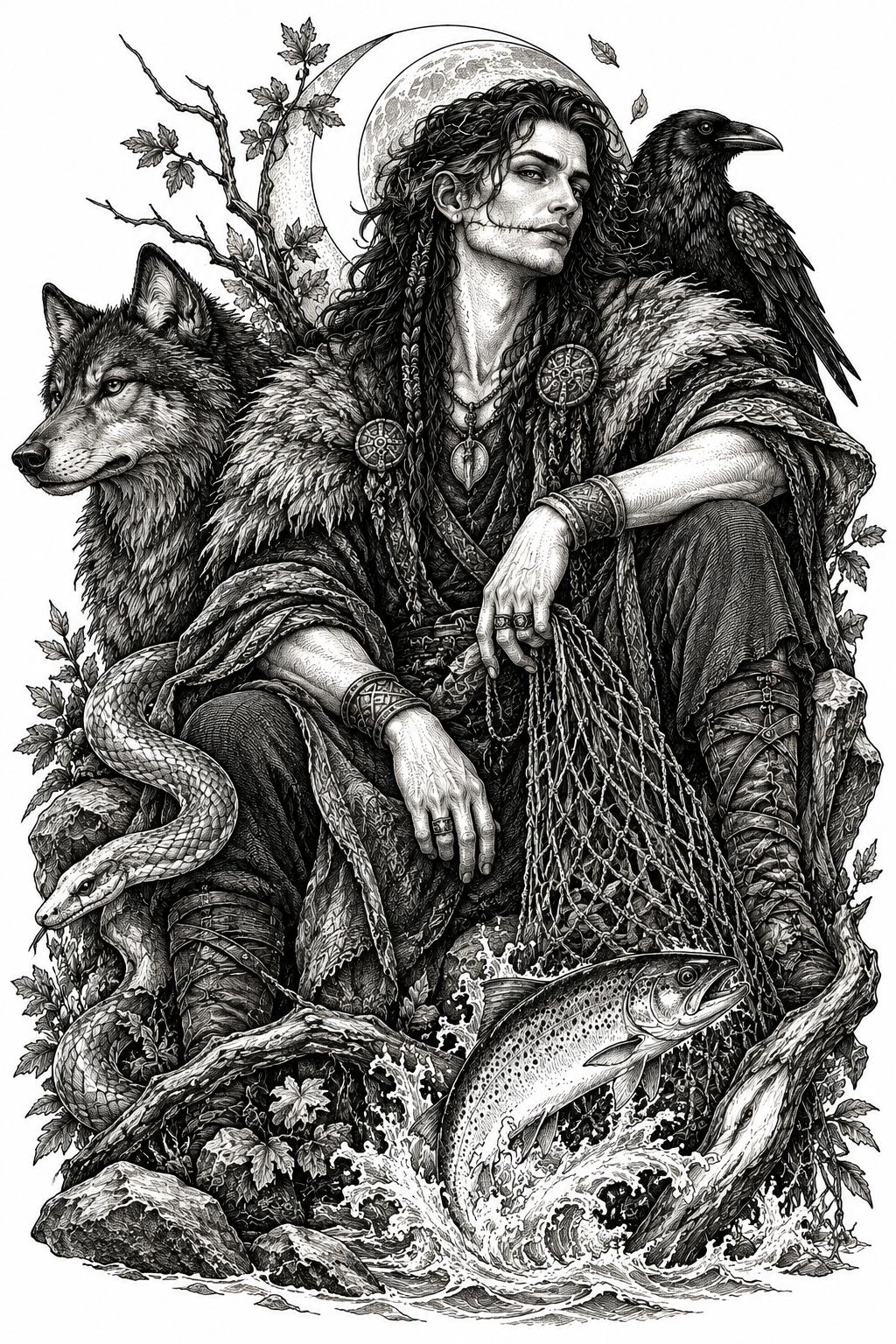
- Sewn mouth
- Net and salmon
- Shape-shifting
- Vartari
- Sleipnir through the mare story
- Serpent and binding imagery
Offerings
- No securely attested standardized historical offering system
- Modern: clever or handmade work
- Modern: devotional writing or humor
- Modern: simple food or drink
- Modern: honest acts of change
Aspects
- Son of Fárbauti and Laufey/Nál
- Companion and opponent of the gods
- Father of Fenrir, Jörmungandr, and Hel
- Mother of Sleipnir
- Bound figure at Ragnarök
Magical / Spiritual Work
- Adaptability
- Creative problem-solving
- Transformation
- Questioning rigid roles
- Boundary reflection
- Accountability after disruption
⚠ Important Context
Loki is not securely an ancient fire god, and “god of chaos” is modern shorthand rather than a medieval title. He helps and harms the gods, while Snorri names giant parentage.
Sacred Days / Festivals / Times
No historically required Moon phase
Devotional Approach
Approach Loki through source study, adaptability, creative problem-solving, honest accountability, and clearly labeled contemporary devotion rather than invented ancient certainties.
Core Correspondences
Page 2 of 2
Deeper Reading
OVERVIEW
Loki occupies an unusual place in Norse mythology. He is neither simply an outsider nor simply one of the gods. He travels with the Æsir, shares their feasts, solves crises for them, obtains important treasures, and appears as a companion to figures such as Thor and Odin. At other times he humiliates, betrays, insults, endangers, or directly harms the gods. This unstable position is one reason later readers call Loki a trickster, but “trickster” is a modern comparative label rather than a formal Old Norse divine office. The same is true of “god of chaos.” Chaos is a useful modern shorthand for some aspects of Loki’s disruptive behavior, but the surviving medieval sources do not present him with a simple title meaning “god of chaos.” The safest way to understand Loki is through what the stories actually show: • extraordinary cunning • deception • problem-solving • shape-shifting • social disruption • transgression • movement across gender and species boundaries • participation in both divine rescue and divine destruction
SOURCE CONTEXT
Most detailed surviving Loki narratives were written down in medieval Iceland after Christianization. Major sources include: • the Poetic Edda • Snorri Sturluson’s Prose Edda • later saga and skaldic material • limited archaeological/visual evidence such as the Snaptun stone These sources are not one uniform document. A responsible page should distinguish: • poetic evidence • Snorri’s systematized prose mythology • archaeological interpretation • later modern reconstruction This matters especially for Loki because his role becomes increasingly destructive in some later narrative frameworks.
FAMILY & PARENTAGE
In Snorri’s Gylfaginning: Father: Fárbauti Mother: Laufey or Nál Brothers: Býleistr and Helblindi Unlike many major gods, Loki is named through his mother in the familiar form Loki Laufeyjarson. That alone makes his identity unusual within the literary tradition. Wife • Sigyn Snorri names Sigyn as Loki’s wife. Child with Sigyn • Nari / Narfi in differing manuscript/source forms Children with Angrboða Snorri names: • Fenrir • Jörmungandr, the Midgard Serpent • Hel These children become central figures in the mythic destruction associated with Ragnarök. Sleipnir Loki also becomes the mother of Sleipnir, Odin’s eight-legged horse. This happens after Loki takes the form of a mare and draws the stallion Svaðilfari away from the builder of Ásgard’s fortification. The story is one of the clearest examples of Loki crossing both species and gendered reproductive roles.
LOKI AMONG THE GODS
Loki repeatedly appears among the Æsir even though Snorri gives him giant ancestry. He is a companion, guest, helper, rival, and eventual enemy. In Lokasenna, Loki reminds Odin that the two once mixed their blood and that Odin had promised not to accept drink unless it were offered to both of them. The poem preserves the claim, but no surviving myth tells us the full story of that blood-mixing bond. This is a good example of how Norse mythology often preserves fragments of traditions that are otherwise lost.
CUNNING, CRISIS & PROBLEM-SOLVING
Loki frequently causes the crisis and then becomes the person capable of solving it. That pattern appears again and again. He may: • give dangerous advice • make a reckless wager • steal or damage something • betray information • create a situation that threatens the gods Then, under threat or pressure, he uses intelligence, disguise, movement, persuasion, or transformation to repair what happened. This does not make him secretly harmless. It makes him narratively unstable. The same cunning can save the gods in one story and destroy them in another.
SIF’S HAIR & THE TREASURES OF THE GODS
In Skáldskaparmál, Loki cuts off Sif’s hair. Thor threatens him, and Loki promises to have the dwarfs create replacement hair of gold. That crisis expands into a contest of craftsmanship. The resulting treasures include: • Sif’s golden hair • Skíðblaðnir • Gungnir • Gullinbursti • Draupnir • Mjölnir Loki’s role is therefore paradoxical. His destructive prank ultimately leads to some of the most important treasures in Norse mythology.
THE SEWN MOUTH
The same treasure-making story leads to one of Loki’s most distinctive visual motifs. Loki wagers his head against the dwarf Brokkr and loses. He escapes decapitation through a technical argument: Brokkr may take the head, but Loki says he has no right to the neck. Brokkr instead pierces Loki’s lips and stitches his mouth closed. Snorri names the thong used in the stitching Vartari. A famous carved stone from Snaptun, Denmark, generally interpreted as depicting Loki, shows a face with scarred or sewn-looking lips and is commonly connected with this myth. This is one of the strongest archaeological/visual anchors available for Loki.
THE SNAPTUN STONE
The Snaptun stone is an important piece of Viking Age material culture associated with Loki. The National Museum of Denmark interprets the face on the stone as Loki with his mouth sewn shut. The object appears to have functioned as a hearth or bellows stone used in metalworking. That is especially interesting because the myth connected with Loki’s sewn mouth involves dwarfs, craftsmanship, and the production of divine treasures. However, one object is not enough to prove a universal historical iconography or cult. The Snaptun interpretation is presented carefully; one object cannot establish what all Viking Age communities believed Loki looked like.
SHAPE-SHIFTING
Loki changes shape repeatedly. The stories attribute to him forms that include: • mare • salmon • fly • bird forms through magical feather garments or disguise • human disguises of different genders Shape-shifting is therefore one of his strongest source-grounded characteristics. It is more historically defensible than trying to assign Loki a modern list of sacred crystals or fixed elemental correspondences. Transformation for Loki is not only cosmetic. Changing form changes what he can do, where he can go, and how he can escape rules that apply to ordinary bodies.
SLEIPNIR & THE MARE FORM
When the gods hire a builder to fortify Ásgard, Loki advises allowing the builder to use his stallion Svaðilfari. The horse makes the work progress so quickly that the gods fear they will have to pay the promised price. They blame Loki and demand that he stop the builder from finishing. Loki transforms into a mare and lures Svaðilfari away. The work is delayed. Later, Loki gives birth to the eight-legged horse Sleipnir, who becomes Odin’s mount. This story should not be erased because it complicates modern assumptions about Loki’s gender. At the same time, modern readers should avoid forcing present-day identity labels backward onto an ancient myth as though the medieval sources used those categories. A respectful modern discussion can acknowledge the genuine gender-crossing material without pretending the source says more than it does.
LOKI, THE SALMON & THE NET
After the gods turn against Loki, Snorri describes him hiding near a waterfall. He invents or works with a net and later transforms into a salmon in an attempt to escape. The gods use the net to capture him. This is why net and salmon imagery are useful for Loki when historically grounded through this specific myth. They are not universal “sacred animals” or altar requirements. They are narrative symbols connected with escape, invention, pursuit, and capture.
LOKASENNA — LOKI’S WRANGLING
Lokasenna is one of the most important poetic sources for Loki. At Ægir’s feast, Loki enters into an extended exchange of insults with the gods and goddesses. He accuses them of hypocrisy, cowardice, sexual misconduct, and broken honor. The poem is aggressive, comic, socially dangerous, and full of mythic references—some of which are not preserved anywhere else. Modern readers sometimes treat every accusation as literal historical truth about the gods. That goes too far. Lokasenna belongs to a tradition of insult contest and mythic poetry. Its value lies partly in the tensions it exposes: • reputation • sexuality • masculinity • honor • hypocrisy • social belonging • exclusion Loki is dangerous in the poem because he weaponizes knowledge and speech.
LOKI & ODIN
Lokasenna preserves Loki’s claim that he and Odin once mixed blood. This is often summarized as “Loki is Odin’s blood brother.” That summary is reasonable as a description of the poem’s claim, but the underlying ceremony is not narrated in a surviving source. The relationship between Loki and Odin is therefore important but incomplete. Do not invent a detailed oath ritual that the surviving text does not preserve.
BALDR’S DEATH
In Snorri’s Gylfaginning, Loki becomes central to Baldr’s death. After learning that mistletoe has not sworn the oath protecting Baldr, Loki obtains it and gives it to the blind Höðr. Loki guides Höðr’s throw. Baldr dies. This story marks a major shift in Loki’s narrative role. Earlier stories often show him creating a problem and then fixing it. Here, the consequences move toward irreversible catastrophe. Source caution matters. Baldr’s death is preserved across multiple traditions, but the exact degree and shape of Loki’s responsibility varies across the surviving material and later retellings. In Snorri’s account, Loki is central to Baldr’s death, while surviving traditions differ in how they preserve the story and Loki’s degree of responsibility.
THE BINDING OF LOKI
After the events surrounding Baldr and the breakdown between Loki and the gods, Loki is captured and bound. Snorri’s account tells of: • Loki being tied to rocks • a serpent placed above him • venom dripping downward • Sigyn remaining beside him with a vessel to catch the venom • moments when she must empty the vessel and the venom reaches Loki • Loki’s violent reaction being associated with earthquakes The imagery is also reflected in Völuspá, which describes Loki bound with Sigyn beside him. This is one of the strongest examples of Sigyn’s loyalty in the surviving mythic tradition. It should not be converted into a modern recommendation to imitate ordeal, restraint, venom, pain, or deprivation.
RAGNARÖK
Loki remains bound until Ragnarök. In Snorri’s account, when the final conflict arrives: • bonds break • Loki goes with the hostile forces • he enters the final battle • Loki and Heimdallr fight one another • each kills the other Loki’s story therefore ends on the opposite side of the gods with whom he once travelled. That arc is part of what makes him so difficult to classify. He is neither consistently friend nor consistently enemy across the mythology.
LOKI IS NOT SECURELY A “FIRE GOD”
The idea that Loki is a Norse fire god is common in modern popular writing. The surviving medieval sources do not give him a straightforward title or domain as “god of fire.” The resemblance between Loki and Logi, a personification of fire in the Útgarða-Loki story, has encouraged confusion, but they are distinct figures in that narrative. Some older scholarship proposed elemental/fire interpretations of Loki. Those theories belong to the history of scholarship and should not be presented as settled historical fact. Loki is not securely attested as an ancient fire god. The similarity between Loki and Logi, a personification of fire in the Útgarða-Loki story, has contributed to later confusion, but they are distinct figures in that narrative.
CULT & HISTORICAL WORSHIP
Loki is extremely important in the surviving mythology, but evidence for a distinct organized historical cult devoted specifically to Loki is limited and debated compared with gods such as Thor, Odin, Freyr, and Freyja. This does not prove that nobody ever honored Loki. Absence of extensive surviving evidence is not the same as proof of absence. The limited evidence does not support inventing: • standardized Loki temples • universal historical Loki priesthoods • fixed ancient offering lists • archaeological certainty where none exists The strongest historical evidence for Loki is literary and mythic, with limited visual/material evidence such as the Snaptun stone.
SYMBOLS & ATTRIBUTES
Strongly source-grounded narrative symbols • sewn or scarred lips • net • salmon • shape-shifting • Sleipnir through the mare episode • Fenrir • Jörmungandr • Hel • Sigyn • mistletoe through Snorri’s Baldr narrative • cunning speech • disguise • boundary crossing • transformation • conflict with Heimdallr • binding / serpent / venom imagery Important caution Fenrir, Jörmungandr, Hel, ravens, wolves, snakes, and horses are not automatically “sacred animals of Loki.” Some are Loki’s children or appear in specific myths. Narrative relationship is not the same thing as cult correspondence.
MODERN DEVOTIONAL PRACTICE
Modern Heathens, Pagans, witches, occultists, queer practitioners, and independent devotees approach Loki in many different ways. Contemporary themes may include: • transformation • adaptability • humor • uncomfortable truth • outsider identity • questioning rigid social rules • creative problem-solving • survival through intelligence • identity beyond simple categories • living with contradiction • rebuilding after disruption These are modern devotional interpretations. They can be meaningful without being mislabeled as Viking Age doctrine.
CONTEMPORARY OFFERINGS
No single historically attested universal Loki offering list survives. Modern offerings should therefore be clearly labeled contemporary. Possible choices: • a spoken poem or humorous story • written reflection • food or drink offered according to personal practice • a candle or lamp used safely • crafted objects • knots, thread, or net imagery • an act of problem-solving • support for outsiders or marginalized people • a deliberately funny or irreverent devotional gift • study of the original sources No specific offering is required.
CONTEMPORARY CORRESPONDENCES
These are MODERN correspondences, not reconstructed ancient facts. Colors: red, black, green, gold, smoke-gray Themes: change, transformation, cunning, disruption, truth-telling, adaptability, boundaries, identity Element: no secure universal ancient element; “Fire” is a common modern assignment but historically uncertain Planet: no historically required planet Moon phase: none historically required Tarot: no ancient correspondence Chakra: not part of Norse religion Sacred number: no universal historically established Loki number Modern crystal choices Not ancient sacred stones: • Obsidian — modern transformation/shadow symbolism • Labradorite — modern liminality/change symbolism • Carnelian — modern action/creativity symbolism • Clear Quartz — modern clarity/adaptability symbolism Modern botanicals Do not invent a fixed ancient Loki herb list. Modern practitioners may choose botanicals according to personal symbolism, later folklore, or ritual intention, but they should remain labeled contemporary unless a historical source supports the connection.
WAYS TO WORK WITH LOKI
Contradiction journaling Write two things about yourself that seem incompatible. Ask: • Do they actually contradict each other? • Who taught me that only one could be true? • What changes if I stop forcing myself into one category? Problem-solving devotion Take one practical problem and deliberately find three different ways to solve it. Loki’s stories repeatedly center ingenuity under pressure. Source study Read one myth in more than one translation. Notice how translation choices change the tone. For Loki especially, this helps prevent modern social-media summaries from becoming the only version of the story. Humor as release Use humor carefully to break tension without using it to avoid accountability. Loki’s mythology repeatedly shows that cleverness can solve problems—but cleverness also has consequences. Transformation ritual Choose one habit, identity story, or assumption that no longer fits. Symbolically change its form: • rewrite it • tear up and recycle a written version • rework an object • turn old material into something useful Keep the ritual safe and practical.
ORIGINAL MODERN DEVOTIONAL PRAYER
This is original Black Cat Curiosity Co. devotional writing, not a historical prayer. Loki, walker between categories, speaker where silence becomes too comfortable, shape-changer and problem-maker, problem-solver and boundary-crosser— teach me to recognize when cleverness is wisdom and when it is only escape. Help me question what deserves questioning without destroying what deserves care. Show me the difference between changing shape to survive and changing myself only to be accepted. When the road closes, help me notice another path. When I cause harm, help me face the consequence. When I am told I must be only one thing, remind me that a life can hold contradiction.
RESPECTFUL PRACTICE & IMPORTANT CONTEXT
Loki is not simply “the Norse devil” Later narratives place him against the gods, but Norse mythology does not map neatly onto Christian Satan-versus-God theology. Loki is not securely a fire god Do not turn an older scholarly theory or name confusion with Logi into established fact. “Chaos god” is modern shorthand It may be useful as a contemporary interpretation, but it is not a formal Old Norse title. Shape-shifting is central Loki crosses species and gendered forms in the surviving stories. That fact should not be erased. Modern identity language is modern Contemporary queer or gender-expansive readings can be meaningful while still being identified as modern interpretations. Historical cult evidence is limited Do not fabricate ancient offerings, temples, or priesthood. Source layers matter Snorri’s Loki and poetic Loki overlap, but the texts are not identical in purpose or date.
SAFETY & CARE
Loki’s stories include: • violence • binding • poison • bodily injury • dangerous wagers • deception • ordeal • death These are narrative themes—not ritual instructions. Do NOT: • imitate binding or hanging • use venom or poisonous plants • cut, pierce, or stitch the body as devotional reenactment • use dangerous dares as “Loki tests” • manipulate or deceive other people in the name of devotion • harass wildlife because an animal appears in a myth • use alcohol or intoxicants unsafely Transformation does not require physical danger.
Notes & Personal Connection
Explore This Entry
Keep This Grimoire Entry
Print every generated page in order, single-sided or front and back.
Download to Print