Return to entryChecking Loki printable layout…
Deity Grimoire

Loki

Norse shapeshifter, cunning problem-solver, and boundary-crosser

Domains

  • Cunning and deception
  • Problem-solving
  • Shape-shifting
  • Boundary crossing
  • Transformation

Symbols

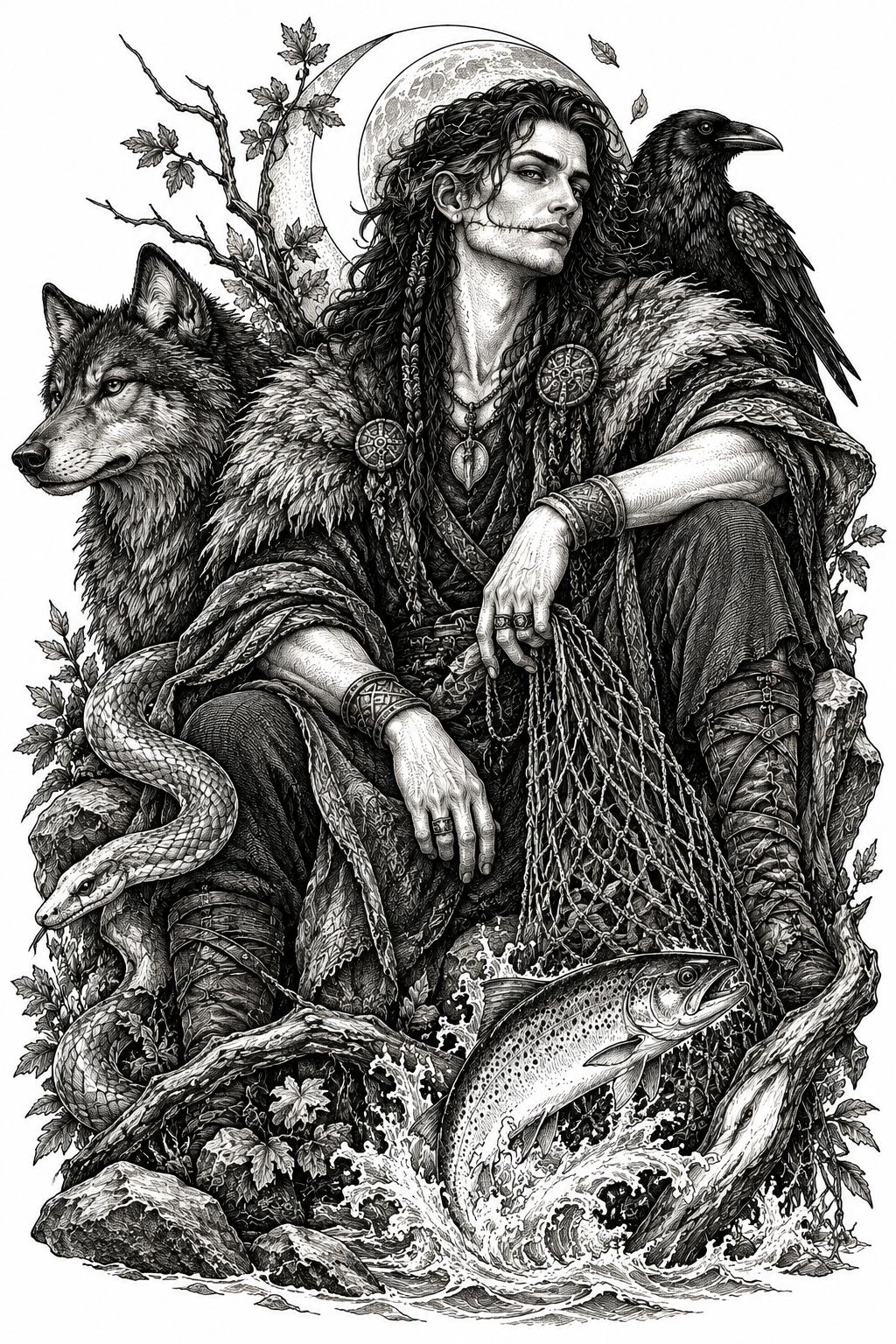
  • Sewn mouth
  • Net and salmon
  • Vartari
  • Mare and Sleipnir
  • Binding serpent

Offerings

  • Modern: clever handmade work
  • Writing or humor
  • Simple food or drink
  • An honest act of change

Aspects

  • Son of Fárbauti and Laufey/Nál
  • Lives and acts among the Æsir
  • Parent of Fenrir, Jörmungandr, Hel, and Sleipnir
  • Bound adversary at Ragnarök

Magical / Spiritual Work

  • Adaptability
  • Creative solutions
  • Transformation
  • Boundary reflection
  • Accountability

Important Context

Loki is not securely an ancient fire god or formally titled a god of chaos.

Sacred Days / Festivals / Times

No historically required Moon phase

Devotional Approach

Study the sources, practice adaptive thinking, make or repair something clever, and pair disruption with responsibility.

Core Correspondences

No fixed ancient color correspondence · Not securely an ancient fire god · No historically required planet

Deity Grimoire

Loki

Norse shapeshifter, cunning problem-solver, and boundary-crosser

Mythology, History & Important Context

Historical & Cultural Context

Loki belongs to Norse myth preserved mainly in medieval Icelandic texts after Christianization. Snorri names Fárbauti and Laufey/Nál as his parents. He acts among the Æsir without Æsir parentage.

Major Myths & Stories

After cutting Sif’s hair, Loki compels dwarfs to replace it and brings the gods treasures including Mjölnir, Gungnir, Draupnir, Gullinbursti, and Skíðblaðnir. A lost wager ends with Brokkr sewing Loki’s mouth. Loki repeatedly changes form and crosses gendered roles; as a mare, Loki draws away Svaðilfari and later bears Sleipnir. These stories show cleverness solving crises while also producing consequences.

Loki, the Salmon & the Net

Snorri describes Loki hiding near a waterfall, working with a net, and becoming a salmon to escape. The gods use the net to capture him. Net and salmon imagery therefore belongs to this specific story of invention, pursuit, escape, and capture—not to a universal sacred-animal system.

Lokasenna & Odin

In Lokasenna, Loki enters Ægir’s feast and weaponizes knowledge through an extended insult contest concerning honor, sexuality, reputation, hypocrisy, and belonging. The accusations belong to mythic poetry, not neutral biography. Loki also claims that he and Odin mixed blood, but no surviving source narrates the ceremony itself.

Baldr’s Death

In Snorri’s Gylfaginning, Loki learns that mistletoe has not sworn to protect Baldr, gives it to the blind Höðr, and guides his fatal throw. This moves Loki from reversible trouble toward catastrophe. Other surviving traditions vary, so Snorri’s account is identified rather than treated as one universal Norse version.

Binding & Sigyn

After Baldr’s death and the gods’ break with Loki, he is bound to rocks beneath a serpent. Sigyn remains beside him, catching venom in a vessel; when she empties it, the venom reaches Loki and his convulsions are linked with earthquakes. Völuspá also preserves bound Loki with Sigyn beside him. This is myth, not an ordeal practice to imitate.

Ragnarök

Loki remains bound until Ragnarök. Snorri places him with the hostile forces in the final battle, where Loki and Heimdallr kill one another. His path from companion and problem-solver to opponent resists a simple friend-or-enemy label.

Deity Grimoire

Loki

Norse shapeshifter, cunning problem-solver, and boundary-crosser

Mythology, History & Important Context

Important Historical Context

Loki is not securely attested as an ancient fire god, and “god of chaos” is modern shorthand rather than an Old Norse title. Literary evidence is strong, but evidence for a standardized historical Loki cult, temples, priesthood, festival calendar, or universal offerings is limited. Narrative figures and animals are not automatically sacred correspondences.

Later Interpretation / Important Context

Trickster is a useful modern comparative label; god of chaos and fire god are not secure Old Norse titles. Modern identity readings should acknowledge real gender-crossing material without projecting modern terms backward.

Personal Notes

Worship & Historical Practice

Evidence does not establish one standardized historical Loki cult, temple system, priesthood.

Working With Loki Today

Contemporary devotion may use source study, clever craft, humor, adaptive problem-solving, devotional.