Deity Grimoire
Thor
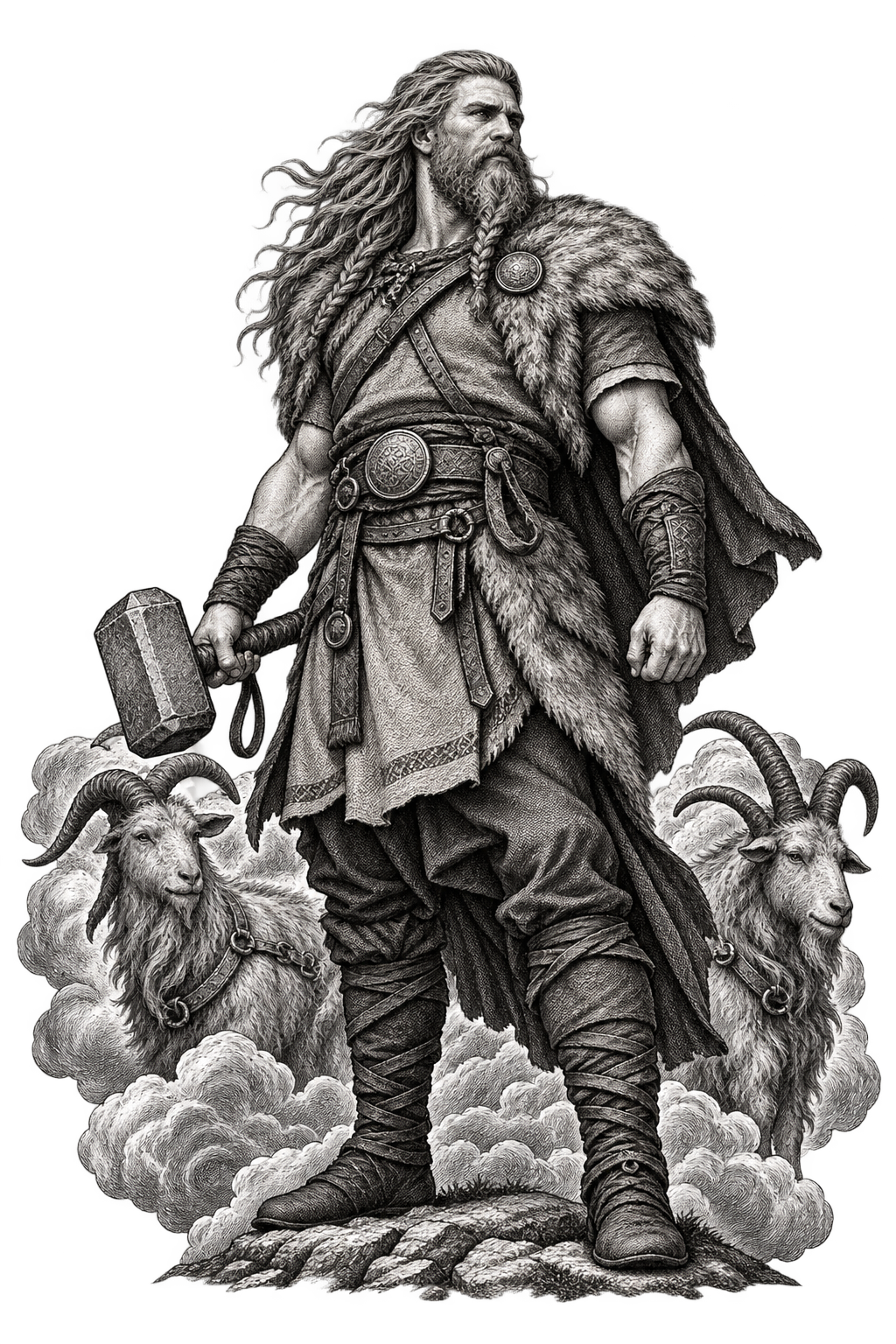
Norse god of thunder and protection · Defender of gods and humans · Bearer of MjölnirDomains
- Thunder
- Protection
- Strength
- Defense of gods and humans
- Battle against giants
- Fertility and blessing in some contexts
Symbols
- Mjölnir
- Goats Tanngnjóstr and Tanngrisnir
- Chariot
- Jörmungandr
- Iron gloves Járngreipr
- Strength belt Megingjörð
Offerings
- Historically contextual communal food and drink
- Modern: bread, food, or drink
- Modern: a hammer image or pendant
- Modern: acts of protection or service
- Modern: strength used responsibly
Aspects
- Son of Odin and Jörð
- Husband of Sif
- Father of Magni, Móði, and Þrúðr
- Bearer of Mjölnir
- Defender of Midgard
Magical / Spiritual Work
- Protection
- Courage
- Strength with purpose
- Defense of home and community
- Grounding
- Responsible leadership
⚠ Important Context
Thor is more than a war god. Historical evidence strongly emphasizes protection and defense; modern superhero imagery is not evidence for Norse religion.
Sacred Days / Festivals / Times
Thursday through linguistic connection to Thor · No historically required Moon phase
Devotional Approach
Honor Thor through source study, protective service, dependable action, responsible strength, and modern offerings clearly labeled contemporary.
Core Correspondences
Page 2 of 2
Deeper Reading
Name & Identity
Primary name: Thor Old Norse: Þórr Tradition: Old Norse / pre-Christian Scandinavian religion Divine group: Æsir Primary roles: thunder; protection; strength; defense of gods and humans; battle against giants; fertility and blessing in some historical interpretations Father: Odin in the surviving mythic tradition Mother: Jörð, personified Earth, in major textual traditions Wife: Sif Children named in surviving tradition: Magni, Móði, Þrúðr Primary weapon: Mjölnir Other famous possessions: iron gloves Járngreipr; belt Megingjörð Vehicle: chariot drawn by the goats Tanngnjóstr and Tanngrisnir Reader-facing overview Thor is one of the most prominent gods in surviving Old Norse religion and mythology. He is strongly associated with thunder, physical strength, protection, and the defense of the human and divine worlds against destructive powers. His hammer, Mjölnir, is his defining symbol. In myth, Thor uses it against giants and monstrous beings. Archaeologically, hammer-shaped amulets from the Viking Age show that Mjölnir also functioned beyond storytelling as a meaningful religious emblem. Thor’s role cannot be reduced to warfare. He appears as a protector of Midgard, a defender of order, a god invoked through the symbol of the hammer, and a deity with strong evidence of broad popularity in Viking-Age Scandinavia. Modern portrayals often emphasize his physical power, but the historical Thor is equally important as a guardian.
Historical & Cultural Context
Thor is known through a combination of: • medieval Icelandic literary sources; • skaldic poetry; • runic and inscriptional evidence; • place names; • visual monuments; • hammer amulets and other archaeological finds. The Poetic Edda and Prose Edda preserve many of his best-known myths. These texts were written down after Scandinavia had undergone Christianization, so they are essential but not uncomplicated witnesses to pre-Christian religion. Archaeological evidence is especially important for Thor because hammer pendants occur widely across the Viking world. The National Museum of Denmark describes Thor as one of the most popular gods and emphasizes his protective role, while Viking-Age hammer amulets provide material evidence that his symbol mattered in lived religion, not only later literature. Evidence note The surviving myths are not a complete ritual handbook. We can identify important religious themes and material symbols, but we should not pretend that every literary episode represents a standardized historical rite.
Thor as Protector
Thor’s strongest historically grounded identity is protective. In mythology he repeatedly confronts giants and beings that threaten gods or humans. His hammer protects Midgard—the human world—and functions as a weapon against destructive forces. This protective role also appears in material culture. Thor’s hammer pendants were worn during the Viking Age. Some finds are interpreted as protective amulets, and the hammer became especially visible during the period when Christianity and pre-Christian Norse religion existed side by side. A Danish casting mould capable of producing both crosses and Thor’s hammers illustrates that religious symbols could exist in direct competition or coexistence during conversion. Thor therefore represents more than combat. His force is directed toward defense, stability, and protection.
Mjölnir
Mjölnir is Thor’s hammer and his most recognizable attribute. In myth it: • returns to Thor after being thrown; • destroys or repels giants and monsters; • serves as a sign of Thor’s extraordinary strength and divine authority. Hammer-shaped pendants occur archaeologically across Northern Europe. A particularly important tenth-century find from Købelev on Lolland bears a runic inscription meaning essentially “this is a hammer.” The inscription confirmed that such pendant forms were understood as hammers rather than merely modern scholarly guesses. The hammer could function as a marker of devotion, protection, identity, or religious allegiance. Historical caution Modern practitioners often assign a long list of magical functions to Mjölnir. The strongest historical basis is for Thor’s protective divine power and the hammer’s religious symbolism.
Thor’s Goats & Chariot
Thor travels in a chariot drawn by two goats: • Tanngnjóstr • Tanngrisnir His movement across the sky is associated in later literary description with thunder. One myth tells of Thor slaughtering the goats for food and restoring them afterward through the power associated with Mjölnir, provided their bones have been treated correctly. A broken bone creates consequences. The story combines: • divine abundance; • rules and consequences; • restoration; • the extraordinary nature of Thor’s household and traveling companions. Modern readers should not treat the story as instruction to imitate animal sacrifice.
Thor & Jörmungandr — The Fishing Expedition
One of Thor’s most important mythic relationships is with Jörmungandr, the Midgard Serpent. In a famous story, Thor goes fishing with the giant Hymir. Thor uses an ox head as bait and hooks Jörmungandr from the sea. He pulls the serpent upward and prepares to strike it with Mjölnir. The story varies across surviving sources, but the confrontation is important enough that the fishing scene appears in Viking-Age and medieval visual art. The Hørdum stone in Denmark is interpreted as depicting this myth. This gives the Thor–Jörmungandr encounter unusually strong support because the story is preserved both in literature and in visual material culture.
Þrymskviða — The Theft of Mjölnir
In the Eddic poem Þrymskviða, the giant Þrymr steals Thor’s hammer. He demands Freyja as his bride in exchange for returning it. The gods instead disguise Thor as Freyja and Loki as his accompanying woman. Thor’s enormous appetite and fierce eyes nearly expose the deception, but Loki explains each suspicious detail. When Mjölnir is finally brought out to bless the supposed bride, Thor regains the hammer and kills Þrymr and the surrounding giants. The poem shows: • Mjölnir’s importance; • Thor’s dependence on cunning as well as strength; • comic gender disguise; • Loki and Thor functioning together; • the hammer used in a ritualized blessing context within the literary story. Evidence caution The poem is a literary source. It should not automatically be converted into a claim that every detail reflects universal historical wedding ritual.
Thor & Útgarða-Loki
Another major story places Thor and his companions in the hall of Útgarða-Loki, where they face a series of impossible contests. Thor: • attempts to empty a drinking horn; • tries to lift a cat; • wrestles with an old woman. He appears to fail. Later, the illusions are revealed: • the drinking horn was connected to the sea; • the “cat” was actually Jörmungandr; • the old woman represented Old Age. Thor’s failures therefore reveal extraordinary strength rather than weakness. The story emphasizes: • limits; • deception; • perspective; • cosmic scale; • strength confronted by forces that cannot simply be overcome.
Thor, Giants & the Defense of Order
Thor’s myths repeatedly place him against jötnar, commonly translated as giants. It is misleading to reduce this to “good gods versus evil giants.” Jötnar are a complex mythic category. They may be enemies, relatives, marriage partners, sources of wisdom, or embodiments of dangerous and untamed forces. Thor’s role is often to defend gods and humans when those forces become threatening. His conflicts therefore represent boundary defense and cosmic tension more accurately than a simple moral war between two species.
Thor, Sif & Family
Thor is married to Sif, who is famous for her golden hair in myth. Their daughter Þrúðr is named in surviving material. Thor is also father of: • Magni • Móði Magni and Móði survive Ragnarök in later mythic accounts and inherit Mjölnir afterward. Thor’s mother is Jörð, whose name means Earth, while Odin is his father in major surviving traditions. These relationships reinforce Thor’s place within the Æsir while also connecting him directly with the Earth through his mother.
Ragnarök
Thor’s final confrontation with Jörmungandr occurs at Ragnarök. In the surviving mythic tradition, Thor kills the serpent. He then walks only nine steps before dying from its venom. The story completes the conflict established earlier in their myths. Thor succeeds in destroying one of the greatest threats to the world but does not survive the victory. This makes his Ragnarök story one of courage, protection, mortality, and cost—not invulnerability. His sons Magni and Móði survive and inherit Mjölnir afterward, connecting destruction with continuity.
Historical Worship & Popularity
Thor appears to have been widely important in pre-Christian Scandinavian religion. The National Museum of Denmark describes him as a highly popular god and emphasizes his broad appeal. Evidence includes: • numerous Thor’s hammer pendants; • place-name evidence; • textual references; • artistic representations; • religious-symbol interaction during Christianization. Hammer amulets were worn by both men and women. Some hammer imagery becomes particularly visible in the context of Christianity’s spread, when the cross and Mjölnir could function as recognizable religious symbols. Historical caution Popularity does not mean all Scandinavians practiced one standardized Thor cult. Pre-Christian Norse religion varied by region, period, household, and social context.
Thor & Christianization
Thor’s hammer became especially significant during the conversion period. Archaeological evidence shows: • cross pendants and hammer pendants existing in the same cultural landscape; • moulds capable of casting both symbols; • graves and objects showing mixed or transitional religious expression. This does not mean every hammer was consciously “anti-Christian.” But it does demonstrate that Mjölnir was a recognizable pre-Christian religious symbol at a time when communities were negotiating religious change. Later Christian-era texts preserved Thor’s myths even after his worship had declined.
Symbols & Historically Grounded Associations
Historically grounded Thor symbols include: • Mjölnir; • hammer-shaped amulets; • thunder; • lightning in later explanatory tradition; • goats Tanngnjóstr and Tanngrisnir; • chariot; • Jörmungandr as major mythic opponent; • giants / jötnar as recurring adversaries; • iron gloves Járngreipr; • belt Megingjörð; • oak associations in broader Germanic comparative tradition should be presented cautiously rather than as a universal Norse rule. Color There is no securely standardized ancient “Thor color system.” Red is common in modern Thor devotion and may draw partly from literary descriptions of his appearance and modern symbolic practice, but it should not be presented as a universal Viking-Age ritual requirement.
Offerings — Historical Evidence vs. Modern Devotion
Historically grounded context Pre-Christian Norse religious practice included: • sacrifice; • feasting; • shared drinking; • offerings; • ritual gatherings; • invocations and blessings. Specific universal “Thor offering lists” are not preserved in the neat form modern devotional guides often imply. Historically responsible discussion may include: • food; • drink; • communal feasting; • sacrificial practice within its historical context; • hammer symbolism; • acts of devotion or invocation. Do not create a fake standardized Viking menu. Modern devotional offerings Modern Heathen or eclectic practitioners may choose: • bread; • hearty food; • beer, ale, mead, or non-alcoholic drink; • clean water; • devotional craft; • hammer imagery; • acts of protection; • physical labor done for a good purpose; • repairing something; • helping family or community; • donations to storm/disaster relief. These are modern choices unless specifically evidenced historically.
Modern Devotional Context
Modern Heathens, Norse Pagans, and eclectic practitioners approach Thor in different ways. A respectful modern practice can begin with historically grounded themes: • protection; • strength; • thunder; • Mjölnir; • defense of Midgard; • reliability; • resistance to dangerous forces. Thor may be meaningful in modern work involving: • home protection; • family protection; • courage; • resilience; • keeping commitments; • practical strength; • healthy boundaries; • defending vulnerable people; • recovering after hardship; • doing difficult work without unnecessary drama. Thor’s strength is best understood as strength used for a purpose, not aggression for its own sake.
Modern Magical Associations
This section is MODERN INTERPRETATION, not reconstruction of Viking-Age ritual. Modern practitioners may associate Thor with: • protection; • courage; • strength; • boundaries; • storm energy; • resilience; • household guardianship; • justice; • determination; • physical labor; • community protection; • breaking through obstacles. These associations are strongest when grounded in his documented protective and thunder-related mythology.
Modern Correspondences — Clearly Labeled
Modern devotional / witchcraft correspondences only. Suggested colors • red — common modern Thor symbolism; • iron / steel tones — modern hammer and strength symbolism; • storm gray — modern thunder symbolism; • earthy tones — modern connection to Jörð / Earth. Suggested altar symbols • Mjölnir image or pendant; • goat imagery; • storm imagery; • simple bowl or cup; • strong practical tools; • oak only if clearly labeled as broader modern/Germanic symbolic use rather than a universal Norse requirement. Crystals No crystal should be labeled “historically sacred to Thor” without direct evidence. Any crystal use belongs to modern symbolic practice and should use the Black Cat Grimoire’s established crystal system.
Working With Thor — Modern Devotional Practice
Simple devotional practice 1. Clean and prepare the space. 2. Place a symbol of Thor, such as Mjölnir. 3. Offer food, drink, water, or another respectful modern offering. 4. State what needs protection or strength. 5. Speak clearly rather than dramatically. 6. Spend a few moments reflecting on the practical action required. 7. Close with thanks. 8. Follow the ritual with real-world effort. Reflection prompts • What am I protecting? • Is my strength serving something worthwhile? • Where do I need a firmer boundary? • What problem requires steady work rather than anger? • Where have I confused aggression with courage? • What promise do I need to keep? • Who around me could benefit from practical protection or support?
Practical Ritual — Strength With Purpose
Modern devotional ritual inspired by Thor’s protective role. It is not an ancient Norse rite. Purpose For protection, courage, and turning personal strength toward a practical task. You will need • a Thor/Mjölnir symbol if desired; • a bowl of clean water; • paper and pen; • a candle or safe electric candle. Practice 1. Place the water before you. 2. Light the candle safely. 3. Write: What needs protecting? 4. Name one person, place, boundary, responsibility, or part of yourself. 5. Under it, write: What action would actually protect it? 6. Choose one concrete step. 7. Hold or touch the Mjölnir symbol if using one. 8. Say: May strength serve protection. May courage become action. 9. Sit quietly for a moment. 10. Give thanks if working devotionally with Thor. 11. Carry out the practical action. The ritual is incomplete if no real-world action follows.
Suggested Modern Prayer
Modern devotional writing — not an Old Norse translation. Thor, defender of Midgard, bearer of Mjölnir, lend me strength that has a purpose. Teach me to protect without becoming cruel, to stand firm without becoming rigid, and to meet what is difficult without running from it. May my strength shelter what matters. May my courage become action. May I remember that power is most honorable when it is used to defend rather than dominate.
Short Invocation
Modern devotional writing — not an ancient text. Thor, wielder of Mjölnir and protector of Midgard, stand with me in this work. Let strength serve protection, courage serve action, and boundaries hold firm.
Respect, Cultural Context & Boundaries
Old Norse religion belongs to real historical cultures and modern living religious communities. Respectful practice should distinguish: • pre-Christian Scandinavian religion; • Viking-Age material culture; • medieval Icelandic literary preservation; • later Scandinavian folklore; • modern Heathenry / Ásatrú; • eclectic modern witchcraft. Avoid: • Marvel imagery presented as historical; • horned helmets; • fake runic spells; • modern crystals presented as Viking-Age Thor worship; • treating every Viking warrior image as evidence of Thor; • racialized or ethnically exclusionary claims about who may honor Norse gods. Modern devotion does not require Scandinavian ancestry.
Common Misconceptions
“Thor is just a war god.” Too narrow. His surviving mythology and material symbolism strongly emphasize protection, thunder, strength, and defense. “Mjölnir is only a fantasy weapon.” No. Hammer-shaped Viking-Age amulets provide direct archaeological evidence of the hammer as a real religious symbol. “Thor’s hammer pendants are modern inventions.” No. Large numbers of Viking-Age hammer pendants have been found. “Every hammer pendant was definitely anti-Christian.” No. Some existed in conversion-era contexts where Christian and pre-Christian symbols interacted, but individual motivations cannot always be known. “Thor is invincible.” No. At Ragnarök he kills Jörmungandr but dies from its venom. “Thor and Loki are always enemies.” No. Several myths show them traveling or solving problems together, even though their relationship becomes deeply hostile in later mythic events. “Modern storm magic is exactly what ancient Thor worshippers practiced.” No. Modern magical practice may be inspired by Thor’s thunder association but is not automatically historical reconstruction.
Related Deities & Figures
Odin — Thor’s father in major surviving tradition; associated with sovereignty, war, wisdom, magic, and the dead. Jörð — Thor’s mother; personification of Earth. Sif — Thor’s wife, famous in myth for her golden hair. Loki — accompanies Thor in several myths and plays a major role in the recovery of Mjölnir in Þrymskviða. Jörmungandr — Thor’s great serpent opponent; their conflict culminates at Ragnarök. Magni and Móði — Thor’s sons who survive Ragnarök and inherit Mjölnir. Þrúðr — Thor’s daughter in surviving tradition. Only create internal links where canonical Black Cat Grimoire records already exist.
Safety & Ethics
• Never imitate mythic violence as devotional practice. • Do not handle lightning, electrical systems, rooftops, or storms recklessly for ritual reasons. • Do not stand outdoors in dangerous thunderstorms to “honor Thor.” • Keep candles away from alcohol, cloth, herbs, wood dust, and unattended spaces. • Do not give alcohol or ritual foods to animals. • If using tools symbolically, handle them as real tools with normal safety precautions. • Do not misuse runes or archaeology to make unsupported historical claims. • Historical information here is educational and is not a substitute for specialist Old Norse or archaeological scholarship.
Notes & Personal Connection
Explore This Entry
Keep This Grimoire Entry
Print every generated page in order, single-sided or front and back.
Download to Print