Deity Grimoire
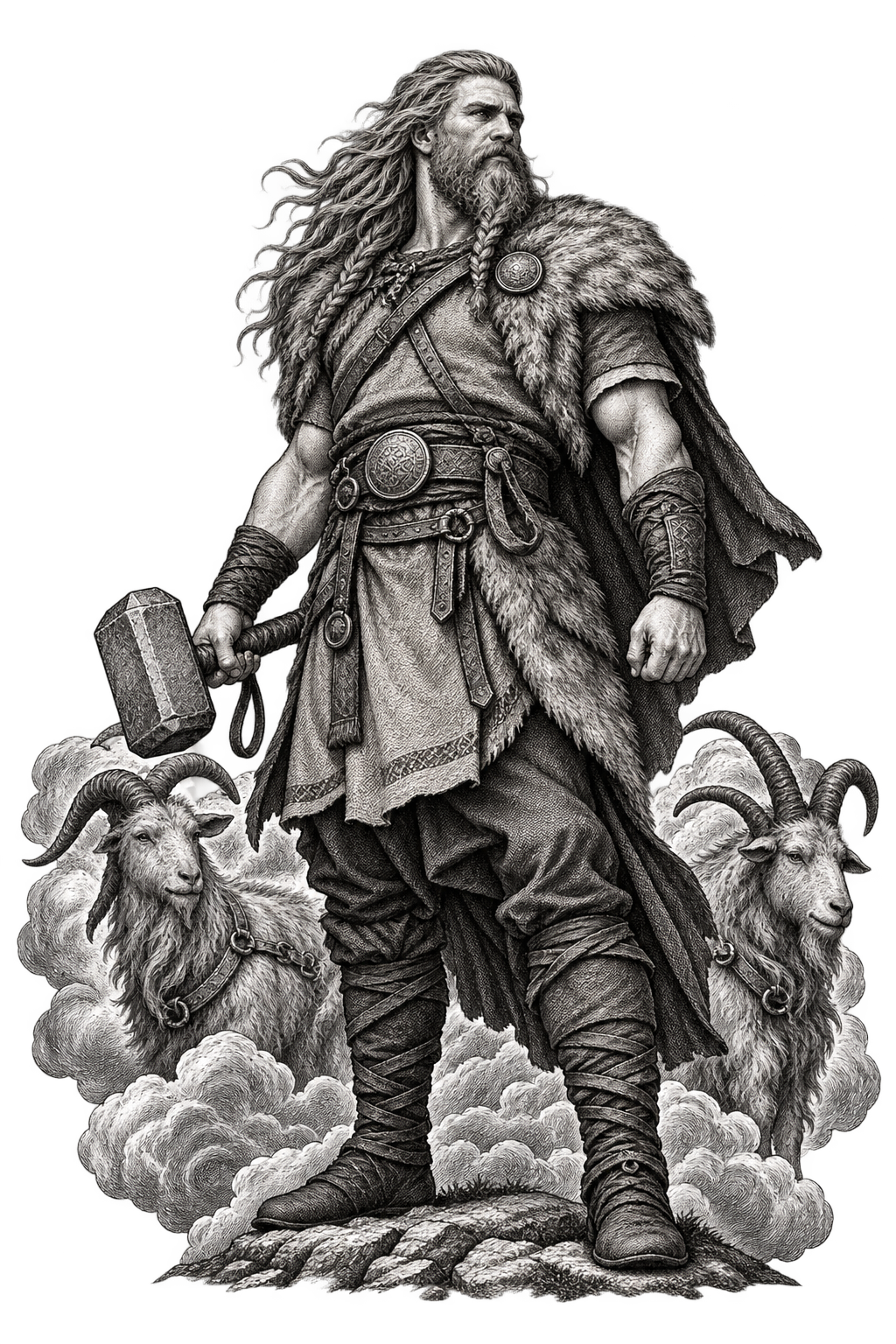
Thor
Norse god of thunder, protection, strength, blessing, and defense
Domains
- Thunder
- Protection
- Strength
- Defense of gods and humans
- Battle against giants
Symbols
- Mjölnir
- Goats Tanngnjóstr and Tanngrisnir
- Chariot
- Jörmungandr
- Iron gloves Járngreipr
- Strength belt Megingjörð
Offerings
- Historically contextual communal food and drink
- Modern: bread, food, or drink
- Modern: a hammer image or pendant
- Modern: acts of protection or service
Aspects
- Son of Odin and Jörð
- Husband of Sif
- Father of Magni, Móði, and Þrúðr
- Bearer of Mjölnir
- Defender of Midgard
Magical / Spiritual Work
- Protection
- Courage
- Strength with purpose
- Defense of home and community
- Grounding
Important Context
Thor is more than a war god.
Sacred Days / Festivals / Times
Thursday through linguistic connection to Thor · No historically required Moon phase
Devotional Approach
Core Correspondences
Deity Grimoire
Thor
Norse god of thunder, protection, strength, blessing, and defense
Mythology, History & Important Context
Historical & Cultural Context
Thor is known through a combination of: • medieval Icelandic literary sources; • skaldic poetry; • runic and inscriptional evidence; • place names; • visual monuments; • hammer amulets and other archaeological finds. The Poetic Edda and Prose Edda preserve many of his best-known myths. These texts were written down after Scandinavia had undergone Christianization, so they are essential but not uncomplicated witnesses to pre-Christian religion. Archaeological evidence is especially important for Thor because hammer pendants occur widely across the Viking world.
Major Myths & Stories
Mjölnir is Thor’s hammer and his most recognizable attribute. In myth it: • returns to Thor after being thrown; • destroys or repels giants and monsters; • serves as a sign of Thor’s extraordinary strength and divine authority. Hammer-shaped pendants occur archaeologically across Northern Europe. A particularly important tenth-century find from Købelev on Lolland bears a runic inscription meaning essentially “this is a hammer. ” The inscription confirmed that such pendant forms were understood as hammers rather than merely modern scholarly guesses. The hammer could function as a marker of devotion, protection, identity, or religious allegiance.
Thor & Jörmungandr
One of Thor’s most important mythic relationships is with Jörmungandr, the Midgard Serpent. In a famous story, Thor goes fishing with the giant Hymir. Thor uses an ox head as bait and hooks Jörmungandr from the sea. He pulls the serpent upward and prepares to strike it with Mjölnir. The story varies across surviving sources, but the confrontation is important enough that the fishing scene appears in Viking-Age and medieval visual art. The Hørdum stone in Denmark is interpreted as depicting this myth. This gives the Thor–Jörmungandr encounter unusually strong support because the story is preserved both in literature and in visual material culture.
Þrymskviða
In the Eddic poem Þrymskviða, the giant Þrymr steals Thor’s hammer. He demands Freyja as his bride in exchange for returning it. The gods instead disguise Thor as Freyja and Loki as his accompanying woman. Thor’s enormous appetite and fierce eyes nearly expose the deception, but Loki explains each suspicious detail. When Mjölnir is finally brought out to bless the supposed bride, Thor regains the hammer and kills Þrymr and the surrounding giants.
Deity Grimoire
Thor
Norse god of thunder, protection, strength, blessing, and defense
Mythology, History & Important Context
Thor & Útgarða-Loki
Another major story places Thor and his companions in the hall of Útgarða-Loki, where they face a series of impossible contests. Thor: • attempts to empty a drinking horn; • tries to lift a cat; • wrestles with an old woman. He appears to fail. Later, the illusions are revealed: • the drinking horn was connected to the sea; • the “cat” was actually Jörmungandr; • the old woman represented Old Age. Thor’s failures therefore reveal extraordinary strength rather than weakness. The story emphasizes: • limits; • deception; • perspective; • cosmic scale; • strength confronted by forces that cannot simply be overcome.
Later Interpretation / Important Context
Thor’s final confrontation with Jörmungandr occurs at Ragnarök. In the surviving mythic tradition, Thor kills the serpent. He then walks only nine steps before dying from its venom. The story completes the conflict established earlier in their myths. Thor succeeds in destroying one of the greatest threats to the world but does not survive the victory. This makes his Ragnarök story one of courage, protection, mortality, and cost—not invulnerability. His sons Magni and Móði survive and inherit Mjölnir afterward, connecting destruction with continuity.
Personal Notes
Worship & Historical Practice
Thor appears to have been widely important in pre-Christian Scandinavian religion.
Working With Thor Today
Simple devotional practice 1. Clean and prepare the space. 2.