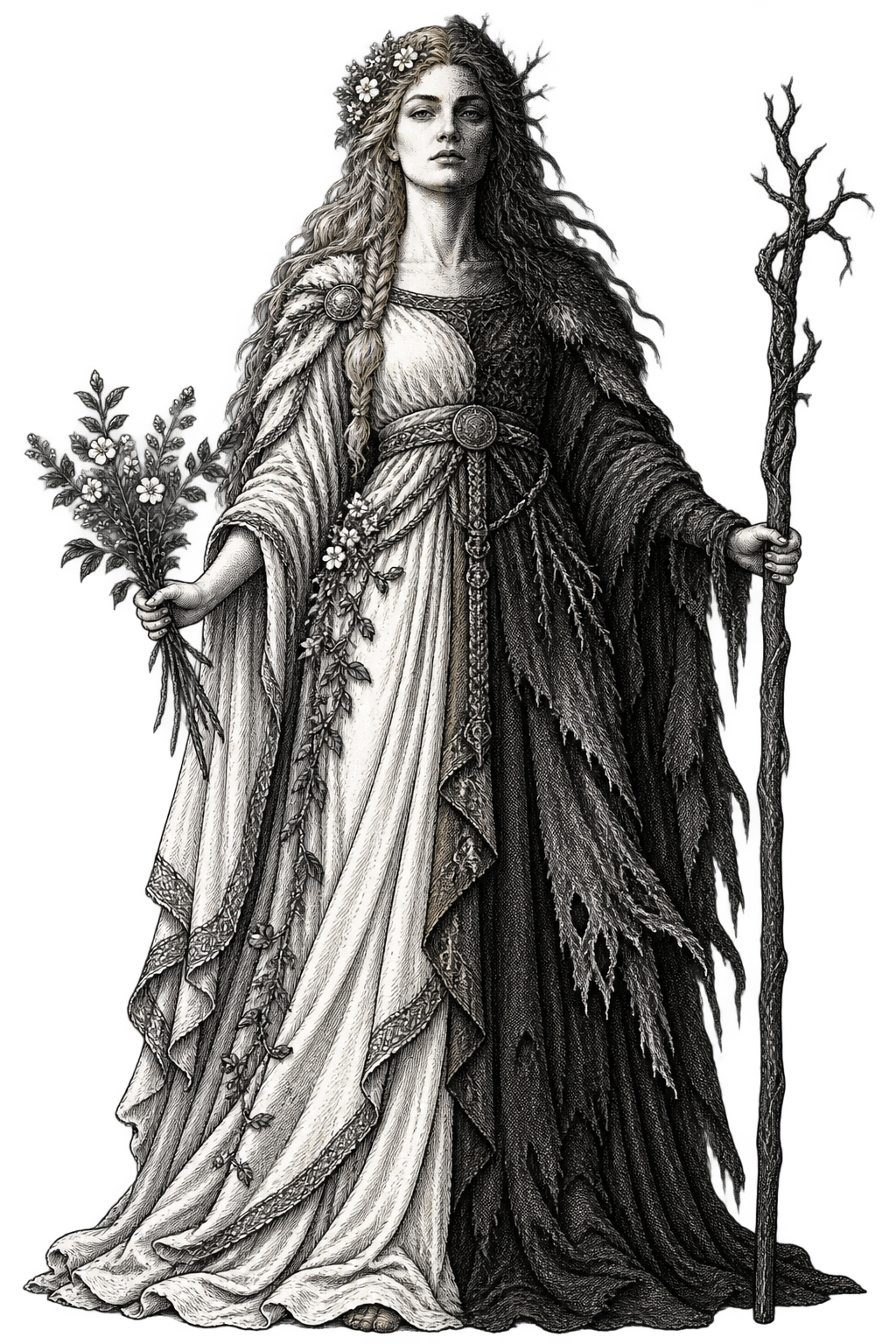
Return to entryChecking Hel printable layout…
Deity Grimoire

Hel

Norse ruler of Hel and daughter of Loki in medieval mythic tradition

Domains

  • The dead and the underworld
  • Boundaries
  • Endings
  • Mortality
  • Grief and acceptance

Symbols

  • Divided light and dark appearance
  • The realm Hel
  • Baldr and Hermóðr story
  • Éljúðnir
  • Threshold imagery
  • Winter stillness

Offerings

  • No securely documented universal historical offering
  • Modern: remembrance of the dead
  • Modern: clean water or simple food
  • Modern: flowers or a safe candle

Aspects

  • Daughter of Loki and Angrboða
  • Sister of Fenrir and Jörmungandr
  • Ruler of Hel in Snorri's account
  • Keeper of the dead
  • Being and realm sharing one name

Magical / Spiritual Work

  • Grief and acceptance
  • Mortality reflection
  • Ancestor remembrance
  • Endings and transition
  • Boundaries

Important Context

Hel is not Satan, the realm Hel is not simply Christian Hell, and those who go there are not automatically being punished.

Sacred Days / Festivals / Times

Winter in modern symbolic practice · No historically required Moon phase

Devotional Approach

Use source study, remembrance, grief reflection, and safe modern devotional practice while respecting the ambiguity between Hel as realm and Hel as.

Core Correspondences

Black and white — modern · Gray — modern · Deep blue — modern · Earth in some modern systems; not a.

Deity Grimoire

Hel

Norse ruler of Hel and daughter of Loki in medieval mythic tradition

Mythology, History & Important Context

Historical & Cultural Context

Hel survives in Old Norse literature as both: • a personified female figure; and • the name of an underworld or realm of the dead. That overlap is important. The personified Hel is especially developed in the Prose Edda, written by Snorri Sturluson in Christian-era Iceland. Earlier poetic material preserves Hel as a place, power, or destination of the dead, but the detailed image of Hel as Loki’s daughter ruling a richly described hall belongs strongly to the medieval literary tradition. This means the historical picture is not simple. We have strong evidence that hel was an important term connected with death and the underworld in the Germanic/Norse religious world.

Major Myths & Stories

One of the most important things to understand is that Hel is both a name and a place-name in the surviving tradition. The realm Hel is a destination of the dead. In medieval mythological description, the figure Hel rules there. Because the same word is used for both, modern readers can easily assume that every reference to “Hel” in a poem is necessarily describing the goddess as a person. That is not always safe. Some passages may refer to: • the realm; • the condition of death; • the power of death; • the personified ruler; • or a poetic overlap between them.

Parentage & Siblings

In Snorri’s mythological account, Hel is one of three children born to Loki and Angrboða. Her siblings are: • Fenrir, the great wolf; • Jörmungandr, the Midgard Serpent. The gods fear what these children may become. Odin therefore acts against all three: • Jörmungandr is thrown into the sea around Midgard; • Fenrir is eventually bound; • Hel is cast into the underworld realm and given authority there.

Deity Grimoire

Hel

Norse ruler of Hel and daughter of Loki in medieval mythic tradition

Mythology, History & Important Context — Continued

Hel & Baldr

The most important story involving Hel as an active ruler comes after the death of Baldr. After Baldr is killed, the gods seek a way to bring him back. Hermóðr rides to Hel to negotiate for Baldr’s release. Hel agrees to a condition: if all beings and things weep for Baldr, he may return. Nearly everything weeps. One figure refuses. As a result, Baldr remains among the dead until after Ragnarök. Why this matters Hel is not portrayed as randomly cruel. She sets a condition. She does not simply release Baldr because the gods want him back.

Hel’s Appearance

Snorri gives Hel one of the most memorable descriptions in Norse mythology. She is described as having a divided appearance, with one half of her body different in color from the other. Translations vary because the Old Norse color vocabulary does not map perfectly onto modern English. A common translation describes her as: • half flesh-colored; • half blue-black or dark. The important point is not modern horror imagery. Her divided appearance visually expresses the boundary between life and death.

Deity Grimoire

Hel

Norse ruler of Hel and daughter of Loki in medieval mythic tradition

Mythology, History & Important Context

Later Interpretation / Important Context

The similarity between the English word hell and Old Norse Hel is historically related through Germanic language, but the concepts are not identical. Christian Hell becomes a place of punishment for the damned within Christian theology. Old Norse Hel is a realm of the dead and is not defined primarily by moral damnation. Later Christian-era writers inevitably wrote within a world already influenced by Christian ideas. That makes careful distinction especially important. Common error Do not write: “Hel is the Norse goddess of Hell.

Personal Notes

Worship & Historical Practice

Evidence for a distinct historical cult of Hel is limited.

Working With Hel Today

Simple devotional practice 1. Prepare a quiet space. 2.