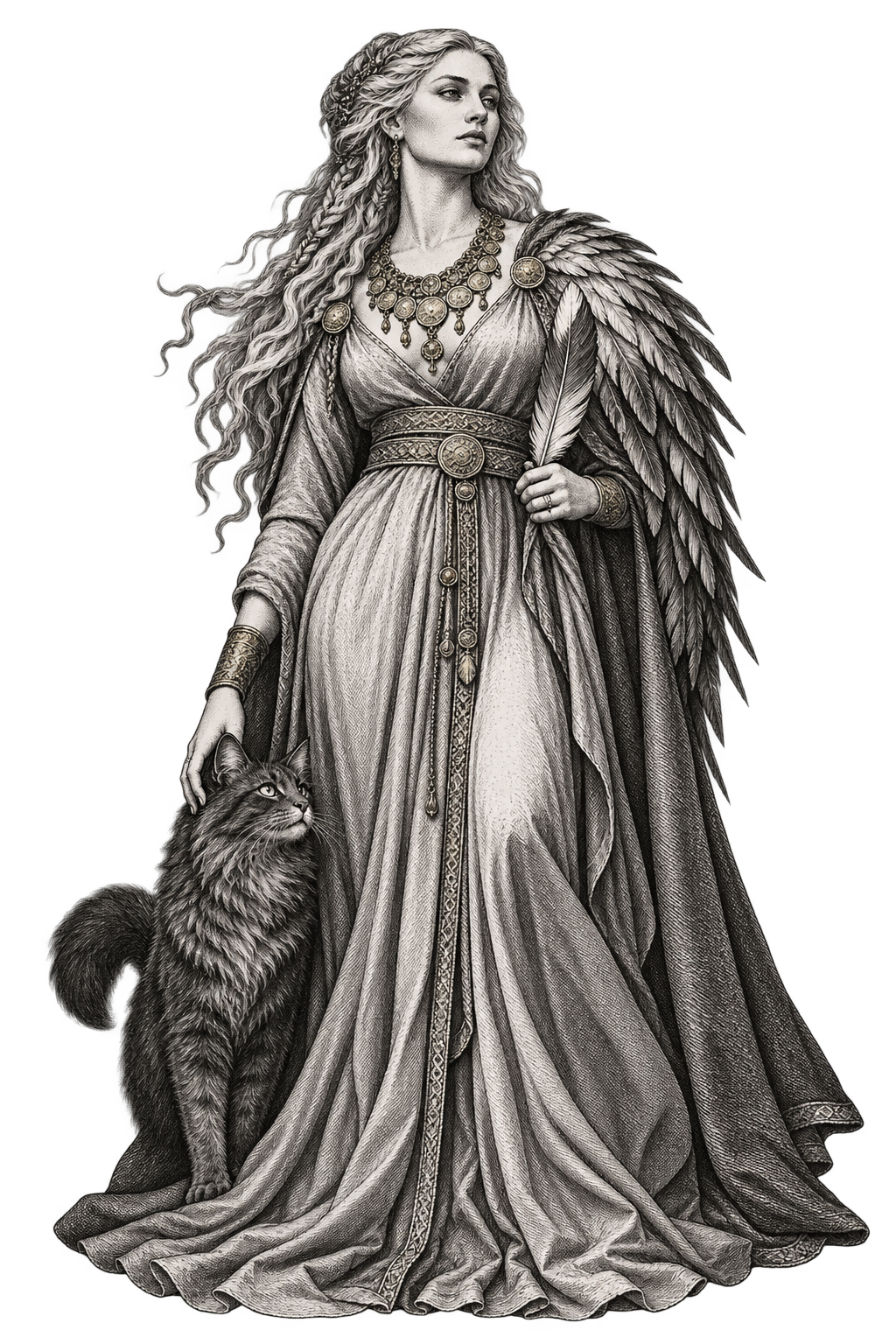
Deity Grimoire
Freyja
Vanir goddess of love, seiðr, wealth, grief, and the battle-slain
Domains
- Love and desire
- Fertility
- Seiðr and magic
- Wealth and precious things
- Grief
Symbols
- Brísingamen
- Cats and cat-drawn vehicle
- Falcon-feather garment
- Hildisvíni
- Golden tears
- Fólkvangr
Offerings
- No universal historical offering list survives
- Modern: jewelry or beautiful craft
- Modern: flowers, food, or drink
- Modern: poetry or song
Aspects
- Vanir goddess
- Lady of Fólkvangr
- Bearer of Brísingamen
- Practitioner and teacher of seiðr
- Seeker of Óðr
Magical / Spiritual Work
- Love and desire
- Seiðr study
- Self-worth
- Grief and longing
- Prosperity
Important Context
Freyja is not merely a love goddess.
Sacred Days / Festivals / Times
Friday through linguistic and later associations, with caution · No historically required Moon phase
Devotional Approach
Core Correspondences
Deity Grimoire
Freyja
Vanir goddess of love, seiðr, wealth, grief, and the battle-slain
Mythology, History & Important Context
Historical & Cultural Context
Our knowledge of Freyja comes from several kinds of evidence: • medieval Icelandic texts such as the Poetic Edda and Prose Edda; • skaldic poetry; • saga material; • place names; • archaeological objects and iconographic interpretations; • comparative evidence from pre-Christian Scandinavian religion. The written sources are indispensable but must be read carefully. Much of the mythology was written down after the conversion of Scandinavia to Christianity. That does not make the material worthless, but it means modern readers should avoid treating every medieval literary detail as a direct transcript of Viking-Age ritual. Archaeology and place-name evidence help confirm that the divine figures known from the texts were not merely literary inventions.
Major Myths & Stories
Freyja is deeply associated with seiðr, a form of Old Norse magic involving prophecy, altered states, fate, influence, and ritual performance. Later literary sources portray Freyja as exceptionally skilled in seiðr and connect her with the transmission of that knowledge among the gods. The völva or seeress is one of the best-known ritual specialists associated with seiðr in the surviving record. Archaeological burials containing staffs and other unusual objects are sometimes interpreted in connection with such practitioners.
Fólkvangr & the Battle-Slain
Freyja is not only a goddess of love and fertility. In the surviving mythic tradition, she receives half of those slain in battle in her field called Fólkvangr, while Odin receives the other half. Her hall there is called Sessrúmnir. This makes Freyja part of the Norse religious imagination surrounding battle, death, honor, and the afterlife. Her association with the dead complicates the modern tendency to frame her as purely soft, romantic, or domestic. Freyja can therefore hold both: • desire and death; • fertility and grief; • beauty and battle; • pleasure and loss.
Brísingamen
One of Freyja’s most famous possessions is the necklace Brísingamen. The necklace appears in several literary traditions and becomes one of her defining symbols. Its exact mythic history varies depending on the source. Modern retellings often present one single dramatic acquisition story as though it is universally ancient and uncontested.
Deity Grimoire
Freyja
Vanir goddess of love, seiðr, wealth, grief, and the battle-slain
Mythology, History & Important Context
Óðr, Grief & the Golden Tears
Freyja’s husband is called Óðr in the surviving mythological tradition. He is often absent, wandering, or difficult to identify clearly. Freyja is described as searching for him and weeping tears associated with gold. These stories add grief, longing, and separation to her character. The golden-tears motif has made Freyja meaningful to modern practitioners working with: • grief; • longing; • love across distance; • abandonment wounds; • continuing love after separation. Those modern uses should be labeled as interpretation built from mythic themes, not reconstructed ancient therapy practice.
Later Interpretation / Important Context
Freyja and Frigg are sometimes treated online as though scholarship has proven they were originally one goddess. The reality is more complicated. They share some overlapping themes: • love and marriage; • high divine status; • magical or prophetic associations; • names that may invite linguistic comparison. But the surviving mythology treats them as distinct figures. Some scholars have explored whether they may share earlier roots, while others emphasize their separate identities in the surviving sources.
Personal Notes
Worship & Historical Practice
Freyja’s worship is harder to reconstruct in detail than modern devotional guides.
Working With Freyja Today
Simple devotional practice 1. Clean and prepare the space. 2.