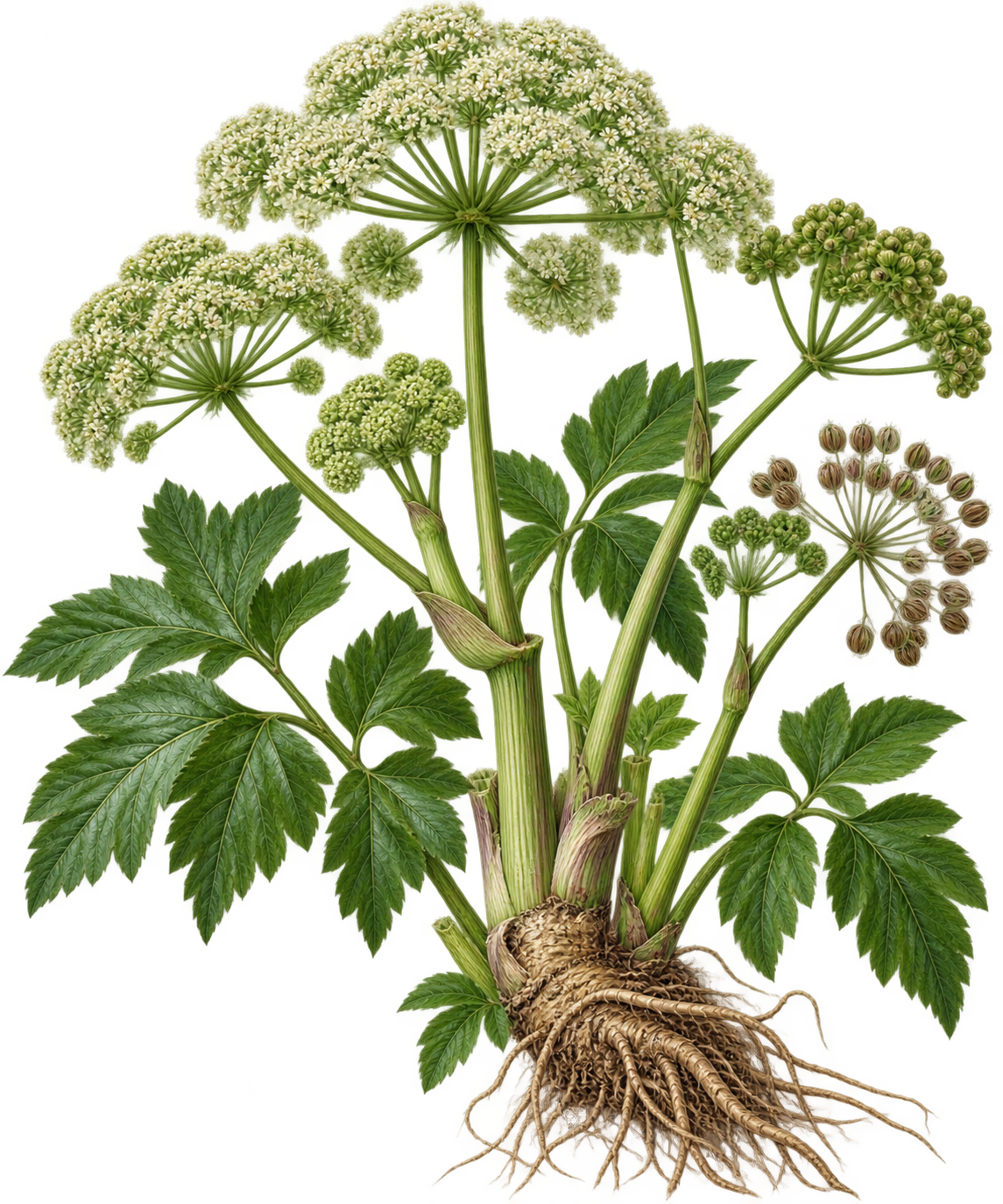
Herbs & Salts Grimoire
Angelica
Angelica archangelica L.
Traditional Uses
Historically an aromatic bitter and European folk herb, especially in digestive/respiratory contexts; stems have also been candied and used as flavoring. Historical use is not proof of clinical efficacy.
Folklore
Angelica has a long northern/central European history as food, flavoring and herbal material. Angelica species have substantial traditional-medicine records; A. archangelica became prominent in European herbals. Later European naming/folklore connected it with angels and archangels; present this as regional/later tradition, not universal ancient belief.
Magical Associations
- protection
- purification
- blessing
- courage
Core Correspondences
- Energy:
- protection · purification
Witchcraft Uses
- protection
- purification
- blessing
- courage
- spiritual guardianship
Caution
Apiaceae allergy is possible. Angelica contains furanocoumarins; plant material/some preparations may increase UV-related photosensitivity/photodermatitis risk.
Educational purposes only. Not medical advice.
How to Work With
Commonly used symbolically for protection, blessing, purification, courage, spiritual guardianship and firm boundaries. Angelic naming/history also lends itself to guidance/protection symbolism.
Best Time to Harvest
Correspondences
Herbs & Salts Grimoire
Angelica
Angelica archangelica L.
Botanical Profile
Plant FamilyApiaceae
Common NamesAngelica · Garden angelica · archangel
Alternate NamesGarden angelica · archangel · wild celery
Growth HabitTall aromatic biennial/perennial with hollow grooved stems, large divided leaves and rounded
Native RangeAngelica has a long northern/central European history as food, flavoring and herbal
HabitatTall aromatic biennial/perennial with hollow grooved stems, large divided leaves and rounded umbels of greenish-white
Identifying CharacteristicsTall aromatic biennial/perennial with hollow grooved stems, large divided leaves and rounded umbels of greenish-white flowers
Parts Traditionally UsedNot separately specified in the approved
Traditional Uses & Modern Evidence
Magical & Spiritual Practice
Notes & Personal Connection
Add your own experiences, observations, and notes about working with this plant. How does it speak to you? What is your personal connection?
Safety & Caution
Apiaceae allergy is possible. Angelica contains furanocoumarins; plant material/some preparations may increase UV-related photosensitivity/photodermatitis risk.
Sources & Research Notes
https://pubmed.ncbi.nlm.nih.gov/34254374/ • https://pubmed.ncbi.nlm.nih.gov/15180579/