Herbs & Salts Grimoire
Thyme
Thymus vulgaris L.Quick Reference
Traditional Uses
Thyme has long been used as a culinary seasoning and aromatic household herb. Traditional preparations include teas, infusions, syrups, and other herb preparations made from the leaves and flowering aerial parts. The European Medicines Agency recognizes long-standing traditional medicinal use of thyme preparations for productive cough associated with colds. That designation is based primarily on long-standing use rather than strong modern clinical evidence.
Magical Associations
- Courage
- Protection
- Purification
- Strength
- Vitality
- Clarity
- Resilience
- Good fortune
Folklore
Thyme has accumulated symbolism around courage, vigor, purification, and grace. Oxford’s botanical history notes that Thymus species have historically been associated with courage. Later European plant lore and household practice also treated aromatic thyme as a cleansing and strengthening herb. These symbolic traditions help explain why modern practitioners often use thyme in courage, protection, and purification work. The connection between thyme and courage is historically stronger than many of the highly specific modern occult correspondences sometimes assigned to the plant. The Grimoire should preserve that distinction.
Core Correspondences
Witchcraft Uses
- Add dried thyme to a protection sachet or household charm.
- Include it in a cleansing or purification blend.
- Use a small amount as incense when smoke is safe and appropriate.
- Add to a non-ingested ritual bath blend for courage, renewal, or energetic clearing.
- Keep a sprig on an altar during confidence, resilience, or strength work.
- Add to spell jars centered on courage, protection, focus, or good fortune.
- Pair thyme with rosemary when the intention combines cleansing with clarity and remembrance.
⚠ Caution
Culinary thyme is widely used as food, but medicinal preparations and essential oil are more concentrated.
Educational purposes only. Not medical advice.How to Work With
For courage work, place a small sprig of dried thyme in a bowl or on the altar and name one action you are willing to take despite uncertainty. The herb is used as the ritual symbol; the practice is completed by taking the real-world action you named. For cleansing, thyme can be placed in a sachet, bowl, bath blend, or smoke-free herb bundle. It does not have to be burned to be used symbolically. In household work, place thyme near an entryway or workspace as a reminder of clear boundaries, strength, and purposeful action.
Best Time to Harvest
Because common thyme is evergreen, small sprigs can be harvested throughout the year. The soft new growth of late spring and summer is especially flavorful and aromatic. Leaves and flowers may both be harvested; for drying, cut healthy sprigs and dry them in a warm, dark, well-ventilated place before storing airtight.
Correspondences
Page 2 of 2
Deeper Reading
Botanical Profile
- Plant Family
- Lamiaceae
- Alternate Names
- Common Thyme · Garden Thyme · English Thyme · French Thyme
- Growth Habit
- Common thyme is a small evergreen woody-based subshrub, usually forming a compact mound. Older stems become woody while younger shoots remain flexible and leafy. Depending on conditions and cultivar, common thyme is generally around 15–30 cm tall, sometimes somewhat larger.
- Native Range
- Thymus vulgaris is native to southwestern Europe and southeastern Italy, with a strong western Mediterranean association. It has been cultivated far beyond its native range as a culinary, ornamental, aromatic, and traditional herbal plant.
- Habitat
- Thyme is adapted to sunny, dry, free-draining conditions. It performs especially well in poor to moderately fertile, stony, neutral-to-alkaline soils and is drought tolerant once established. Waterlogged soil and heavy winter moisture are more troublesome than dryness. Its small flowers provide nectar for bees and other pollinators.
- Identifying Characteristics
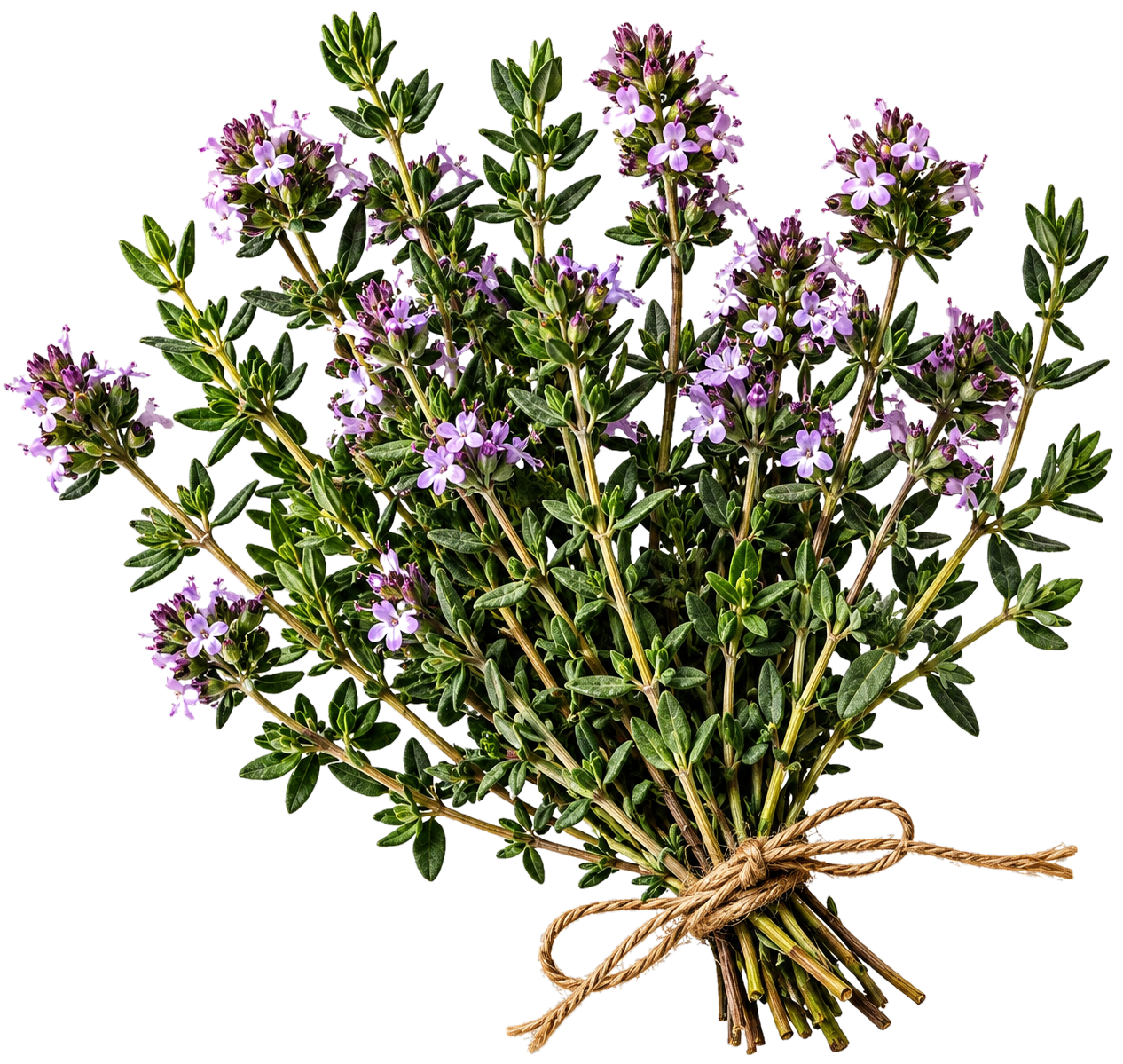
- Small, strongly aromatic leaves arranged oppositely on the stem Woody lower stems and softer green new growth Tiny tubular two-lipped flowers, commonly pink, mauve, purple, or white Compact, bushy habit rather than the creeping habit of some other thyme species Warm, earthy, peppery fragrance when leaves are crushed
- Parts Traditionally Used
- Leaves and flowering aerial parts are the principal culinary and traditional herbal material. Essential oil is a highly concentrated preparation and is not interchangeable with ordinary dried thyme.
History & Cultural Context
Thyme belongs to a large and taxonomically complex genus, so ancient references to “thyme” do not always refer specifically to modern Thymus vulgaris. Historical sources discuss several different Thymus species. Broadly, thyme species were used in ancient Mediterranean cultures as aromatic plants, medicines, fumigants, and culinary herbs. Oxford’s Plants 400 notes long use of Thymus in ancient cultures, including perfumery and embalming in Egypt and medicinal/fumigant use among Greeks and Romans. Common garden thyme itself is a western Mediterranean species that became an important European culinary and garden herb. It was also incorporated into medieval and later European herbal traditions, although historians caution against assuming that every ancient or medieval “thyme” reference identifies the exact modern species.
Traditional & Historical Medicinal Uses
Historically, thyme and related Thymus species appeared in European and Mediterranean herbal traditions in respiratory, digestive, cleansing, and aromatic contexts. Medieval and early herbal literature also attributed a wide variety of uses to thyme, but species identification in old texts can be uncertain. These are historical/traditional uses and should not be presented as proof that thyme treats modern medical conditions.
Magical Uses
For courage work, place a small sprig of dried thyme in a bowl or on the altar and name one action you are willing to take despite uncertainty. The herb is used as the ritual symbol; the practice is completed by taking the real-world action you named. For cleansing, thyme can be placed in a sachet, bowl, bath blend, or smoke-free herb bundle. It does not have to be burned to be used symbolically. In household work, place thyme near an entryway or workspace as a reminder of clear boundaries, strength, and purposeful action.
Modern Evidence
Modern pharmacological research has focused heavily on thymol, carvacrol, and other volatile constituents found in thyme and thyme essential oil. Laboratory work supports antimicrobial and other biological activity for some isolated compounds and preparations, but laboratory findings do not automatically translate into proven benefits from ordinary culinary thyme. For medicinal thyme preparations, the EMA’s current public summary supports traditional use for productive coughs associated with colds and explicitly notes that firm clinical conclusions are limited. This page should therefore avoid claims that thyme cures infection, bronchitis, respiratory disease, digestive disease, or other conditions.
Notes & Personal Connection
Add your own experiences, observations, and notes about working with this plant. How does it speak to you? What is your personal connection?
Keep This Grimoire Entry
Print Page 1 and Page 2 together, single-sided or front and back.
Download to Print