Deity Grimoire
Nyx
Greek primordial goddess and personification of NightDomains
- Night itself
- Cosmic rhythm of Night and Day
- Sleep and dreams through genealogy
- Death and fate through genealogy
- Mystery and stillness in modern practice
Symbols
- Night
- Stars and starry sky
- Dark mist or veil
- Wings
- Four-horse chariot
- Star-spangled garments
- Transition between Night and Day
Offerings
- No standardized ancient offering list
- Modern: spoken hymn or prayer
- Modern: poetry or devotional artwork
- Modern: safely lit candle or lamp
- Modern: water, quiet meditation, or night-sky observation
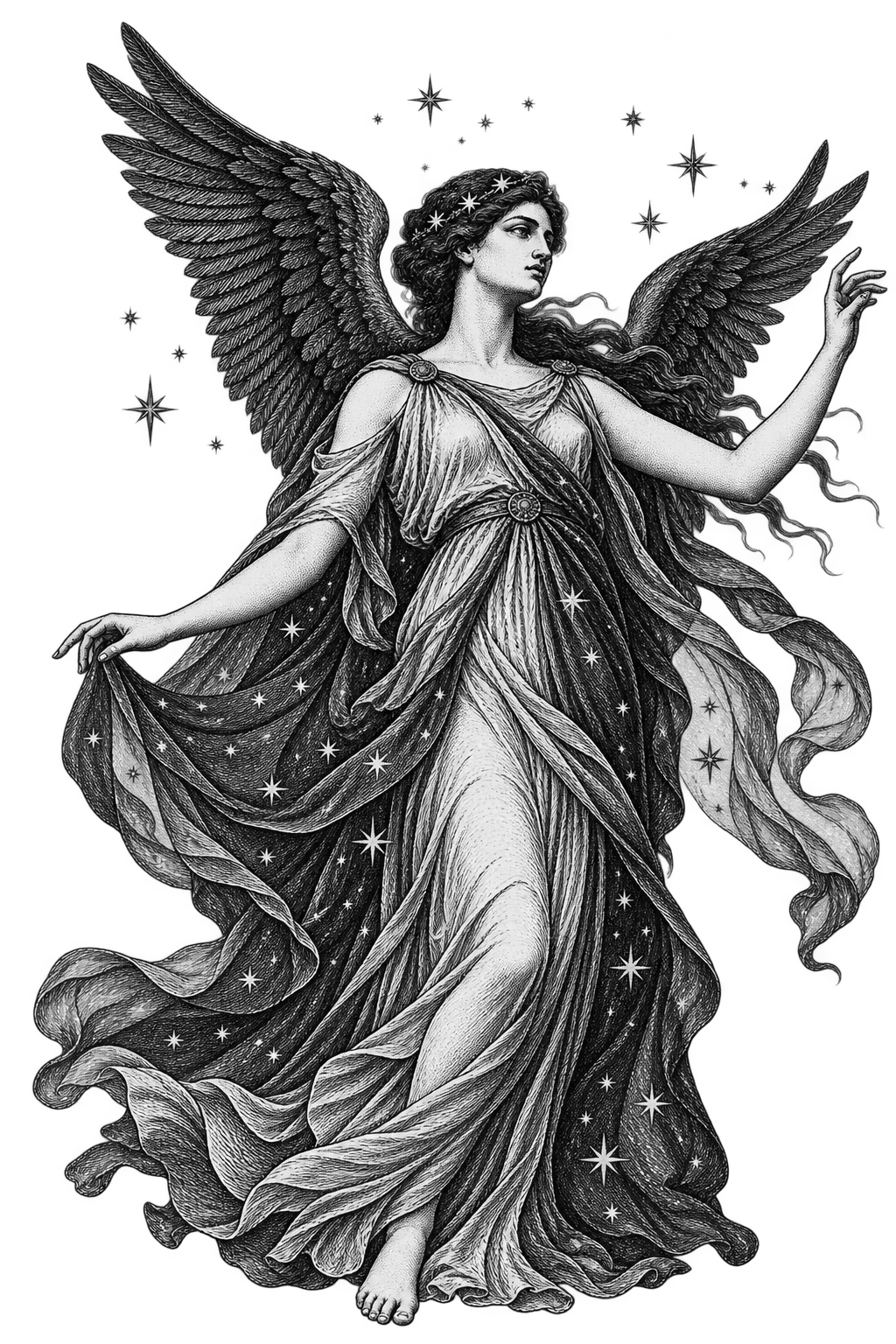
Aspects
- Primordial Night
- Daughter of Chaos in Hesiod
- Paired cosmic power with Erebos
- Mother of Aither and Hemera
- Mother of personified powers in Hesiod
- Winged and chariot-bearing Night in ancient imagery
Magical / Spiritual Work
- Night-sky devotion
- Dusk and pre-sleep reflection
- Dream journaling
- Rest as sacred rhythm
- Gentle shadow work
- Acceptance of uncertainty
⚠ Important Context
Nyx is the Greek personification of Night, not Selene or a generic moon goddess. Her literary, cosmogonic, and iconographic evidence is stronger than evidence for a large standardized cult.
Sacred Days / Festivals / Times
None historically required; Nyx is Night, not Selene
Devotional Approach
Honor Night through quiet observation, historically aware prayer or study, dream journaling, dusk and dawn reflection, rest, and gently paced shadow work without treating Nyx as the Moon.
Core Correspondences
Page 2 of 2
Deeper Reading
OVERVIEW
Nyx is Night personified. She is not simply a goddess who rules over nighttime from a distance. In the oldest surviving Greek cosmogonic poetry, Nyx belongs to the earliest generation of divine beings: powers that represent the basic conditions and structures of existence itself. Hesiod's Theogony places Nyx among the first beings to emerge after Chaos. From Chaos come Erebos, the deep darkness, and Nyx, Night. Nyx and Erebos then produce Aither, the bright upper air, and Hemera, Day. This makes Nyx part of a cosmic rhythm rather than merely a later Olympian personality. Night and Day meet and alternate. Darkness gives way to light, and light gives way again to darkness. Nyx is also presented as the mother of a remarkable group of personified powers. In Hesiod, many of these children are born from Nyx alone. They include figures associated with sleep, death, dreams, fate, retribution, age, strife, deception and other unavoidable dimensions of life. Because of that genealogy, Nyx can feel immense in Greek mythology. She is not best understood as “the goddess of one thing.” She is the night from which many difficult, mysterious and necessary conditions of existence emerge.
HISTORICAL & CULTURAL CONTEXT
Nyx belongs to the oldest stratum of Greek divine genealogy preserved in surviving literature. In Hesiod's Theogony, composed in the early archaic Greek period, Nyx is one of the primordial powers. She is born from Chaos alongside Erebos. Together Nyx and Erebos become the parents of Aither and Hemera. The same poem later gives Nyx a long line of children born without a consort. These include Moros (Doom), Ker and the Keres (violent or fated death), Thanatos (Death), Hypnos (Sleep), the Oneiroi (Dreams), Momos, Oizys, the Hesperides, the Moirai (Fates), Nemesis, Apate, Philotes, Geras and Eris. Ancient authors did not preserve one completely uniform genealogy. As with many Greek divine figures, parentage and relationships can vary between authors and religious traditions. The Hesiodic genealogy is especially important because it is early and unusually detailed. Nyx also appears in Homeric epic. In Iliad Book 14, Hypnos recalls taking refuge with Nyx after angering Zeus. Zeus does not pursue him further because, in the poem's wording, he is in awe of displeasing Night. This episode became one of the best-known examples of Nyx's extraordinary status in later retellings. It is better to read this scene as literary evidence for Nyx's formidable cosmic standing than as proof that she “outranks Zeus” in every Greek religious system. Greek myth is not a single fixed hierarchy, and individual poems emphasize divine relationships differently.
ORIGINS & GENEALOGY
Parents In Hesiod: • Chaos — Nyx emerges from Chaos. Consort / Paired Cosmic Power • Erebos / Erebus — primordial Darkness. With Erebos, Nyx bears: • Aither / Aether — bright upper air • Hemera — Day Children attributed to Nyx in Hesiod Nyx alone is said to bear: • Moros — Doom • Ker / Keres — Death-fates / violent death spirits • Thanatos — Death • Hypnos — Sleep • Oneiroi — Dreams • Momos — Blame / Criticism • Oizys — Misery / Distress • Hesperides — nymphs associated with evening and the western garden • Moirai — the Fates • Nemesis — Retribution • Apate — Deceit • Philotes — Affection / intimacy • Geras — Old Age • Eris — Strife Important: Ancient genealogies vary. Do not present every later source as though all Greek communities held one identical family tree.
MYTHOLOGY & STORIES
Nyx and the coming of Day Hesiod describes a cosmic threshold where Nyx and Hemera, Night and Day, pass one another. When one enters, the other leaves. They do not occupy the world at the same time. This image captures one of Nyx's central meanings in ancient cosmology: she is part of the ordered alternation that structures human experience. Zeus, Hypnos and Nyx In Homer's Iliad, Hypnos tells Hera about an earlier time when Zeus became furious with him. Hypnos fled to Nyx for protection. Zeus stopped his pursuit because he was reluctant to offend or anger Night. The passage does not turn Nyx into a warrior goddess. Instead, it presents her as a primordial force whose status commands unusual respect even in a story centered on Olympian gods. Mother of Sleep, Death, Dreams and Fate Much of Nyx's mythic importance lies in her genealogy. Sleep and Death are siblings under Night. Dreams emerge from Night. So do powers connected with fate, old age, deception, suffering and strife. This family structure reflects an ancient poetic way of understanding the world: nighttime, sleep, dreaming, death, uncertainty and fate belong to a connected imaginative landscape.
HISTORICAL WORSHIP & CULT
Evidence for Nyx's worship is real but comparatively limited. She does not appear to have had the same widespread civic cult infrastructure as major Olympian deities such as Athena, Apollo, Artemis or Zeus. Pausanias records an oracle of Nyx at Megara, showing that Night could have a specific sacred presence within a local religious landscape. Pausanias also preserves evidence for artistic and sacred representations of Night. He mentions an image/statue of Night associated with Ephesus and describes the famous Chest of Cypselus, where Nyx was represented holding Hypnos and Thanatos. A later Orphic hymn is addressed directly to Night. It treats Nyx as a divine power worthy of invocation and praise and associates her with stars, sleep, dreams, darkness, cosmic necessity and the turning of the natural cycle. These sources support the existence of devotional and religious attention to Nyx, but they do not justify inventing a standardized “ancient Nyx ritual” or a universal list of ancient offerings.
ANCIENT ICONOGRAPHY
Surviving Greek art gives us unusually useful clues about how Nyx could be visualized. Historically attested visual features include: • A winged female figure • A star-spangled garment • A four-horse chariot • Dark mist or a dark celestial orb • Movement across the sky • Relationship/opposition with Eos or Hemera • Torches in at least one later vase representation An Attic black-figure lekythos in the Metropolitan Museum of Art, around 500 BCE, depicts Nyx driving away as Helios rises and Eos arrives. Nyx is identified by inscription and by a dark symbol above her. Other vase imagery shows Nyx winged and dressed in stars. What is NOT a primary historical identifier A crescent moon is not one of Nyx's defining ancient attributes. The Moon is personified separately as Selene. Modern art may combine general night imagery with Nyx, but Nyx remains distinct from Selene.
SYMBOLS & ATTRIBUTES
Historically supported / strongly grounded • Night • Darkness • Stars / starry sky • Dark mist or veil • Wings • Four-horse chariot • Star-spangled garments • The transition between Night and Day • Sleep and Dreams through her genealogy • Death through her genealogy • Fate through her genealogy Modern symbolic associations These are contemporary devotional or witchcraft associations, not a universal ancient correspondence system: • Liminality • Rest • Silence • Mystery • Deep reflection • Shadow work • Boundaries • Protection through concealment or darkness • Dream work • Acceptance of uncertainty • Endings and transitions
NYX IS NOT THE SAME AS...
Selene Selene is the personified Moon. Nyx is Night. Hekate Hekate has strong historical connections with crossroads, thresholds, ghosts, torches and later magical traditions. Nyx is a primordial personification of Night. Artemis Artemis is an Olympian goddess with her own cult, mythology and domains. Later visual culture sometimes uses lunar imagery around Artemis, but she is not Nyx. Keeping these distinctions clear makes modern practice richer rather than more restrictive: each figure has her own historical identity.
MODERN DEVOTIONAL PRACTICE
Modern practitioners who honor Nyx often approach her through the themes naturally suggested by her ancient identity: night, stillness, sleep, dreams, cosmic order, mystery and the vastness of what exists beyond ordinary daylight awareness. Contemporary devotional practice may include: • prayer or spoken praise after dark • reading or adapting an ancient hymn to Night • sitting quietly beneath the night sky • keeping a dream journal • reflecting on the relationship between rest and action • observing dusk and dawn as thresholds between Night and Day • lighting a single candle or lamp as a deliberate point of light within darkness • devotional writing, poetry or art • shadow-work journaling approached gently and without forcing emotional intensity These are modern devotional suggestions, not claims that ancient worshippers followed one standardized ritual.
OFFERINGS
Historically grounded evidence The surviving evidence does not provide a single standardized ancient offering list for Nyx. The Orphic hymn tradition gives ritual context for invoking Night and includes torches in its heading/instruction. Pausanias provides evidence for sacred sites and images but not a comprehensive offering system. Modern offering lists are contemporary suggestions, not traditional ancient offerings. Contemporary devotional offerings Clearly label these as modern suggestions: • a spoken hymn or prayer • poetry • a safely lit candle or oil lamp • quiet nighttime meditation • star imagery • dark cloth used on a devotional altar • water offered simply and respectfully • time spent observing the night sky • a written account of a meaningful dream • devotional artwork The most historically honest offering may simply be attention: recognizing Night as a divine cosmic presence rather than filling an altar with objects.
CONTEMPORARY CORRESPONDENCES
These are MODERN correspondences only. Colors: black, deep indigo, midnight blue, silver Time: night; especially deep night, dusk, and the transition toward dawn Element: no securely attested single ancient elemental correspondence; do not force one Planet: none historically required Moon phase: none; Nyx is Night, not the Moon Tarot: no historical correspondence; any tarot link is personal/modern Number: no historically established sacred number specific to Nyx Chakra: not part of ancient Greek religion; omit from historical section Modern crystals sometimes chosen symbolically Not ancient attributes: • Obsidian — darkness, introspection, boundaries • Labradorite — mystery, thresholds, liminality • Black Tourmaline — modern protective symbolism • Amethyst — sleep/dream symbolism in modern practice These choices belong to contemporary crystal practice and should never be described as sacred stones of ancient Nyx worship. Modern botanicals sometimes chosen symbolically No securely attested sacred herb list specific to Nyx survives. Practitioners may choose plants associated in modern practice with night, sleep, dreaming or liminality, but those choices should remain explicitly contemporary. Do not add ingestion instructions merely because a plant appears in a correspondence list.
WAYS TO WORK WITH NYX
Night-sky devotion Step outside after dark and spend several minutes simply observing the sky. The practice does not require seeing the Moon. In fact, working without lunar imagery can reinforce the distinction between Nyx and Selene. Threshold reflection Use dusk or the period before sleep to ask: • What am I carrying out of the day? • What can remain unfinished until tomorrow? • What becomes easier to hear when everything is quieter? Dream practice Keep a notebook near the bed and record dreams upon waking. Approach dreams as material for reflection rather than automatic prophecy. Rest as sacred rhythm Nyx's relationship with Hemera can be used as a reminder that darkness and daylight alternate. A modern devotional practice may honor rest not as failure to act, but as one part of a larger cycle. Shadow work Nyx can serve as a symbolic companion for looking at what is difficult to see clearly. Work slowly. Shadow work does not require emotional overwhelm, and stopping is allowed.
PRAYER / DEVOTIONAL INVOCATION
This is an original modern devotional text for Black Cat Curiosity Co., not an ancient prayer: Nyx, ancient Night, keeper of the quiet hours, you who move where daylight ends, teach me not to fear what is unseen. Let darkness be more than absence. Let stillness become a place of listening. Let rest have its season, and let what must remain unknown remain mysterious without becoming frightening. As Night gives way to Day and Day returns again to Night, help me remember that no single moment is the whole of the cycle. Nyx, star-clad and ancient, be welcome in this quiet space.
RESPECTFUL PRACTICE & IMPORTANT CONTEXT
Nyx belongs to ancient Greek religion and mythology, but modern devotion is not identical to ancient Greek cult practice. A historically respectful approach: • distinguishes surviving ancient evidence from modern reconstruction • avoids claiming unsupported ancient correspondences • recognizes that literary mythology and local cult practice are related but not identical • does not treat every child of Nyx as one of her “domains” • does not call Nyx a moon goddess • does not present modern witchcraft practices as ancient Greek fact There is room for contemporary devotion without pretending that every modern practice is historically attested.
SAFETY & CARE
Nyx devotion itself does not require dangerous materials or extreme practices. For modern ritual work: • use fire-safe candle holders • never leave candles, lamps, incense or charcoal unattended • ventilate smoke appropriately • do not ingest herbs simply because they are listed in modern correspondence systems • approach dream work and shadow work gently • if reflection becomes overwhelming, stop and return later or seek appropriate support Spiritual practice should not require pushing through distress.
Notes & Personal Connection
Explore This Entry
Keep This Grimoire Entry
Print every generated page in order, single-sided or front and back.
Download to Print