Deity Grimoire
Persephone
Greek queen of the Underworld · Daughter of Demeter · Goddess of the Eleusinian MysteriesDomains
- Underworld sovereignty
- Death and the realm of the dead
- Agricultural and seasonal return
- Sacred mystery and initiation
- Transition between realms
Symbols
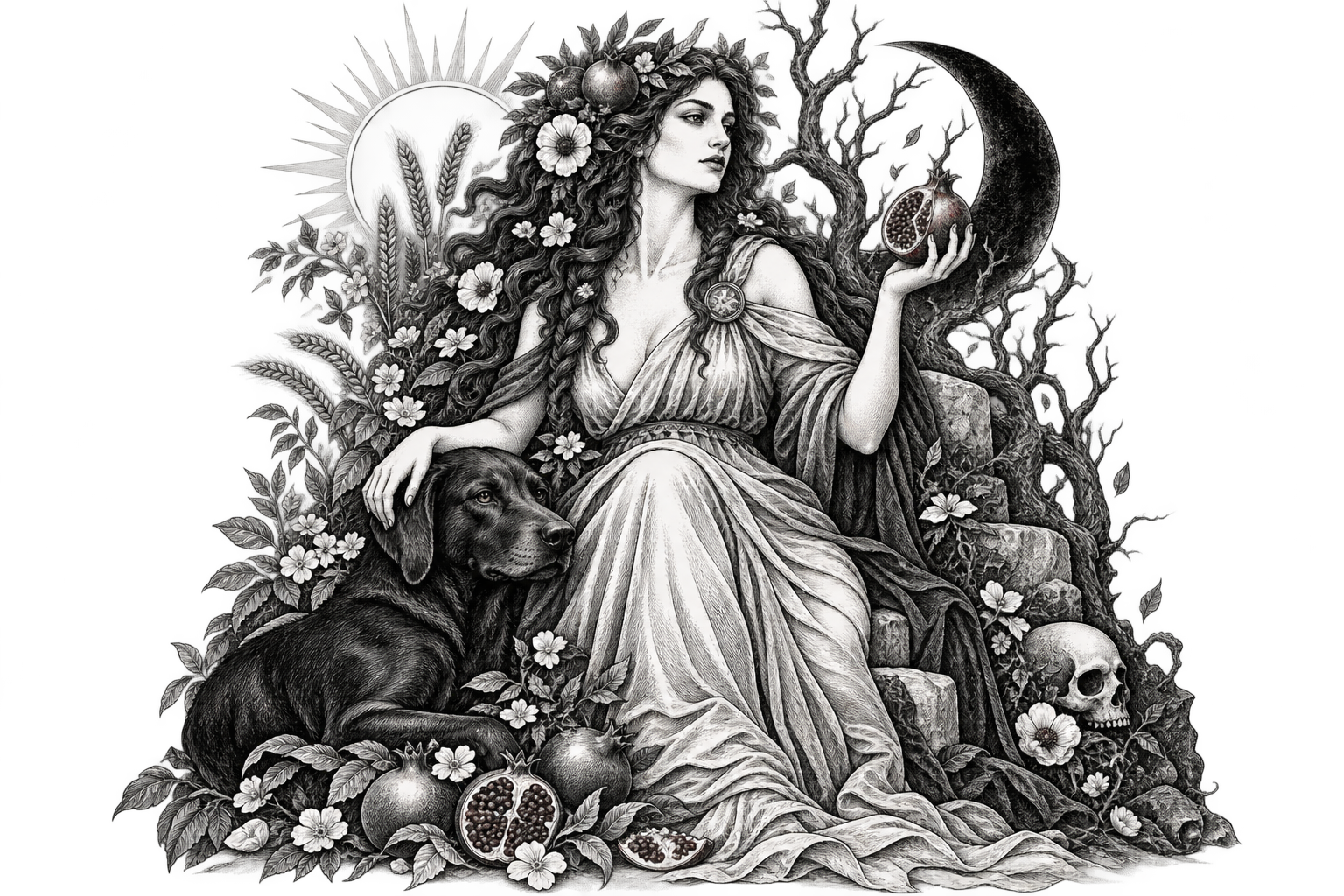
- Pomegranate
- Torch
- Crown, diadem, or polos
- Throne
- Grain and agricultural imagery
- Flowers
- Underworld opening and ascent
Offerings
- Modern devotional choices: pomegranate or its imagery
- Grain or bread
- Seasonal flowers
- Clean water
- A safely lit candle or lamp
- Devotional poetry, prayer, gardening, study, or remembrance of the dead
Aspects
- Kore — the Maiden or Daughter
- Queen beside Hades
- Daughter reunited with Demeter
- Central goddess of the Eleusinian Mysteries
- Sovereign figure in Locrian cult imagery
Magical / Spiritual Work
- Seasonal transition
- Grief and reunion
- Living through change
- Boundaries between different parts of life
- Symbolic descent and return
- Remembrance of the dead
- Garden devotion
⚠ Important Context
In the Homeric Hymn, Hades takes Persephone against her will with Zeus’s authorization. The same ancient record also presents her as an established Underworld queen. The hymn gives one-third of the year below and two-thirds above; the familiar half-and-half version is later and is not treated as the only ancient account.
Sacred Days / Festivals / Times
Eleusinian Mysteries — historically documented, with secret rites not reconstructed here · Autumn and descent; spring and return in modern seasonal practice
Devotional Approach
Modern devotional practice may center seasonal transition, grief and reunion, change, descent and return as symbolic reflection, remembrance of the dead, gardening, study, and honoring Persephone alongside Demeter. These approaches are contemporary and do not reconstruct the secret rites of Eleusis.
Core Correspondences
Page 2 of 2
Deeper Reading
Historical & Cultural Context
OVERVIEW Persephone stands at one of the most important thresholds in ancient Greek religion: between mother and husband, upper world and Underworld, agricultural fertility and the realm of the dead, absence and return. She is the daughter of Demeter, goddess of grain and agricultural abundance, and Zeus. She is also the wife of Hades and queen of the Underworld. One of her oldest and most important titles is Kore, “the Maiden” or “the Daughter.” In cult and literature, Demeter and Kore could be invoked together so closely that they function as a divine pair. Persephone's best-known surviving myth is preserved in the *Homeric Hymn to Demeter*. Hades takes her into the Underworld with Zeus's authorization but without Demeter's consent. Demeter's search and grief bring agricultural growth to a halt. Persephone is eventually returned, but because she has eaten pomegranate seed in the Underworld, she must spend part of each year below and part above. The early hymn does not simply say “six months with Hades and six months with Demeter.” It gives Persephone one-third of the year in the Underworld and two-thirds above. Later authors and modern retellings use other divisions. Persephone is therefore much more than a “spring maiden.” Ancient religion also knew her as a formidable Underworld queen, a goddess connected to the dead, sacred mysteries, agricultural renewal, and hopes concerning the afterlife. --- NAMES, TITLES and EPITHETS Persephone Her best-known Greek name. Ancient spelling and dialect variants occur. Kore / Korē “The Maiden” or “Girl/Daughter.” This title is especially important in worship of Demeter and Persephone together. Using Kore does not require treating Kore as a separate modern “light version” of Persephone. Ancient evidence often uses the title for Persephone herself. Proserpina Roman name and later Latin tradition. Local and cult titles Persephone was addressed differently across regions and sanctuaries. Titles such as “Mistress” or “Lady” occur in Greek religious language, but Local epithets should not be collapsed into one universal title list without source support. --- PARENTAGE and DIVINE RELATIONSHIPS Parents • Demeter — mother • Zeus — father in the major surviving Greek tradition Husband • Hades / Aidoneus / Plouton — ruler of the Underworld Important divine relationships • Demeter: central mother-daughter bond; core to myth and cult • Hekate: hears Persephone's cries in the Homeric Hymn and later becomes her companion/attendant • Hermes: sent to retrieve Persephone from the Underworld • Helios: informs Demeter of what happened • Zeus: authorizes the marriage/abduction arrangement and later negotiates Persephone's return Later Orphic and other traditions give Persephone additional genealogies or offspring. Those must be identified as belonging to particular traditions rather than merged into one universal family tree. --- PERSEPHONE'S RETURN Persephone's reunion with Demeter restores the possibility of agricultural life. After the agreement is reached, Demeter allows crops to grow again. The hymn moves from barren land back toward fertility, grain, flowers and abundance. This return makes Persephone deeply connected with seasonal and agricultural imagery. However, saying that ancient Greeks simply invented the myth as a modern-style explanation of “winter happens because Persephone is in Hades” can oversimplify the source material. The hymn is concerned with much more than weather: • the bond between Demeter and her daughter • the consequences of divine power • marriage and separation • death and return • grain and human survival • sacred rites at Eleusis • the different fate of initiates after death Seasonal renewal is real and important, but it belongs inside a larger religious story. --- QUEEN OF THE UNDERWORLD Persephone is not merely a temporary visitor in Hades. Ancient literature and art repeatedly present her as queen of the Underworld, often seated beside Hades as a ruling divine pair. This is especially important because modern retellings sometimes freeze Persephone forever at the moment of her abduction. Ancient religion also knew an established sovereign goddess whose authority belonged to the realm of the dead. In Underworld scenes she may appear enthroned with Hades, receiving figures who enter the realm below. The contrast between Kore, the Maiden/Daughter, and Persephone as Underworld queen is meaningful, but it should not be forced into a modern psychological system of “innocent maiden versus empowered dark queen.” Ancient evidence allows her roles to coexist. --- OTHER HISTORICAL CULT CONTEXTS Persephone was not worshipped only at Eleusis. Locri Epizephyrii At ancient Locri in southern Italy, a major sanctuary of Persephone produced large numbers of votive terracotta plaques called pinakes. These images frequently concern Persephone, Hades, marriage, transition and divine sovereignty. The Locrian material is especially valuable because it shows that Persephone's significance could center not only on agricultural return but also on marriage, female transition, Underworld queenship and local religious life. Sicily and Southern Italy Persephone had strong cultic importance in Sicily and Magna Graecia. Ancient artistic traditions there often depict her beside Hades or within Underworld imagery. Funerary contexts Images and symbols connected with Persephone occur in funerary settings, reflecting her position as queen within the realm to which the dead travel. Local cult should not be treated as perfectly uniform. Persephone's meaning could vary by region, sanctuary and ritual context. --- SYMBOLS and ICONOGRAPHY Pomegranate One of Persephone's clearest mythic symbols because of the food she eats in the Underworld. Pomegranates also carried funerary meaning in Greek material culture beyond this single myth. Torch Ancient imagery connected with Demeter, Persephone, Hekate and Eleusinian religion includes torches. In the Great Eleusinian Relief, Persephone holds a long torch. Crown / diadem / polos Persephone may be shown crowned or with goddess headdress forms, especially in her role as a divine queen. Throne Underworld art can show Persephone enthroned beside Hades. Grain / agricultural imagery Her relationship with Demeter, Eleusis and the restoration of growth gives grain and agricultural abundance a strong historical context. Flowers The Homeric Hymn places Persephone in a meadow gathering flowers immediately before her abduction. The poem names roses, crocuses, violets, irises, hyacinths and the extraordinary narcissus. Underworld opening / ascent Ancient vase painting depicts Persephone rising through an opening in the earth as she returns. --- THE POMEGRANATE The pomegranate is not merely a modern aesthetic accessory for Persephone. It is central to the ancient narrative of her divided existence. In the Homeric Hymn, Persephone reports that Hades secretly gives her pomegranate seed before her departure. Because she has eaten in the Underworld, she must return. Later tellings alter details, including the number of seeds and the amount of time she spends below. The safest historical presentation is therefore: • the pomegranate is ancient and central • the specific number of seeds is not universal across all traditions • one-third below / two-thirds above is the arrangement in the Homeric Hymn • “six seeds = six winter months” is a later/popular simplification, not the only ancient version --- HISTORICAL ART and VISUAL EVIDENCE Great Eleusinian Relief Persephone stands beside Demeter and Triptolemos. She is dressed in chiton and himation and holds a long torch. Persephone Painter bell-krater, ca. 440 BCE Persephone rises from the Underworld through a rocky opening. Hermes guides her and torch-bearing Hekate accompanies her toward Demeter. Locrian pinakes Votive plaques from Persephone's sanctuary at Locri show mythic scenes, marriage imagery and Hades and Persephone enthroned as an Underworld royal pair. Boeotian funerary figurines Some goddess figurines probably representing Persephone feature prominent headdresses and pomegranate necklaces. These are better visual anchors than generic modern fantasy imagery. --- HISTORICALLY GROUNDED THEMES • Underworld sovereignty • death and the realm of the dead • return from below • agricultural renewal • mother-daughter relationship • marriage and separation • sacred mystery • initiation • transition between life and death • seasonal/cyclical return • divine queenship • pomegranate • grain • flowers • torchlight ---
Myths & Primary Stories
The *Homeric Hymn to Demeter*, usually dated to the archaic Greek period, is the single most important surviving ancient narrative for Persephone's abduction and return. Persephone is gathering flowers with companions when an extraordinary narcissus appears. As she reaches for it, the earth opens and Hades emerges in his chariot. He seizes Persephone and carries her into the Underworld. The hymn is explicit that Persephone cries out and does not willingly choose the departure. Hades acts with Zeus's prior approval, while Demeter has not consented. Demeter searches for her daughter. Her grief and anger eventually cause her to withhold the earth's fertility so completely that human beings face destruction through famine and the gods face the loss of mortal offerings. Zeus finally sends Hermes to the Underworld to bring Persephone back. Before she leaves, Hades gives Persephone pomegranate seed to eat. The food binds her to return below. The arrangement described in the hymn is: • one-third of the year in the Underworld • two-thirds with Demeter and the other gods Modern retellings often say half and half, and later ancient authors also vary the division. The early hymn gives one-third of the year below and two-thirds above; later ancient and modern retellings vary. ---
Evolution & Later Interpretations
These are MODERN correspondences, not a reconstructed ancient system. Colors: black, deep red, burgundy, white, green, gold Seasonal themes: autumn/descent; spring/return; agricultural cycles Time: dusk, seasonal thresholds, periods of personal transition Element: no universal historically attested single element; Earth may be chosen in modern practice because of agricultural/Underworld symbolism Planet: no historically required planetary correspondence Moon phase: none historically required Tarot: no ancient correspondence Chakra: not part of ancient Greek religion Number: no universal historically established sacred number specific to Persephone Modern crystal choices — not ancient sacred stones • Obsidian — modern Underworld/boundary symbolism • Garnet — modern deep-red/descent symbolism • Smoky Quartz — modern grounding/transition symbolism • Moss Agate — modern growth/return symbolism Botanicals Ancient narrative associations: • pomegranate • narcissus • crocus • violet • iris • hyacinth • rose • grain through Demeter/Eleusis Other herbs/flowers may be chosen in modern practice, but should not be called ancient sacred plants unless sourced. ---
Worship & Historical Practice
Demeter and Persephone were the central goddesses of the Eleusinian Mysteries at Eleusis near Athens. The rites became among the most famous mystery traditions of the ancient Mediterranean. The *Homeric Hymn to Demeter* connects Demeter's reunion with Persephone to the establishment of sacred rites at Eleusis and says that initiated and uninitiated mortals do not share the same fate after death. That is important evidence for an afterlife dimension to the Mysteries. At the same time, the rites were deliberately secret. Ancient initiates were prohibited from revealing key ritual knowledge. Because of that secrecy, modern people do not possess a complete manual of what happened inside the Mysteries. A responsible Grimoire should therefore say: • Demeter and Persephone were central to Eleusis • initiation carried religious importance concerning life, death and the afterlife • agricultural symbolism was important • processions, sanctuary space and public elements are historically documented • the secret content must not be casually “reconstructed” as certainty No supposed ancient Eleusinian initiation ritual can be responsibly reconstructed from modern guesses. ---
Working With & Honoring This Figure Today
MODERN DEVOTIONAL PRACTICE Modern practitioners may approach Persephone through themes that genuinely grow from her ancient stories while still recognizing that contemporary witchcraft is not identical to ancient Greek cult. Modern devotional work might center: • seasonal transition • grief and reunion • living through change • holding more than one role or identity • boundaries between different parts of life • descent and return as symbolic reflection • remembrance of the dead • tending plants or seasonal gardens • learning about Eleusis without pretending to recreate its secret rites • honoring Persephone alongside Demeter • recognizing Persephone as queen rather than reducing her to perpetual victimhood Modern practice should also avoid “correcting” the ancient myth into a romance because the abduction is uncomfortable. It is possible to honor Persephone's later sovereignty without pretending the Homeric Hymn describes a consensual courtship. --- CONTEMPORARY OFFERINGS There is no single surviving universal ancient Persephone offering list that should be copied uncritically into modern practice. The following are reasonable modern devotional choices because their symbolism connects clearly with ancient material: • pomegranate or pomegranate imagery • grain or bread • seasonal flowers • clean water • a safely lit candle or lamp • devotional poetry or prayer • tending a garden or planting food-producing plants • a written remembrance of someone who has died • learning about ancient Persephone cult and dedicating that study as devotional time • seasonal altar changes marking descent/return Do not label crystals or modern occult ingredients as “traditional offerings” without evidence. --- WAYS TO WORK WITH PERSEPHONE Seasonal altar practice Mark a seasonal threshold with a small altar adjustment rather than pretending there is one historically correct date on which Persephone “descends.” Use pomegranate imagery, grain, flowers or a torch/candle according to season and intention. Mother-daughter study Read the Homeric Hymn as a story about both Persephone and Demeter rather than isolating Persephone from the relationship that structures the surviving narrative. Reflect on: • separation • reunion • grief • changing family roles • what it means to belong to more than one world Descent and return journaling Use descent as metaphor, not diagnosis. Questions: • What part of my life currently feels like a descent or inward period? • What am I learning there? • What do I want to carry back when I return to greater activity? • What deserves to remain behind? Garden devotion Grow a plant, tend food, save seed, or observe seasonal change. This keeps Persephone's agricultural context connected to lived experience rather than reducing her only to Underworld aesthetics. Honoring the dead Because Persephone is queen of the Underworld, modern practitioners may include her in respectful remembrance of the dead. Do not treat her as a tool for forcing spirit contact. --- ORIGINAL MODERN DEVOTIONAL PRAYER This is original Black Cat Curiosity Co. devotional writing, not an ancient prayer. Persephone, Daughter who returns, Queen who dwells below, you who know the road between one world and another— teach me to recognize the seasons that ask me to grow and the seasons that ask me to go inward. May I not mistake change for failure. May I not confuse stillness with ending. May I remember that return does not require becoming the person I was before. Lady of the pomegranate, keeper of thresholds, walk beside me where one chapter closes and another has not yet opened. May I honor what is lost, welcome what is returning, and meet each season as it truly is. --- RESPECTFUL PRACTICE and IMPORTANT CONTEXT Her abduction is not presented as consensual in the Homeric Hymn Modern romantic versions of Hades and Persephone are creative reinterpretations, not a replacement for the ancient text. Her sovereignty is also ancient Persephone is genuinely queen of the Underworld in ancient literature, religion and art. Recognizing this does not require rewriting the abduction into consent. Kore is not simply a modern maiden archetype Kore is an ancient title/name meaning the Maiden/Daughter. Do not automatically map it onto modern maiden-mother-crone systems. The Eleusinian Mysteries were secret We can discuss what ancient sources and archaeology reveal, but we should not pretend to know the full initiation. Seasonal interpretations need nuance Ancient sources clearly connect Persephone's return with renewed growth. But the myth is larger than a simplified modern “six months winter / six months summer” explanation. Local traditions matter Eleusis, Locri, Sicily and other regions could emphasize different aspects of the goddess. --- SAFETY and CARE Persephone devotion does not require dangerous substances, intoxication, fasting, burial simulations, blood, or risky “Underworld” practices. For ritual work: • use candles and lamps safely • do not ingest botanicals simply because they appear in myth or modern correspondence lists • remember that some ornamental plants may be toxic • do not use grief or death-focused spiritual work as a substitute for appropriate personal support • approach intense descent/shadow-work themes gradually • do not pressure yourself to recreate secret ancient mysteries Spiritual depth does not require physical danger or emotional overwhelm. ---
Notes & Personal Connection
Explore This Entry
Keep This Grimoire Entry
Print every generated page in order, single-sided or front and back.
Download to Print