Herbs & Salts Grimoire
Dandelion
Taraxacum officinale F.H.Wigg.Quick Reference
Traditional Uses
Dandelion leaves have been eaten as bitter greens, flowers used in foods and beverages, and roots roasted or prepared in herbal traditions. Traditional uses have included appetite, digestion, urinary/diuretic, and tonic contexts. European herbal regulation recognizes traditional medicinal uses of dandelion root or root-with-herb preparations in areas including loss of appetite, gastrointestinal complaints, and urinary-tract contexts. These are traditional-use designations, not proof of broad medical effectiveness.
Magical Associations
- Resilience
- Wishes
- Persistence
- Transformation
- Divination
- Growth
- Release
- Adaptability
- New beginnings
- Solar vitality
Folklore
Dandelion seed heads became children’s “clocks,” with the number of breaths needed to blow away the seeds used in play to “tell the time.” The same act of blowing the seeds has become strongly associated with wishes in modern folk culture. Its ability to return after mowing, push through disturbed ground, and disperse seeds widely has made dandelion a natural modern symbol of resilience, persistence, transformation, adaptability, and letting go. These symbolic meanings arise from the plant’s visible life cycle rather than from a single universal ancient magical doctrine.
Core Correspondences
Witchcraft Uses
- Blow a mature seed head while naming a wish or intention.
- Use dried seeds or seed imagery in release and letting-go work.
- Add leaves or root to non-ingested spell jars centered on resilience, growth, or persistence.
- Place flowers on an altar for solar vitality, hope, or renewal.
- Use the transition from flower to seed head as a meditation on change and dispersal.
- Include dandelion in seasonal work centered on spring, fresh starts, and persistence after hardship.
- Use in divination or journaling prompts about what you are ready to release and what you want to grow next.
⚠ Caution
Food-level use is considered likely safe for most people, but larger supplemental amounts are less well studied.
Educational purposes only. Not medical advice.How to Work With
Choose one stage of the plant to match the work rather than treating every part as symbolically identical. Use the yellow flower for confidence, visibility, and vitality; the root for persistence and deep foundations; and the seed head for wishes, release, travel, or change. For a simple resilience practice, place a root or leaf image beside your journal and write about one place in your life where persistence is useful and one place where persistence has become refusal to change. Dandelion can symbolize both staying power and the wisdom of letting seeds travel.
Best Time to Harvest
Young leaves are commonly gathered in spring when they are more tender and less bitter. Flowers are harvested when fully open in spring or early summer. Roots may be dug when mature; many herbal traditions prefer root harvest in fall or early spring. Always harvest only from areas known to be free from herbicides, pesticides, roadside contamination, pet waste, and other pollutants.
Correspondences
Page 2 of 2
Deeper Reading
Botanical Profile
- Plant Family
- Asteraceae
- Alternate Names
- Lion’s Tooth · Blowball · Fairy Clock
- Growth Habit
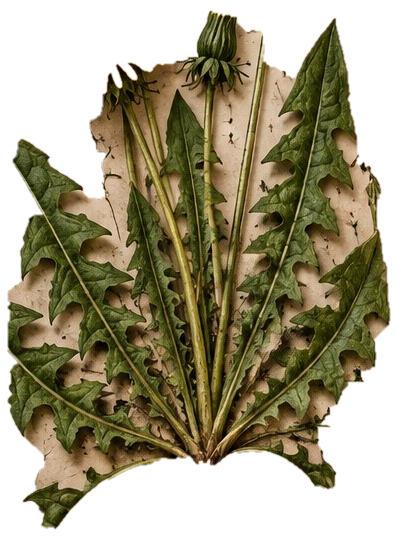
- Dandelion is a hardy herbaceous perennial that grows from a deep taproot. Its leaves form a basal rosette, while each hollow, leafless flower stalk normally bears a single yellow flower head. After flowering, the head becomes the familiar spherical “dandelion clock” of wind-dispersed seeds.
- Native Range
- Dandelions in the Taraxacum officinale complex are Eurasian in origin and are now widespread across temperate regions of the Northern Hemisphere and beyond. They have been introduced widely and thrive in human-disturbed landscapes.
- Habitat
- Dandelions tolerate a wide range of soils and conditions and commonly grow in lawns, meadows, gardens, roadsides, disturbed soils, and waste ground. They can grow in full sun or partial shade. Their deep taproot allows established plants to persist through mowing and disturbance.
- Identifying Characteristics
- Basal rosette of deeply toothed or lobed leaves Hollow leafless stalks containing white latex when broken One bright yellow composite flower head per stalk Flowers open and close with changing light/weather conditions Spherical seed head made of numerous wind-dispersed fruits with parachute-like pappi Thick taproot
- Parts Traditionally Used
- Leaves, flowers, and roots all have culinary or traditional herbal histories. The different parts are not interchangeable and have been prepared differently in food and herbal traditions.
Taxonomic Note
Modern botanical treatments recognize substantial complexity in common dandelions; Kew places Taraxacum officinale within Taraxacum sect. Taraxacum.
History & Cultural Context
Dandelion has a long history as both food and traditional medicine. Medieval and early modern European sources document it as a useful edible and medicinal plant rather than merely a weed. The Metropolitan Museum of Art notes that dandelion was among the edible “weeds” used in medieval pottage, while early printed herbals illustrated and discussed it as a medicinal plant. The name “dandelion” derives from French dent de lion — “lion’s tooth” — referring to the jagged leaf margins. Other historic common names refer to its traditional diuretic reputation, while “blowball” and “fairy clock” reflect the familiar seed head.
Traditional & Historical Medicinal Uses
Historical European herbals used dandelion root and leaves in bitter digestive and diuretic preparations. Other regional traditional systems have also used different plant parts in varied ways. The Grimoire should describe these as traditional and historical medicinal uses, not as guarantees that dandelion treats liver disease, kidney disease, “detoxes” the body, treats inflammation, or cures other conditions.
Magical Uses
Choose one stage of the plant to match the work rather than treating every part as symbolically identical. Use the yellow flower for confidence, visibility, and vitality; the root for persistence and deep foundations; and the seed head for wishes, release, travel, or change. For a simple resilience practice, place a root or leaf image beside your journal and write about one place in your life where persistence is useful and one place where persistence has become refusal to change. Dandelion can symbolize both staying power and the wisdom of letting seeds travel.
Modern Evidence
NCCIH states that very little human research exists on dandelion and that there is no compelling scientific evidence supporting its use for any health condition. Laboratory studies have investigated extracts for anti-inflammatory, antioxidant, and antiviral activity, but those findings do not establish clinical effectiveness in people. Modern evidence therefore does not justify broad claims about “detoxification,” liver cleansing, blood-sugar treatment, cancer treatment, or other marketed benefits.
Notes & Personal Connection
Add your own experiences, observations, and notes about working with this plant. How does it speak to you? What is your personal connection?
Keep This Grimoire Entry
Print Page 1 and Page 2 together, single-sided or front and back.
Download to Print